Monday, November 28, 2011

Become a Sustainability Leader - MSLS Applications Open Dec 1


The challenges facing our global society are apparent on many levels. From a lack of social trust, climate change, poverty, pollution, species extinction, institutional failure and our inability to continue consuming at current levels, the change that needs to take place on a global scale is massive, compounding and complex. In order to combat these challenges, we need both strategic planning that adheres to the limits of the Earth's carrying capacity and leadership that inspires and creates systemic change in a collaborative manner across sectors, borders and disciplines.

I had the very good fortune of attending a graduate programme in Sweden, called the Master’s in Strategic Leadership towards Sustainability (MSLS) programme. We focused on the skills and knowledge necessary to create a sustainable 21st century. This experience taught me that the challenges facing our world require a systems thinking and scientific-based approach, and the ability to work collaboratively with diverse people.

And while this programme taught skills in team-work, facilitation, presentation, project management, communication and strategic planning it taught me so much more. This programme taught me that when you get a group of people together that want to make the world a better place, amazing things become possible. People begin to really listen to one another, enjoy working together and become more authentic. My class had students from over 30 countries and the alumni networks encompasses over 50 countries. Here, I learned the importance of community building, sharing common goals and how working together is not only a lot of fun, but provides the foundation for a sustainable society.

I am writing about this programme to let people know that applications for the MSLS cohort of 2012-2013 are opening December 1st, 2011 and close mid-January. I hope that you will read this and realize you too have an amazing opportunity to work with a dedicated international network that wants to change the world for the better.

Please visit the website www.bth.se/msls to see the full programme brochure and application procedures. If you are an EU citizen, the Swedish Government pays for your tuition. Outside the EU, tuition is 100,000SEK (just under $15,000) for this 10-month program. Scholarships are available and if you are a fee-paying student, you are welcome to visit www.kitesh.org to find out more about the free services available to assist you in the application and funding process.

Do yourself and the world a favor - go on the adventure of a lifetime and join the amazing network of alumni in the Master's in Strategic Leadership towards Sustainability.

Friday, November 18, 2011

How to Avoid the Truth About Climate Change

An interesting video on how it's easy not to understand the climate crisis -- and to improve one's understanding!  Worth watching Dr. Bickmore's whole presentation. The article is from Red, Green & Blue:


A Republican ex-climate skeptic explains how people avoid the truth about climate change
By Barry Bickmore
Professor of Geologic Sciences, Brigham Young University
Brigham Young University prof Barry Bickmore talks climate skepticism

I gave a talk called How to Avoid the Truth About Climate Change for the College of Science and Health at Utah Valley University.  For those of you who aren’t familiar with me, I am a Republican and a geochemist who, until a few years ago, was quite skeptical about the idea that humans are causing significant climate change.

In the presentation, I briefly talked about how I had made the transition from being a climate change skeptic to being an outspoken advocate of mainstream climate science.  I then discussed how it is that people like me can so effectively avoid the truth about climate change.

My sticking points
  • I thought there was lots of scientific controversy about human contributions
  • I thought climate projections are based solely on complex computer models of physical systems, which (I know from experience) are easy to screw up.
  • I know there is always uncertainty in science.

The Truth:

  • There is almost no scientific debate over whether humans are largely responsible for the temperature rise over the last 50 years or so.
  • There are other ways to estimate climate sensitivity (e.g. from paleoclimate data) that give about the same answer as the models.
  • The uncertainty is mostly on the high end, given the data we have now [e.g., it's not whether there will be warming, but how bad it will be].

How we avoid the truth:

  • We tend to believe what we want to hear
  • There are always truth-challenged individuals who will tell us what we want to hear to promote political goals
  • The media makes little or no effort to determine who is right
  • Most people (including many scientists) have naive ideas about the nature of science


Stay going.

Thursday, November 17, 2011

IEA: 5-Years to Avoid Locking-In Climate Disaster

A new report, released last week by the International Energy Agency provides a stark reminder of the urgency of the climate crisis - we have 5 years to avoid irreversible, run-away climate change that will lock us into a scenario where it will be impossible to keep global average temperature increases under 2 degrees.  This article in the Guardian states:
The world is likely to build so many fossil-fuelled power stations, energy-guzzling factories and inefficient buildings in the next five years that it will become impossible to hold global warming to safe levels, and the last chance of combating dangerous climate change will be "lost forever", according to the most thorough analysis yet of world energy infrastructure. 
Anything built from now on that produces carbon will do so for decades, and this "lock-in" effect will be the single factor most likely to produce irreversible climate change, the world's foremost authority on energy economics has found. If this is not rapidly changed within the next five years, the results are likely to be disastrous.

Colleges and universities have been increasingly aware of this "lock-in" effect as they plan and manage their campuses.  Signatories of the ACUPCC have forced themselves to address this reality by imposing the goal of net-zero emissions on themselves -- raising tough questions in planning and development meetings like "do we really need this building?"

Any fossil fuel infrastructure built in the next five years
will cause irreversible climate change, according to the IEA.
Photograph: Rex Features
This type of thinking is now necessary for all types of organizations -- but it is particularly important for colleges and universities as our primary institutions for creating new knowledge and educating so many of our leaders and professionals in every industry.  How campuses are designed, built and managed has a profound impact on students -- as do the conversations and ways of thinking that administrators bring to the community.

Today's graduates need to be prepared to hit the ground running in terms of creating the low-carbon solutions -- not only low-carbon buildings, factories, and power plants, but also economic indicators, product design, policies, cultural norms, city planning, new technologies, and other strategies that transform the ways we go about meeting our needs and leading healthy, prosperous, fulfilling lives.

This report puts a finer point on what we know - we must face up to the physical reality of serious constraints on carbon emissions and take serious action now:
Yet, despite intensifying warnings from scientists over the past two decades, the new infrastructure even now being built is constructed along the same lines as the old, which means that there is a "lock-in" effect – high-carbon infrastructure built today or in the next five years will contribute as much to the stock of emissions in the atmosphere as previous generations. 
The "lock-in" effect is the single most important factor increasing the danger of runaway climate change, according to the IEA in its annual World Energy Outlook, published on Wednesday.

Last week, Australia took an important step in helping the world move in that direction by passing a law to put a price on carbon.  Many voluntary efforts in the US are working in this direction, with efforts in higher education among the leaders. Luckily, imposing these constraints can drive innovation, open up ways to re-think well-being, and create a real, fundamental economic recovery based on real value.

Stay going. 

Friday, September 30, 2011

Sustainable Economy 2040

Forum for the Future has produced a great report for Aviva Investors called sustainable economy in 2040: a roadmap for capital markets (pdf)


In focusing on a key leverage point -- capital markets -- and taking a backcasting approach, the report gets around the usual stalemate of investors seeing the way things are and investing accordingly, while many in civil society cry foul as those investments accelerate our progress down an unsustainable path; and provides actionable steps for the investment community to take in creating a sustainable society.

It provides the rationale for why and strategies for how investors can be more proactive in creating the kind of economy we need in the long-run, with a focus on 5 key areas: energy, health & wellbeing, mobility, food, and finance.

The report also serves as a call to action ahead of the Rio +20 summit in June 2012.

A great resource, and worth the read.

Stay going.


Wednesday, September 21, 2011

Global Green - I Am

A new video from Global Green about rising sea levels from climate change via Fast Company:


Check out Global Green.

Stay going.

Saturday, September 03, 2011

The Sustainability Bubble

A couple of weeks ago, Yale e360 published a great article by Christian Schwägerl titled "A Planetary Crisis is a Terrible Thing to Waste." It's a nice straightforward piece highlighted the similar dynamics in the failing economic system and failing ecological system.

The two of course are inexorably linked - or I should say, the economic system is a subset of the ecological system, the former doesn't exist without the latter (ecological systems of course would go right on truckin' in the absence of a human economic system).

Image: Erik Madigan Heck for 
The New York Times
This recent article about Jeremy Grantham - "Can Jeremy Grantham Profit from Ecological Mayhem?" - reinforces this basic tenet of sustainability.  As we approach "Peak Everything Else," we are inflating the biggest bubble of all time - but it's not prices that will fall when it bursts, it's our complex modern society.

Image: Chelsea Green
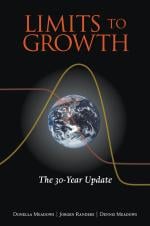
Given the size of the 'sustainability bubble' it inflates more slowly and there are factors that periodically let air out or enable it to grow bigger without popping, but eventually we know it will pop if we don't make dramatic changes to the way we do things.  Just like there were plenty of people who were brushed off for years as they pointed out the housing and credit bubble would burst, people who have been bringing attention to the sustainability crisis have had trouble really breaking into the mainstream - dismissed as alarmists.  Forty years ago the authors of Limits to Growth faced this dismissal.  Many often point to the famous bet between Paul Ehrlich and Julian Simon that the article references as proof that technology and innovation will save us when the price signals demand it; they picked 5 commodities and bet if their prices would be higher in the next 10 years.  Simon bet innovation would bring the prices down and he was right, 5-0.  But, as the article points out, today Ehrlich's winning 4-1.

Image: Chelsea Green
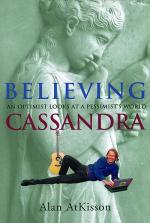
Alan AtKisson's Believing Cassandra does an excellent job of articulating this dilemma.  Of course, those of us who are shouting from the rooftops that there's trouble ahead want to be wrong.  We work every day to ensure that we are wrong.  The changes we need to make -- in our policies, our lifestyles, our technologies, our economic systems, our worldviews -- will enable us to create a sustainable future.  When we're successful in doing that, by definition, we will be wrong about the sustainability bubble bursting.  We will have avoided it.  And if we're not wrong - if we don't enact the shift to sustainability fast enough; well, it will make our current bubble-burst woes look like a holiday.

To systems-thinkers the parallels between economic bubbles and sustainability are obvious.  As a system is pushed beyond certain thresholds, it collapses or jumps to a new state.  We will cross that threshold as a global human society.  Our great challenge is to ensure that we do so by jumping to a new state - a sustainable society - and avoid devastating population collapse and further wholesale destruction of the life-support system upon which we depend.

It's encouraging to know there are investors like Grantham out there - sharing this perspective with a voice that is respected and credible with the mainstream investment community.  And it's heartening to see that his foundation is making such smart investments as well.

Stay going.