Monday, September 27, 2010


Friday, September 17, 2010
Stories of Meaning
When talking about taking a strategic approach to sustainability, among the most powerful tools we have are stories. That may sound weird for a lot of people "strategic" brings to mind action plans, hard-nosed business decisions, grand plans in theaters of war - but really it just means you've started with the end in mind and you're being smart about moving towards your goal. In our case, that goal is a sustainable society.
 As we know, sustainability can be defined scientifically with four sustainability principles - three ecological principles to ensure we're not systematically undermining the very life-support system of which we are a part, and one social principle to ensure we're not systematically undermining people's capacity to meet their needs. Right now our society is unsustainable, and with regard to social sustainability, that is evidenced through a deterioration in the social fabric globally. (This piece talks about Gallup data showing America's declining trust in our institutions, and this graph shows it visually).
Stories of meaning are one of the most effective ways we can rebuild and strengthen the social fabric, and to remind ourselves that we're all in this together. I often intend to use this blog as a venue for stories of meaning, and I usually fail to - spending more time on SSD theory or news or actions we can take.
Luckily there is Subhankar Banerjee who recently launched ClimateStoryTellers.org. I've only read a little bit so far, but the stories and writing are great, and the concept is phenomenal. I highly recommend checking it out.
Stories of meaning and building the social fabric are so key because at the end of the day sustainability is about people and working to ensure a high quality of life for as many of the people on the planet as possible and for as many future generations as possible. To do this requires that we respect and live in harmony with all other living systems. This point was brought home again to me today by a friend who sent me this article in Newsweek by George Will. It references an piece by Robert Laughlin that has a correct (if obvious) thesis - the earth system has changed dramatically over geological time and will continue to do so, irregardless of if humans cause any big changes or not.
But Will's article interprets Laughlin's piece in an incredibly misleading way - insinuating that as a result of this fact, we shouldn't do anything about correcting our unsustainable path. It takes advantage of the fact that the human brain has a tough time dealing with time - often one of the trickiest components of systems thinking for most people - and neglects to point out that all of human civilization has happened in the past 10,000 years - a time of relatively stable climate and a unique balance of ecosystem conditions with which humans have co-evolved. Changing those conditions radically (by continuing to violate the first 3 sustainability principles) will not "hurt" the planet - but it will make the planet unlivable for human civilization.
Will's piece is the opposite of a story of meaning - it's a twisted story that sows doubt, breeds passivity, and encourages people not to think too much, worry to much, or act at all. (It also includes this ridiculous statement as if it's a fact and a foregone conclusion: "Someday, all the fossil fuels that used to be in the ground will be burned.")
So don't spend much time on it - instead, cruise over to ClimateStoryTellers.org and get involved with strengthening the social fabric around the world.
Stay going.
Stories of meaning are one of the most effective ways we can rebuild and strengthen the social fabric, and to remind ourselves that we're all in this together. I often intend to use this blog as a venue for stories of meaning, and I usually fail to - spending more time on SSD theory or news or actions we can take.
Luckily there is Subhankar Banerjee who recently launched ClimateStoryTellers.org. I've only read a little bit so far, but the stories and writing are great, and the concept is phenomenal. I highly recommend checking it out.
Stories of meaning and building the social fabric are so key because at the end of the day sustainability is about people and working to ensure a high quality of life for as many of the people on the planet as possible and for as many future generations as possible. To do this requires that we respect and live in harmony with all other living systems. This point was brought home again to me today by a friend who sent me this article in Newsweek by George Will. It references an piece by Robert Laughlin that has a correct (if obvious) thesis - the earth system has changed dramatically over geological time and will continue to do so, irregardless of if humans cause any big changes or not.
But Will's article interprets Laughlin's piece in an incredibly misleading way - insinuating that as a result of this fact, we shouldn't do anything about correcting our unsustainable path. It takes advantage of the fact that the human brain has a tough time dealing with time - often one of the trickiest components of systems thinking for most people - and neglects to point out that all of human civilization has happened in the past 10,000 years - a time of relatively stable climate and a unique balance of ecosystem conditions with which humans have co-evolved. Changing those conditions radically (by continuing to violate the first 3 sustainability principles) will not "hurt" the planet - but it will make the planet unlivable for human civilization.
Will's piece is the opposite of a story of meaning - it's a twisted story that sows doubt, breeds passivity, and encourages people not to think too much, worry to much, or act at all. (It also includes this ridiculous statement as if it's a fact and a foregone conclusion: "Someday, all the fossil fuels that used to be in the ground will be burned.")
So don't spend much time on it - instead, cruise over to ClimateStoryTellers.org and get involved with strengthening the social fabric around the world.
Stay going.
Sunday, September 05, 2010
Solar Road Trip
On this Tuesday night (Sept. 7, 2010), the Solar Road Trip will stop in Boston. Second Nature has teamed up with Unity College, 350.org, Students for a Just and Stable Future, and others to help promote this exciting trip.
Author Bill McKibben and a team of students from Unity College in Maine travel to Washington D.C. to deliver one of the original Carter panels to President Obama, asking him to reinstall solar on the White House, and to follow this symbolic gesture with substantial legislative action.
Second Nature President Tony Cortese will speak, along with Bill McKibben and other leaders, about the importance of taking action on climate and energy. This should be a major press event, and a strong showing of supporters will go along way to raise the profile of these efforts – please join us on Tuesday night!
Here are the details of the event:
And if you didn’t catch Bill McKibben on Letterman Tuesday night, watch the clip here.
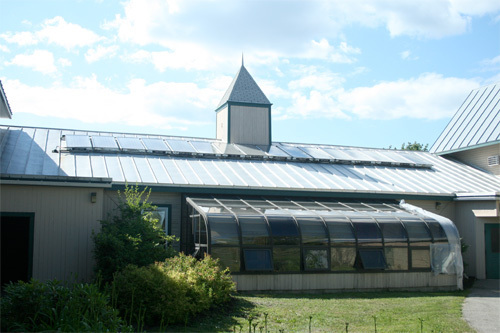 |
| Carter solar panels on the cafeteria of Unity College (image source: huff-po) |
Author Bill McKibben and a team of students from Unity College in Maine travel to Washington D.C. to deliver one of the original Carter panels to President Obama, asking him to reinstall solar on the White House, and to follow this symbolic gesture with substantial legislative action.
Second Nature President Tony Cortese will speak, along with Bill McKibben and other leaders, about the importance of taking action on climate and energy. This should be a major press event, and a strong showing of supporters will go along way to raise the profile of these efforts – please join us on Tuesday night!
Here are the details of the event:
- Date: Tuesday, September 7
- Location: Old South Church, Copley Square, Boston
- Schedule:
- 5:30pm - Bicycle pedal-powered climate rock band, Melodeego
- 6:00pm - Guest Speakers, including Bill McKibben (of http://www.350.org), Tony Cortese (of http://www.secondnature.org), representatives from Students for a Just and Stable Future and Interfaith Power and Light
- 7:00pm - Screening of "A Road Not Taken," new documentary that tells the story of the original Carter White House solar panel installation.
And if you didn’t catch Bill McKibben on Letterman Tuesday night, watch the clip here.
Stay going.
Monday, August 02, 2010
The Glorious Mess
In this recent piece for Yale e360, Eric Pooley, deputy editor of Bloomberg BusinessWeek and author of The Climate War gives a great analysis of the current status of a national climate bill this year (near dead).
While the disastrous downsides of this failure to act are many, this quote sums up pretty well what we're looking at for next steps, and why it is about as far from a strategic and effective approach as we can get:
I remain hopeful that good sense will prevail, that we will be able to remove poisonous partisan politics from this issue and realize that this is one we're all in together, and we're way overdue in responding to. My optimism also leads me to believe (or at least hope) that maybe the glorious mess won't be quite as messy as suggested above - the Regional Greenhouse Gas Initiative (RGGI), the Midwestern Greenhouse Gas Reduction Accord, and the Western Climate Initiative (WCI) are getting more and more established, and looking into linking. These states and provinces account for nearly 40% of US GHG emissions, and are taking important steps in internalizing more of the true costs of carbon emissions and driving the investments in better design, efficiency upgrades, and product innovation that will not only reduce emissions but also spark economic activity and create jobs.
State and regional precedent is important for federal policy, and now I expect NGOs, businesses, and local and state government to refocus energy on effective programs that will set that precedent while reducing emissions and creating jobs at the same time.
Sector-wide approaches continue to lay the ground work. Hundreds of colleges and universities are demonstrating real leadership, educating students, driving research, eliminating their own emissions, and engaging with communities to create solutions. Through the ACUPCC hundreds have publicly reported comprehensive climate action plans on how they will do this. ICLEI continues to help municipalities ramp up progress, and the C40 Cities initiative has the world's most influential cities stepping up and trying to out-do each other in the most productive ways possible.
It's painful to dwell on the missed opportunity the Senate's inaction represents, but it's possible it will open up more unexpected opportunities that will enable us to avoid the worst impacts of climate disruption.
Stay going.
While the disastrous downsides of this failure to act are many, this quote sums up pretty well what we're looking at for next steps, and why it is about as far from a strategic and effective approach as we can get:
Welcome to the “glorious mess” — Michigan Rep. John Dingell’s phrase for the tangle of regulation and litigation that will follow when Congress fails to act. We are about to experience precisely the sort of costly, protracted, plant-by-plant trench warfare the cap was intended to avoid. Since the utilities and the manufacturers weren’t willing to cut a deal, this is what they get. The fragile period of compromise and cooperation between environmentalists and big business may now be coming to an end. Green groups that have invested time and money into the legislative process are now putting on their war paint and returning to the courts, with a renewed focus on stopping new coal-fired power plants and shutting down the oldest and dirtiest ones.
I remain hopeful that good sense will prevail, that we will be able to remove poisonous partisan politics from this issue and realize that this is one we're all in together, and we're way overdue in responding to. My optimism also leads me to believe (or at least hope) that maybe the glorious mess won't be quite as messy as suggested above - the Regional Greenhouse Gas Initiative (RGGI), the Midwestern Greenhouse Gas Reduction Accord, and the Western Climate Initiative (WCI) are getting more and more established, and looking into linking. These states and provinces account for nearly 40% of US GHG emissions, and are taking important steps in internalizing more of the true costs of carbon emissions and driving the investments in better design, efficiency upgrades, and product innovation that will not only reduce emissions but also spark economic activity and create jobs.
State and regional precedent is important for federal policy, and now I expect NGOs, businesses, and local and state government to refocus energy on effective programs that will set that precedent while reducing emissions and creating jobs at the same time.
Sector-wide approaches continue to lay the ground work. Hundreds of colleges and universities are demonstrating real leadership, educating students, driving research, eliminating their own emissions, and engaging with communities to create solutions. Through the ACUPCC hundreds have publicly reported comprehensive climate action plans on how they will do this. ICLEI continues to help municipalities ramp up progress, and the C40 Cities initiative has the world's most influential cities stepping up and trying to out-do each other in the most productive ways possible.
It's painful to dwell on the missed opportunity the Senate's inaction represents, but it's possible it will open up more unexpected opportunities that will enable us to avoid the worst impacts of climate disruption.
Stay going.
Tuesday, July 27, 2010
C-Level Leadership
Leadership for sustainability is critical for maintaining and fostering a decent quality of life on this planet for as many of its inhabitants as possible. This leadership needs to come from everywhere - citizens, government, business, religion, education, etc. - and from all levels - the boss, the workers, the students, the moms, the kids, etc.
The recently released McKinsey Global Survey on how companies are managing (or not managing) sustainability stresses the importance of active C-Level leadership in avoiding the risks and taking advantage of the opportunities that the sustainability challenge presents for every organization. They state:
This is something we stress all the time in our work with college & university presidents through the ACUPCC - and a central theme of the Leading Profound Change (pdf) resource we developed with presidents and chancellors on how exactly to take an active leadership role in this process on an ongoing basis.
It's also why the lack of such leadership from the other "C-level" - Congress - is so disheartening. I won't go into details on why, because others have done so more eloquently than I would be able to in recent days, but I would highly recommend taking the time to read the following:
In "We're Gonna Be Sorry" Friedman shares a story that ran in The China Daily the same day news that the Senate would not pursue a bill before the August recess was released, and that clearly shows how this inaction and lack of leadership is ceding power and moral authority to China (and undermining one Massachusetts Senator's rationale for inaction):
He also cites a hedge fund manager Jeremy Grantham, who wrote:
Finally, in "What 7 Republicans Could Do" Friedman notes:
Hopefully there will be - this is the kind of thinking needed to get past partisan politics and implement smart policies that will benefit all of us. But it is going to take a heavy push from all of us to encourage our Senators to see that and to actually take up a real charge on passing a climate bill this year after the August recess.
Stay going.
The recently released McKinsey Global Survey on how companies are managing (or not managing) sustainability stresses the importance of active C-Level leadership in avoiding the risks and taking advantage of the opportunities that the sustainability challenge presents for every organization. They state:
Companies where sustainability is a top item in their CEOs’ agendas are twice as likely as others to integrate sustainability into their companies’ business practices. This suggests that senior executives who want to reap the benefits of incorporating sustainability into their companies’ overall strategies must take an active role in the effort.
This is something we stress all the time in our work with college & university presidents through the ACUPCC - and a central theme of the Leading Profound Change (pdf) resource we developed with presidents and chancellors on how exactly to take an active leadership role in this process on an ongoing basis.
It's also why the lack of such leadership from the other "C-level" - Congress - is so disheartening. I won't go into details on why, because others have done so more eloquently than I would be able to in recent days, but I would highly recommend taking the time to read the following:
- "Who Cooked the Planet?" by Paul Krugman on who has the real motive to create confusion and ensure inaction;
- "The Senate Punts Recklessly on Energy and Climate" by Mindy Lubber, who shows that most companies - and investors - are looking for the clarity and innovation-sparking constraints that a price on carbon would provide, and that inaction is sending jobs and sustainable development opportunities abroad, while discouraging investment and leaving capital on the sidelines; and
- "What 7 Republicans Could Do" and "We're Gonna Be Sorry" by Thomas Friedman
In "We're Gonna Be Sorry" Friedman shares a story that ran in The China Daily the same day news that the Senate would not pursue a bill before the August recess was released, and that clearly shows how this inaction and lack of leadership is ceding power and moral authority to China (and undermining one Massachusetts Senator's rationale for inaction):
“BEIJING — The country is set to begin domestic carbon trading programs during its 12th Five-Year Plan period (2011-2015) to help it meet its 2020 carbon intensity target. The decision was made at a closed-door meeting chaired by Xie Zhenhua, deputy director of the National Development and Reform Commission ... Putting a price on carbon is a crucial step for the country to employ the market to reduce its carbon emissions and genuinely shift to a low-carbon economy, industry analysts said.”
He also cites a hedge fund manager Jeremy Grantham, who wrote:
Conspiracy theorists claim to believe that global warming is a carefully constructed hoax driven by scientists desperate for ... what? Being needled by nonscientific newspaper reports, by blogs and by right-wing politicians and think tanks? I have a much simpler but plausible ‘conspiracy theory’: the fossil energy companies, driven by the need to protect hundreds of billions of dollars of profits, encourage obfuscation of the inconvenient scientific results. I, for one, admire them for their P.R. skills, while wondering, as always: “Have they no grandchildren?”
Finally, in "What 7 Republicans Could Do" Friedman notes:
What if the G.O.P. said: We will support a carbon tax provided one-third of the revenue goes toward cutting corporate taxes, one-third toward cutting payroll taxes for every working American and one-third toward paying down the deficit. The G.O.P. would actually help us get a better energy policy. Surely there are seven Republican senators who can see this. Aren’t there?
Hopefully there will be - this is the kind of thinking needed to get past partisan politics and implement smart policies that will benefit all of us. But it is going to take a heavy push from all of us to encourage our Senators to see that and to actually take up a real charge on passing a climate bill this year after the August recess.
Stay going.
Wednesday, July 21, 2010
40 Years & Obama's Chance
The Environmental Defense Fund (EDF) have created a quick video that brings home the point about how long we've been trying to break our addiction to oil and create systems that use much less energy, so our demand can be met by safe, clean, renewable, and sustainable sources of energy.
After 40 years we have what may very well be our last chance to put the policies in place that will make such a shift possible before irreversible and catastrophic climate disruption becomes unavoidable. This will require great leadership from Obama, but also from each of us - call you Senators today and let them know you support strong climate legislation that helps to internalize the true costs of carbon and correct the artificial market distortion that makes fossil energy seem cheaper than it really is. And sign EDF's petition calling for strong leadership from Obama to help make this happen.
Stay going.
After 40 years we have what may very well be our last chance to put the policies in place that will make such a shift possible before irreversible and catastrophic climate disruption becomes unavoidable. This will require great leadership from Obama, but also from each of us - call you Senators today and let them know you support strong climate legislation that helps to internalize the true costs of carbon and correct the artificial market distortion that makes fossil energy seem cheaper than it really is. And sign EDF's petition calling for strong leadership from Obama to help make this happen.
Stay going.
Thursday, July 15, 2010
Clean Energy & a Price on Carbon
Below is a new video from Repower America about boosting wind turbine manufacturing in the US. With the debate in the Senate on climate legislation about to kick into full gear, now is the time to get to work.
Without strong legislation this year, there's a good chance we won't get it for a while - and we know to have any chance at avoiding really destructive climate disruption, we need global carbon emissions to peak by 2015.
That's not going to happen without leadership from the US in the form of meaningful correction to the price signals. We can continue to keep the price of fossil fuels artificially low, but as we continue to find out in so many ways, we end up paying the true cost eventually, and it is much much higher, in the forms of oil spills, wars, Katrinas, droughts, floods, crop failures, and so on - all of which have huge real financial costs and unfathomable moral costs.
Here in the Commonwealth we're looking to Scott Brown to step up and take advantage of what amounts to a huge leadership opportunity to champion a bi-partisian bill, rise above the nonsense that this is a economy-destroying conspiracy, and make the case that this is a market-correction that needs to happen to ensure American competitiveness, create jobs, boost national defense, and most importantly give us half a chance at ensuring a livable planet for our children and grandchildren. Sign Repower America's petition and give your Senators a call today.
Without strong legislation this year, there's a good chance we won't get it for a while - and we know to have any chance at avoiding really destructive climate disruption, we need global carbon emissions to peak by 2015.
That's not going to happen without leadership from the US in the form of meaningful correction to the price signals. We can continue to keep the price of fossil fuels artificially low, but as we continue to find out in so many ways, we end up paying the true cost eventually, and it is much much higher, in the forms of oil spills, wars, Katrinas, droughts, floods, crop failures, and so on - all of which have huge real financial costs and unfathomable moral costs.
Here in the Commonwealth we're looking to Scott Brown to step up and take advantage of what amounts to a huge leadership opportunity to champion a bi-partisian bill, rise above the nonsense that this is a economy-destroying conspiracy, and make the case that this is a market-correction that needs to happen to ensure American competitiveness, create jobs, boost national defense, and most importantly give us half a chance at ensuring a livable planet for our children and grandchildren. Sign Repower America's petition and give your Senators a call today.
Stay going.
Subscribe to:
Posts (Atom)