Monday, October 30, 2006

Stern review on the economics of climate change

An interesting report on the economics of climate change was released in the UK today - I won't get into the details of where I agree and disagree with the analysis, but hopefully this will continue to push the much needed drastic action. Here are a couple of interesting quotes from presentation session to the Royal Society:

Tony Blair today said that the world was facing "nothing more serious, more urgent, or more demanding of leadership" than climate change...

The chancellor, Gordon Brown, who commissioned the review, said climate change was "the world's biggest market failure"...

I realize there's not much new in those kinds of statements, but it highlights what I think are two of the most important aspects of this challenge: the need for leadership, and the need to improve and update our thinking on markets - what free-markets were, what they are, and what they ought to be (of course, this brings us back to leadership)...


Publication of the Stern Review on the Economics of Climate change

30 October 2006

The most comprehensive review ever carried out on the economics of climate change was published today.

The Review, which reports to the Prime Minister and Chancellor, was commissioned by the Chancellor in July last year. It has been carried out by Sir Nicholas Stern, Head of the Government Economic Service and former World Bank Chief Economist.

Sir Nicholas said today:

“The conclusion of the Review is essentially optimistic. There is still time to avoid the worst impacts of climate change, if we act now and act internationally. Governments, businesses and individuals all need to work together to respond to the challenge. Strong, deliberate policy choices by governments are essential to motivate change.

But the task is urgent. Delaying action, even by a decade or two, will take us into dangerous territory. We must not let this window of opportunity close.”

The first half of the Review focuses on the impacts and risks arising from uncontrolled climate change, and on the costs and opportunities associated with action to tackle it. A sound understanding of the economics of risk is critical here. The Review emphasises that economic models over timescales of centuries do not offer precise forecasts – but they are an important way to illustrate the scale of effects we might see.

For more information and the complete report, click here.

One of our external lecturers at the MSLS programme, Christian Azar, did a simliar analysis back in 2002, also finding how small the costs of mitigating our emissions are compared to "baseline" GDP forecasts -- (of course, these are measurements wrought with flawed assumptions in that we talking about 'business as usual' and using GDP as if it were a measure of success or well-being -- still, it makes a point):


On a percentage basis the difference between the BAU and the stablization at 350 PPM up around the $200 trillion mark in 2100 is tiny - what the graph doesn't show is the huge costs associated with impacts if anything close to the BAU scenario were to occur.

Stay going.

Thursday, October 19, 2006

The final product

Our thesis is finally published! Of course it feels quite good, and at the same time as I look back over it I immediately wish we could have done more - expanded here, clarified there - I suppose that's the way it usually goes! All in all it was a great experience, and I am ever grateful to my partners, Michelle & Mauricio for making the process so amazing and fulfilling.

If you're interested, you can access it through the BTH system by clicking here.

Stay going.

Wednesday, October 18, 2006

Amsterdam, making markets work:


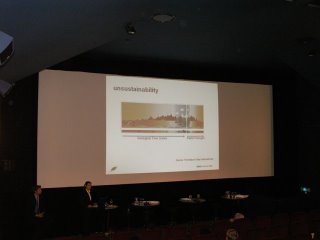
I am on the train back from Amsterdam, where Greenland Enterprises just presented at the Make Markets Work for Climate conference. We hosted a side event at the end of a long first day, and were pleased by a good turn out, engaged participants from around the world and an interesting dialogue following the presentation.
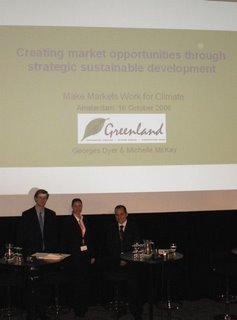


We started off talking for about 20 minutes, introducing our background and briefly describing our thesis research and the creation of CDM Select, focusing mostly on the framework for strategic sustainable development, on which the tool is based. Then we had our panel members – Mauricio Mira (our thesis partner and sustainability consultant in Bogota, doing some CDM-related work), Anne Morgan (a student in this year’s class with background in the NGO sector) and Brendan Demelle (a friend who does freelance research on all kinds of social & environmental topics, with a big focus on global warming education & public awareness) – join us and we spent about 40 minutes in a dialogue with the audience.

It was great. Although we essentially packed an hour presentation into 20 minutes, most people seemed to grasp the concepts of the funnel, the importance of understanding the system and having a clear definition of success in the system (the 4 sustainability principles), and the power of backcasting in the context of group decision making and strategic planning. There was a good deal of confusion as well, of course, and some of the expected questions and responses that typically bring the discourse into the “leaves” of detail, confusing the issue, but overall I think people appreciated the broad, high-level, whole-system perspective, and saw how helpful, and indeed vital it is to have some clarity and agreement on that, before diving into the details. Great learning experience for us, and really exhilarating to engage with a live, fresh audience on these ideas and see such a positive response.


The conference itself was dominated by finance and policy types, though there was some NGO presence, energy & technology company reps and project developers. The Prime Minister of the Netherlands opened up the conference, and the main session speakers and panelists were a pretty high-profile bunch – including a former PM of the Netherlands, Chairman of ABN AMRO, execs from Shell and BP, Ministers from China, India, Brazil and Pakistan, and a couple of World Bank execs (and of course the accompanying protestors outside).

On the whole, the conference reinforced for me a lot of the trends I’ve been seeing over the last year: a huge focus on long-term certainty (post-2012 when Kyoto ends), and a need for reform of CDM administrative procedures & capacity building.

The long-term certainty issue is a bit amusing, as I would say there is certainty that there will be an international carbon regime of some kind post-2012, but just not clarity on what it will look like exactly – the policy makers and the private sector were playing ping-pong, both saying they needed the other to really commit (business wants a clear message in the form of a long term framework on what regulations will look like and how quickly they’ll have to de-carbonize, and policy makers say it’s complicated and they need clear signals from business on how aggressive they can be). Regardless, the bottom line is that the EU ETS is an EU directive, which goes on in perpetuity – there’s a chance it could be dissolved, but it wouldn’t be easy, and given the growth, momentum and excitement it has enjoyed I’d say the chances are slim-to-none that it goes away. Credits from CDM projects are accepted in the EU ETS – and it looks like RGGI in the US (which is now likely to link up with California as well) will accept project-based credits – so even without getting total certainty on “Kyoto 2” right now, I don’t think it’s at all crazy to be initiating long-term CDM projects.

There wasn’t a whole lot of talk on the technicalities of the CDM accept to say (as usual) things need to be improved – more talk of “programmatic CDM” (where a program comprised of lots of smaller GHG reductions can generate credits, as opposed to having to be a larger, distinct project – e.g. an efficient lighting initiative across a city) and sector-based CDM. There were calls from non-Annex I (i.e. “developing”) countries for better technology sharing, capacity building and education around CDM. And finally, there were some calling for an increased focus on the sustainable development aspect of CDM projects - we attracted some them to our session, and got some good feedback about the potential for the framework and CDM Select to be helpful in capacity building, designing more appropriate projects and evaluating proposed projects with a whole-system perspective.

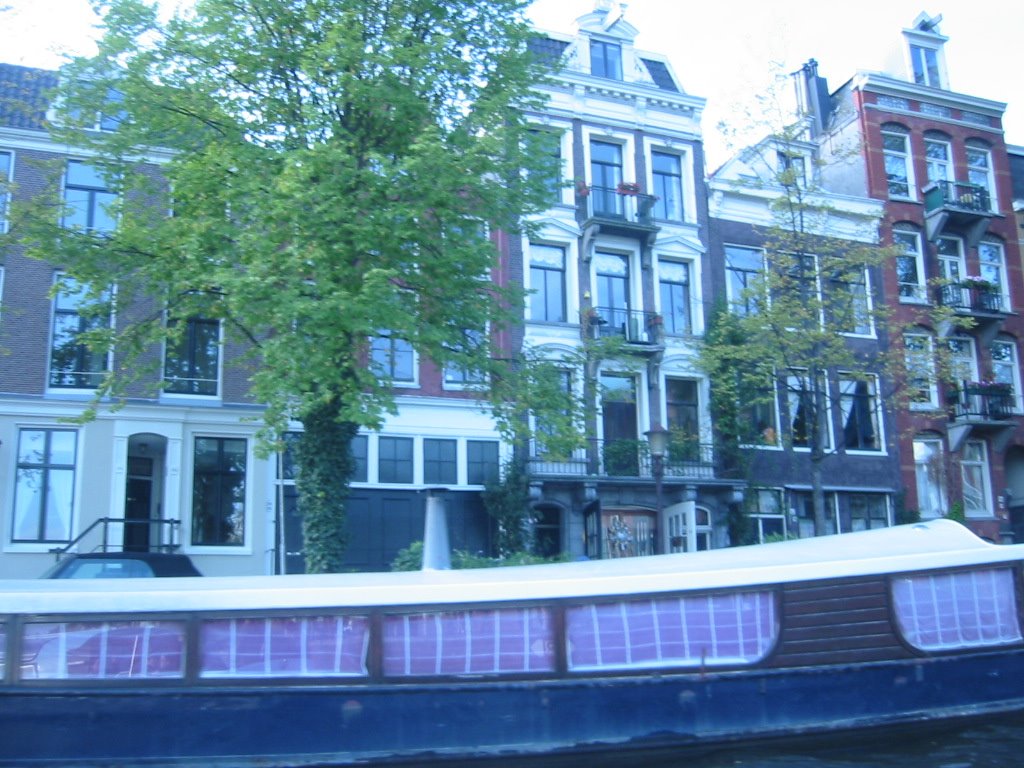
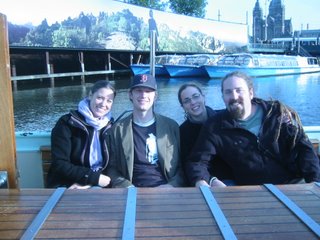
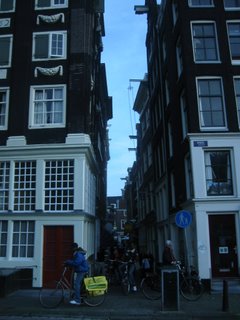
All in all it was a great experience at the conference – we learned a lot, met some more great people, and enjoyed some encouraging feedback on our work. The city of Amsterdam was also incredible – beautiful old buildings (many of which are sinking, as most of the city is below sea level – hence their leadership in fighting climate change), great food, and good vibe – the energy of the chaordic bike and trolley traffic balanced by the serenity of the canals and quiet side streets.



After a few weeks of focusing hard on our BTH project, it was refreshing to check back in with the world of carbon finance and got me really excited about heading to Nairobi in November for COP (the annual international climate negotiations) – it will be an exciting session and hopefully result in serious progress in meeting this colossal challenge. Stay going.

Monday, September 25, 2006

Business regulation or innovation?

A quick note taken from the New Yorker - the sentiments from PG&E (with regards to California's recent greenhouse gas bill) echo what I've been hearing in Europe - that utilities & big emitters are eager to do better, but need some long-term regulatory assurances:

Peter Darbee, the head of the state’s largest utility, P.G. & E., whose support was crucial to the bill’s passage, said he welcomed the strictness of the regulations as a spur to innovation. “The incentives really aren’t there for the creation of new technologies and investments to reduce carbon dioxide unless mandatory caps are put in place,” he told the Times.

GHG caps are not the crippling regulations they're often made out to be - and they have the power to actually help drive development. Stay going.

A Convenient Solution

In response to the common and valid criticism of An Inconvenient Truth – that it drops a lot of solid, scary facts on you, and then leaves you with only flimsy, seemingly insufficient actions to take – the Stratleade alumni have sparked up a dialogue on what some effective ‘next steps’ could be.

The movie is causing some real change – this article from Saturday’s SF Chronicle shows how congress is showing signs of moving past the counter-productive partisanism and towards policies that foster solutions. But Truth is not explicit in how we can identify what the best steps are, and how we can address greenhouse gas emissions, global warming, and climate change in ways that provide jobs, improves America’s reputation, promotes peace, etc.

This needs to be done in a way that moves towards a sustainable society so that the solutions of today do not become tomorrow’s problems. The common example we use is CFCs – refrigerants that replaced toxic chemicals, but were later discovered to destroy the ozone layer. Now in an ad hoc attempt to solve that problem many are moving to HCFCs, which have serious greenhouse gas implications. Given a whole system, sustainability perspective, we know that HFCFs violate Sustainability Principle 2, just as CFCs did – and we need a smarter approach (in this case, Electrolux is taking such an approach, and driving innovation & competitiveness as a result).

With the climate change issue so hot, we run the risk of similar solutions. Nuclear being the most obvious – it is a ‘low carbon’ solution, but not a sustainable solution (it takes very little uranium / plutonium to result in a systematic increase in concentration in the biosphere – thus violating Sustainability Principle 1).

So, the Stratleade crew has thrown the idea of a sequel out there – A Convenient Solution* – that could lay out some possibilities for serious action, based on backcasting from principles for sustainability. We know we have the capabilities, and while “convenient” may be misleading, we can eliminate our sustainability principle 1 violations (and 2 through 4) with a mix of intelligent design for buildings & cities, smart policy moves, ending perverse subsidies, bio-fuels from sustainable agriculture, etc, etc.

Coming to a theater near you…anyone interested? Stay going.


*we're not the first to use the phrase...The Oil Drum uses similar language on the topic, as I'm sure others have...

Sunday, September 24, 2006

damn GOOD magazine


I stumbled upon this launch party for GOOD magazine the other day and sent it to some friends in New York, because it seemed like a cool idea, and clearly had the makings of a great party:

We're going to keep reminding you until we're blue in the face: please don't forget our New York Launch party. It's on Thursday, the 21st, at Emergency Arts at 551 w 21st St (entrance on 11th Ave between 21st and 22nd). Including DJ sets by Grandmaster Flash and Prefuse 73. All subscribers are invited, so please RSVP. Remember, you must subscribe before you can RSVP. Subscribing gets you six issues of GOOD, free drinks at the party, plus all $20 goes to one of our 12 partner organizations. Time is running out, so RSVP fast. Tell your friends. We're looking forward to seeing you all there.

Apparently they had a strong turnout with Gore in the mix (his son is on the staff), and from this video footage from Gawker it looks like a great time (Gawker has been pretty brutal & critical – but they seem to be coming around).

Anyway, in a strange twist of fate, turns out the founder is a childhood friend, Ben Goldshirsh. The WSJ profiled him in July, telling his story – he’s done some pretty amazing stuff, which doesn’t surprise me as all I’ve heard about him through-the-grapevine over the years have been super-solid reports about his various successes.

Anyway, main point – subscribe to GOOD!

http://www.goodmagazine.com/

It’s only $20 and all of it goes to a charity you choose (out of a list of options they provide). From what I’ve seen it looks like they’ve got awesome content and a great, pragmatic, inspiring perspective – and a really cool, innovative business model. Get involved. Stay going.

Thursday, September 21, 2006

Carbon Market News Flash…

A few more exciting recent headlines from PointCarbon – the main clearinghouse for information on the carbon markets – that I wanted to share:

  • Goldman Sachs takes 10.1% stake in Climate Exchange
  • Schwarzenegger’s climate strategist goes national, beginning a multi-state consultation process aimed at inducing federal regulation of greenhouse gases
  • The US Congressional Budget Office (CBO) concluded that putting a price on emissions – through cap & trade – reduces them more cost-effectively than merely funding research and development (R&D) of new technologies
  • The global carbon market could see $100 billion being invested each year
    in the Kyoto Protocol's CDM & JI, according to the secretariat of the UNFCCC
  • The Chicago Climate Exchange (CCX), a voluntary carbon trading programme in the US, will allow members to use greenhouse gas emissions reductions achieved through the Kyoto Protocol’s CDM (clean development mechanism), as well as energy efficiency projects, towards compliance with their targets

When you put the pieces together, it paints a nice picture of the US moving towards a federal cap & trade system that could include credits from CDM projects, which represent a huge market. This all gives me great hope for making real progress on eliminating greenhouse gas emissions – and finding some exciting work in NYC, which is again the top-contender for a move after our project here in Sweden finishes up in December. Stay going.