(check out this link for more pics of NH: http://mistoverfm.org/sps/flood/)
Strategic leadership towards sustainability - individuals, organizations, and communities using systems thinking to create a better future that is peaceful, healthy, prosperous, just, equitable, and resilient for generations to come.
Thursday, May 25, 2006
Teleportation & Carbon Guilt, "we call it life"
(check out this link for more pics of NH: http://mistoverfm.org/sps/flood/)
Sunday, May 14, 2006
Carbon Expo 2006
Here’s a picture of the massive cathedral in the city center – quite a sight:
The real excitement, though, came from the conference. It really brought home for me how fast the carbon markets are growing. I’ve been meaning to give an overview of carbon finance, the basics behind cap & trade schemes, etc. and I will soon, but for now I’ll just run through some of the highlights.
The EU ETS (emissions trading scheme) traded around €9.4 billion in 2005, since it went into effect when
With this huge growth comes some exciting times – the market has a real ‘wild west’ feel to it, with tremendous opportunities. The head of one of the bigger firms in the space referred to it as a “land-grab.” And another noted the market is “full of cowboys.” All of this made for really exciting atmosphere at the conference and a great job market.
Participants were all over the map – but mostly policy and finance types (i.e. a lot of suits, the conference was all business). There were a few of the big banks there (Goldman, Morgan Stanley), technology providers (including GE), government reps from all over the world, World Bank reps, carbon finance firms (EcoSecurities, Natsource, CO2e, Asia Carbon Funds), reps from the exchanges, market news firms (Bloomberg, Reuters, PointCarbon), and a slew of CDM project developers and consultants.
We caught up with a bunch of the experts who have been reviewing and commenting on CDM Select (the tool we’ve developed as part of our thesis), and we got a lot more interest from other project developers, investors, NGOs and governments who said they would have a look and provide feedback.
I was surprised (pleasantly) by how much the market is focused on the CDM (refresher: the Clean Development Mechanism (CDM) is a Kyoto instrument, which allows projects that mitigate GHG emissions in developing countries to generate credits called Certified Emissions Reductions (CERs) that can then be bought by industrialized nations (or companies in them) to meet their emission reduction commitments). A lot of the ‘low hanging fruit’ projects are going fast – these are mostly industrial gas destruction projects that are relatively cheap and straightforward (end-of-pipe technologies) that create a lot of CER revenue due to the high global warming potential of the gases. But more and more developers of all types and sizes (large and small private firms, governments, World Bank, etc.) are looking to more involved with potentially more beneficial kinds of projects like renewable energy, energy efficiency, afforestation/reforestation, etc.
On the political side, there was very little talk of the
Anyway, I’ll stop here, and promise to have more posts on the carbon market soon – which I’ve neglected on the blog, because I spend so much work-time on it – but I think it really is the most exciting aspect of sustainable development going on today. So, the bottom line is that it was a great time with a great bunch of people with all kinds of backgrounds and motivations, the market is unlike any other, but has shown signs of quick maturity (including weathering its first “crash” over the past couple weeks, and models on the exhibition floor at the conference), and there’s plenty of opportunity to ‘do well while doing good’ in environmental markets. Stay going…
Thursday, May 04, 2006
Ethanol - hype, threats and opportunities
There’s no doubt the hype is growing in the ethanol space – as this article from my brother points out – certainly wouldn’t recommend buying stock at this point. But I think there’s little doubt that ethanol and other biofuels (methane, biodiesel) will play a significant role in a sustainable future – as they already are in
Another big piece of news in the space is that the IRS just published Form 8911 Alternative Fuel Vehicle Refueling PropertyCredit which provides the first ever federal income tax credit for the installation of E85 fueling systems. It was part of the 2005 Energy Policy Act and provides a 30% federal income tax credit, up to $30,000 per property, to install alternative fuel dispensing systems (this news from the National Ethanol Vehicle Coalition)
Clearly the momentum is building in the
First: ‘ethanol takes away from needed food production.’ This is a marginal concern – we subsidize farmers not to grow food, global hunger is not a supply issue, and obviously it’s irrelevant in the case of biomass ethanol (produced from crop residues or other biomass, not necessarily food like corn, sugar cane or beets).
Second: ‘it still emits CO2.’ This is true, but it theoretically could be a ‘carbon neutral’ process because the carbon from the biomass will be stored in new biomass – so it’s not a violation of Sustainability Principle 1 (substances from the crust). In reality it's not completely true - E85 means 85% ethanol, 15% gasoline, which is sometimes needed for cold starts. Also, currently in practice, ethanol uses fossil fuel inputs for production, transport, agricultural production, etc.
Third: ‘it deprives the soil of nutrients.’ Here’s where it gets interesting. Fritjof Capra (fantastic writer on sustainability) more or less writes off ethanol for this reason. And he’s got a valid point – soil is the basis of civilization, and oil is not the scarce resource of the future – phosphorous is (with
A whole-system perspective highlights some of the threats of a large-scale shift to ethanol – and there are more than those addressed here, many specific to various regions (particularly water) – but it also highlights the opportunities. While there are only ~600 filling stations with E85 pumps in the US, that number is growing and that tax incentive will surely help. There are already over 5 million flexi-fuel vehicles on the roads in the
The shift to a renewable fuel base will likely happen fast once it reaches a critical mass, as is happening in Sweden, and as it does, it will be vitally important to have this whole-system perspective to ensure that it’s done right. Stay going…
Sunday, April 30, 2006
Ireland and old-school island sustainability

A couple of nights in
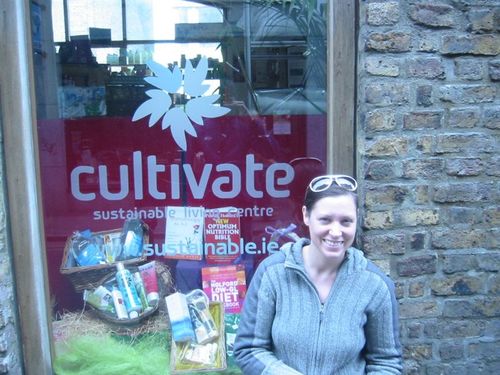
It was impressive to see what they were doing – they had a shop with great books, some food and various eco-design products from electric bikes to window sill greenhouse planters. They had a demonstration yard in the back with displays for green building and organic gardening techniques, and because it was earth day they were ending up a week of events with a movie on Cuba’s response to their “end of oil” crisis when the Soviet Union collapsed in which they relied heavily on Permaculture and urban gardening for food and solar and biofuel for energy – click here for more on the documentary.
Next, we were off to “
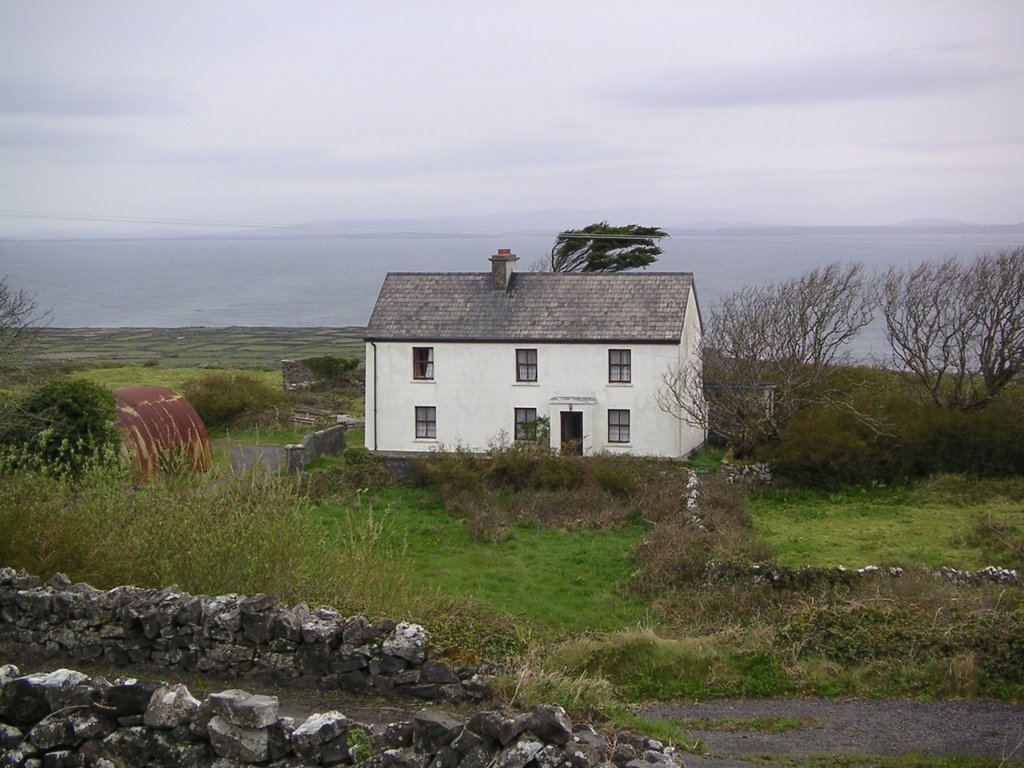
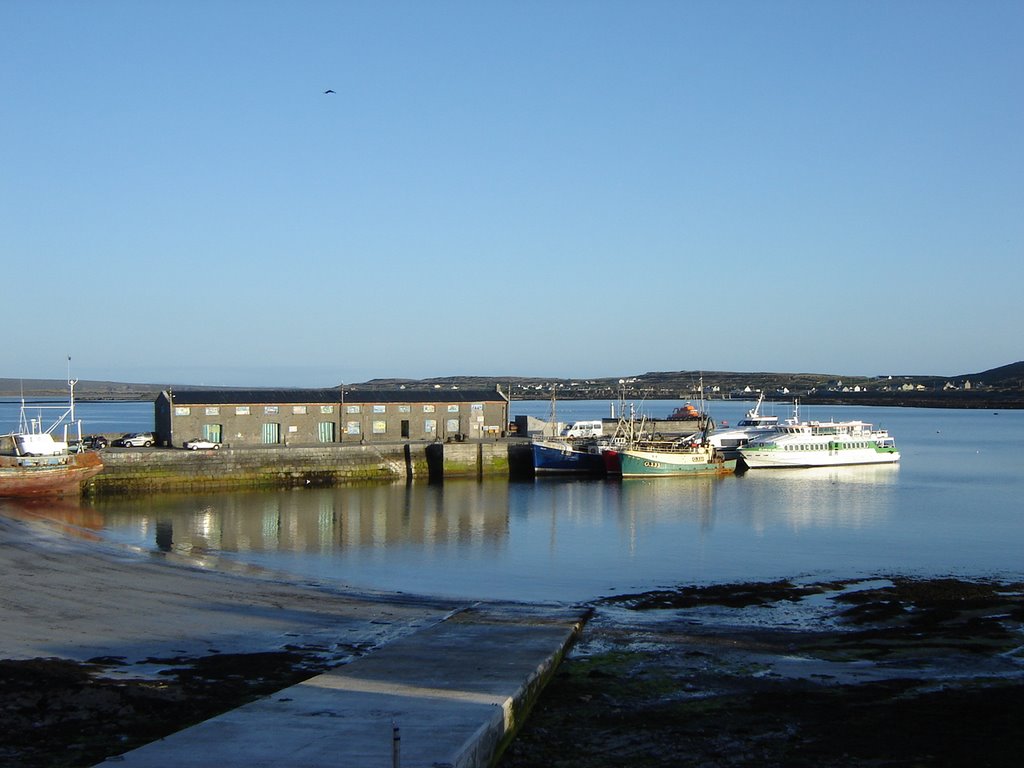
Sunday we took the bus across the country to Galway, where we happen to catch “the Irish rugby game of the decade” and then grabbed a ferry to the
On Monday we had a great tour of the island from Patrick, a 7th generation islander with a full bag of one-liners. He took us to a couple of ruins – both about 2,500-3,000 years old and incredibly well preserved. Just thinking about that sort of time scale in the island setting (where 'limits to growth' are more obvious than on the global scale) was another reminder of how important that perspective is in terms of sustainability – the fact that natural systems have been co-evolving for billions of years, purifying the atmosphere, soil and water systems to create a livable biosphere for humans with relatively low-toxicity is mind-boggling when considering how incredibly quickly we have gone about forcing those systems towards total collapse as we destroy more and more of the interconnected sub-systems (forests, fisheries, lakes, rivers, fertile soil, climate systems, etc). In just 100-200 years we’ve managed to breakdown so much of the resilience from that co-evolution, in some cases irreversibly.
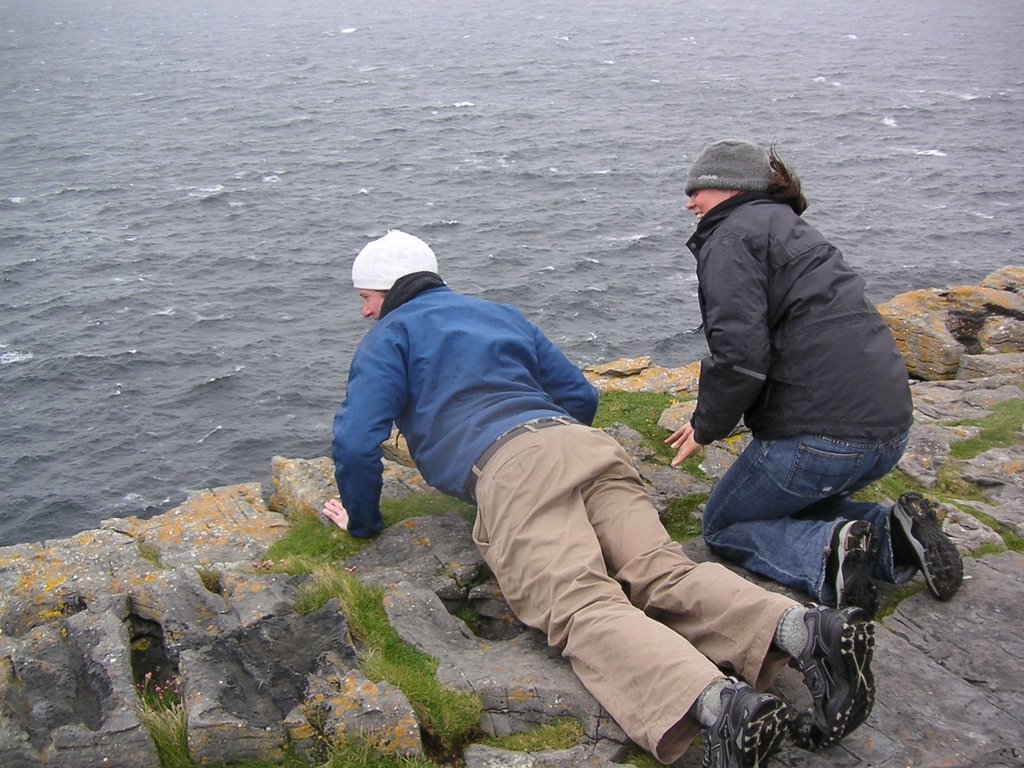
Depressing and enraging thoughts, but fitting with the melancholy grey drizzle and interspersed ferocious gusts of wind (which added some excitement while checking out the ~400 ft (?) cliffs).
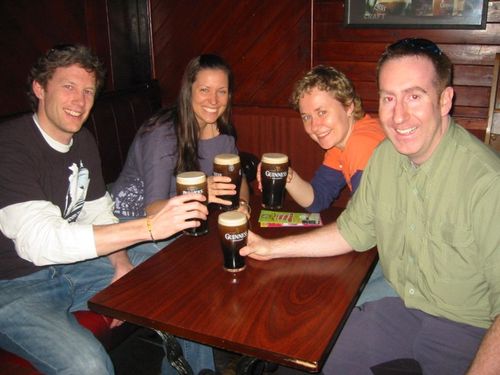
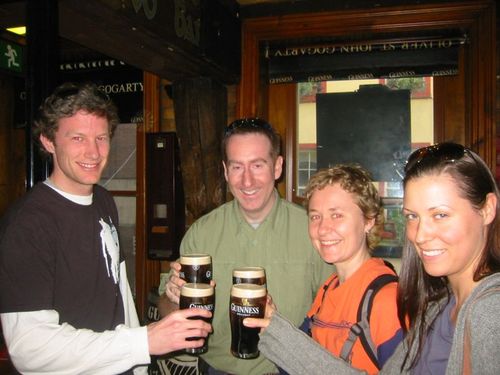
But it was nothing a couple Guinness couldn’t take care of and the inspiration from the positive, restorative solutions from the Cuba movie were keeping us going – and given the growing awareness everywhere you look,
I have no doubt that we will restructure the way we go about meeting our needs in time and achieve that dynamic state of sustainability (hopefully) without too much war and catastrophe.
After a long journey of boats, trains, planes, and automobiles from one corner of
refreshed and ready to dive back into thesis writing – which is pretty much what I’ve been doing non-stop since. It’s going well, getting some great feedback from CDM experts about our tool, “CDM Select,” which is encouraging, and hopefully could lead to its implementation on some real-world projects.
Anyway, for more pics from
http://michellemckay.typepad.com/photos/ireland_trip_april_2/index.html.
Hope you’re all well... Stay going.
Thursday, April 20, 2006
Stockholm on renewables...
So I had to do a quick round-trip to
It was also a good first hand look at the bio-fuel infrastructure that we’ve been learning about here in
The exciting thing about what they’ve got going here in
Once the car makers knew there was a market, the consumers knew there were enough stations, the filling stations knew there was a supply, the producers knew there was a market, etc., etc…. the whole thing tipped. Now there are over 600 filling stations, there are parking and toll incentives for consumers that drive them, and car makers are cranking out flexi-fuel models.
It’s a small example of how a concerted effort, some cooperation, dialogue, and openness to change can make these seemingly impossible shifts happen. Stay going.
Thursday, April 13, 2006
China’s Approach
This article: http://www.guardian.co.uk/china/story/0,,1752851,00.html is yet another interesting take on the situation and highlights the delicate balance they must walk. Two things that jumped out at me – 1) the fact that they’re not falling prey to the “quixotic quest for higher GDP” trap that has not improved quality of life in so many developing countries, and 2) the fact that they have a compelling and responsible vision.
Now, I know the idea of a government supported “vision” will likely raise red flags (pun intended, sorry) with regards to concerns about communism and state-engineered solutions – and that is certainly something that frightens me. In the case of
But regardless, my real point is that creating a vision – while difficult among large groups – can get us out of the mindset that the future is something that we have no control over, that is just pouring down on us, and the best we can hope for is to predict it the best we can, to the realization that we create the future everyday, so we should mindful of creating one we want (this is the essence of Backcasting, which I’m overdue for a “back to basics” post on). As far as creating a detailed vision of a desirable future we all want, well that’s tricky, but at the very least, we should be able to agree on a few principles that ensure that we will have the opportunity to create that future, whatever it may be. Stay going.
Tuesday, April 11, 2006
Sustainable Fossil Fuels
Here’s a link to a summary of an interesting new book: Sustainable Fossil Fuels: The Unusual Suspect in the Quest for Clean and Enduring Energy (scroll down if there’s no image there). Admittedly, I only gave it a quick scan (gimme a break, I’m in the middle of a thesis here), but it looks like a decent read.
Despite the controversial sounding tone of the title, it seems to say that fossil fuels can play a role in a sustainable future, and that they will have to play a role in the interim. From our perspective, that’s certainly not hard to imagine – as long as SP 1 isn’t violated (substances from the Earth’s crust aren’t systematically increasing in concentration), then we’re all good in terms of CO2 (not counting the increases in concentration we’ve already created, but I’m just talking about looking forward right now) – the author points to CO2 capture and sequestration to take care of that. He says coal will last 800 years, before that I’d only heard 200, but the point is the same – not a short-term concern on the supply side for fossil fuels. Of course the sustainable use of fossils would have to be done in a way that doesn’t violate SP 3 (degradation by physical means) and he addresses this fact.
So the main point – that fossil fuels shouldn’t be forced out prematurely – is well taken. First, I would say I don’t think that’s much of a concern at this stage in the game. Second, it seems to follow the old “either / or” mentality, implying that we need to predict if fossils, or renewables, or nuclear will be the answer. Third, the perspective still seems a bit narrow – and ironically so – as the summary states…
Deliberately diverting from this lowest cost path by prematurely forcing fossil fuels out of the energy supply mix may not mean as much for wealthy countries, but for the poorer people on this planet this arbitrary requirement would divert critical resources that could otherwise be devoted to essential investments in clean water, health care, disease prevention, education, basic infrastructure, security, improved governance and biodiversity preservation.
... but fails to acknowledge that many of these SP 4 (capacity to meet basic needs) violations stem from the extraction and use of fossil fuels. Anyway, I just wanted to throw it out there – it highlights some of the confusion and trade-offs, controversy and challenges of the transition to a sustainable future – and I’m not contradicting it, but just trying to show how a whole-system perspective can help make some sense of it all. Stay going…