Thursday, March 30, 2006

Burma and the Karen People

Sustainability is composed into two inseparable, interrelated parts – ecological and social. We cannot have one without the other. The first 3 Sustainability Principles deal with the former, and the 4th with the latter. The systematic undermining of people’s capacity to meet their needs comes in many forms – and stems in one way or another from abuses of power, whether it be economic, political or environmental. It can be subtle and removed or blatant and direct.

The most horrific violations of the 4th Principle come in the form of dictatorships and genocide. A systems perspective is vital in looking at these terrible situations, as the contexts, historical events, direct and indirect impacts of globalization, etc all play into the equation. There are no easy answers, but awareness is certainly a prerequisite for understanding and action.
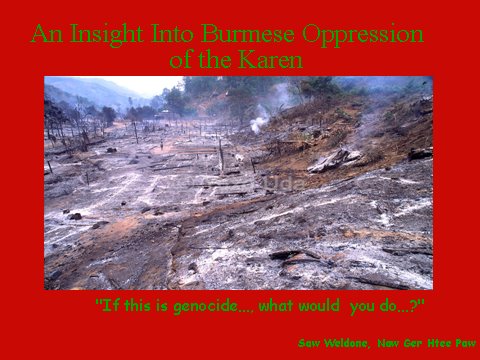
To that end, I wanted to offer some information on a terrible situation that I was just recently made aware of by a friend of mine here from Burma, where a military dictatorship has been waging a campaign of violent oppression on his ethnic minority, the Karen People.


Here is a link to a concise paper he wrote on the subject that gives a good overview of the situation. For more information check out these links:


Karen Humans Rights Group - http://www.khrg.org/index.html

Free Burma - http://www.ibiblio.org/freeburma/

KarenPeople.og - http://www.karenpeople.org/

A couple of important things to remember in terms of human rights issues and sustainability –

First, diversity is an inherent characteristic of living systems (all systems in nature, including global human society). A system lacking diversity, lacks resilience, (whether you’re talking about farming systems, stock portfolios or global society), and is therefore more vulnerable to outside pressures (e.g. a drought, a market crash, climate change). So whether it's through the atrocities of genocide or the seemingly benign spread of a homogenous form of Western ‘culture’, the loss of heritage, language, tradition anywhere is a serious problem for us all, everywhere.

Second, as we are each individuals in society in the biosphere, we each contribute to the current unsustainable reality, and are interconnected (another inherent characteristic of complex systems), no matter how far away and separate these events may seem. And as such, we cannot externalize responsibility for them -

To end on a positive note, it is inspiring to see the dedication and commitment of people like Weldone, who are working to bring peace and justice to these areas. As he said, “I am just a small person, need more help from others.” We all have a vested interest to do just that. Stay going.

Tuesday, March 28, 2006

Venture Cap finally thinks it’s time

Venture Cap finally thinks it’s time

On the flip side of the Time article, here’s some good news:

At the Cleantech Venture Network conference in San Francisco this week, Doerr was bullish on the prospect of green energy and put some focus on the money to be made in the space. He also highlighted the need for good policy as well, including the use of emissions trading schemes – it’s starting to really seem imminent that the US will in some way step up its leadership role, take some responsibility and sign Kyoto. Hopefully this will push the post-2012 negotiations with some stronger targets. Here’s a recap of the Venture Cap take on the issue:

http://www.mercurynews.com/mld/mercurynews/business/14185196.htm

Monday, March 27, 2006

Doomsday goes mainstream


We’re pretty short on English-language newsstands here in Karlskrona, so I hadn’t seen the most recent Time cover story until just now, but it looks to be fairly comprehensive (here’s a summary from CNN.com). It’s one of few I’ve seen in the popular press to talk about systems, time delays and feedbacks. The article touches on the melting tundra and consequent release of methane; the melting ice and the decreasing albedo effect; and the warming oceans adding heat to the atmosphere – all effects that feed on each other in positive feedback loops.

It gives pretty good perspective on the relative vulnerability of different species – but it does little to highlight the vast differences in vulnerability between groups of people, with the toughest burden falling on the world’s poor in drought-ridden and low-lying coastal areas.

The article does touch on the breakdown of the US in taking responsibility as 5% of the world’s population emitting 25% of the world’s CO2 emissions, we have thus far exhibited a tremendous failure in leadership. As we’ve discussed some action is being taken at the local and state levels and encouraging signs are showing up, such as the Regional Greenhouse Gas Initiative trading scheme in the Northeast. Still, hopefully this will act as a wake-up call for all of us to realize how drastically we really do have to change our behavior and lifestyle – not only for the sake of our children’s generation – but for our own.

To me this article seems to sound the final nail in the coffin of the “is climate change happening?” debate, and gives hope that all of that energy can now be focused on working together to enact the solutions we have and creating a sustainable future. The article sums it up nicely:

That goal should be attainable. Curbing global warming may be an order of magnitude harder than, say, eradicating smallpox or putting a man on the moon. But is it moral not to try? We did not so much march toward the environmental precipice as drunkenly reel there, snapping at the scientific scolds who told us we had a problem.

The scolds, however, knew what they were talking about. In a solar system crowded with sister worlds that either emerged stillborn like Mercury and Venus or died in infancy like Mars, we're finally coming to appreciate the knife-blade margins within which life can thrive. For more than a century we've been monkeying with those margins. It's long past time we set them right.

Stay going…

Friday, March 24, 2006

Comment response

In response to Pauli Sommer's comment on the Hitman post, I just wanted to say thank you, and I agree that developing strong networks is key to building the critical mass neccessary for a shift to a sustainable future. I've updated my profile to include my email, and encourage all to keep in touch so we can work together. Stay going...

Wednesday, March 22, 2006

Sustainable buy-outs, sustainable buying

Yesterday’s USA Today ran this story about the trend of big companies buying up small socially and ecologically conscious companies, like Tom’s of Maine (Colgate), Body Shop (L’Oreal) and Ben & Jerry’s (Unilever).

First, this shows the power of consumers in buying responsibly to make these companies with strong values successful. The article quotes the phenomenon as the “Rise of the Ethical Consumer,” and it’s clearly a powerful and growing trend.

Second, there’s the issue of consolidation threatening diversity and hurting the other ‘little guys’ out there. These are valid concerns, but I think the fact that the big guys are starting to really take notice and put their money down is a positive development that outweighs those concerns – at least for now. And the fact that there are so many social entrepreneurs and sustainable small businesses starting up also helps. One’s just got to hope that the positive culture from the little guys flows up to the buyers and not visa versa.

Finally, with regards to the issue of consumerism in general, the article raises an interesting aspect of the shift to sustainability. On the one hand we know we all need to dematerialize in order to stop violating the 4 Sustainability Principles, and cutting out rampant, unchecked, unnecessary consumerism is a huge component of that. This would seemingly make the sustainability crowd pretty much the worst target market if you want to keep sales volumes up, which is still necessary under the ‘old’ business models (before more businesses shift from providing goods to providing services, for example).

But most of us still feel those consumeristic urges (it’s almost impossible not given the power of advertising), and as the article mentions, buying more sustainable products is a way to feel better about giving in to those urges. Many environmentalists would argue that it’s not enough to just buy ‘better’ stuff, and that we really need to get at the root behavioral problem of consumerism (and stop confusing our needs with the satisfiers we use to meet those needs).

I would agree, and I would add that in this period of transition towards sustainability it is also important to support innovative, sustainable products and technologies – to “push” certain technologies, such as hybrids and photovoltaics – so that more sustainable technology and product design is rewarded and pursued, and the transition happens as quickly as possible.

Our collective purchasing power is one of the strongest tools we all have to promote sustainability, so it’s vital that we are all conscientious about what we buy – the little everyday things for sure, but more importantly the long-term big capital investments like cars and houses. Stay going…

Tuesday, March 21, 2006

Corning on the brink...

The following is from a press-release from Corning

It highlights a few key points:

1) It shows more examples of the “funnel wall” – i.e. the consequences of unsustainable activity – for business, this time in the form of regulation, and how these are global issues;

2) It shows how even relatively foresighted companies like Corning (always an innovator from cookware to flat-screens) are still in the “reactionary” mode – monitoring legislation instead of working to stay ahead of it (they seem to be on the brink of taking a strategic approach to sustainability);

3) It shows that legislation and regulation:

a. Can be effective in protecting us and the ecosystems we depend on

b. Can spark innovation and progress and is not necessarily always a bad thing for business (don’t get me wrong – I’m not pushing for heavy regulation across the board – but only in cases where the true costs are not taken into account, and unregulated activity results in higher net costs for all of us in the long run); and

4) How strategic sustainability requires engaging the supply chain…


"In July 2006, two European Union environmental laws -- known as the Waste Electrical and Electronic Equipment (WEEE) and Restriction of Use of Certain Hazardous Substances (RoHS) directives -- will go into full effect, placing strict mandates on electronic equipment waste and banning the use of lead, mercury, cadmium and other hazardous materials in electronics sold into the market. Similar laws have been proposed in several other countries. China will implement its own RoHS regulation in March 2007.

"To help customers in China prepare for the changes, Dow Corning has collaborated with companies to develop, qualify and implement compliant materials for use in electronics manufacturing. Dow Corning's Science & Technology team, working in conjunction with the company's China Application Center in Shanghai, helped one of China's leading power module manufacturers eliminate the use of solvent-based adhesives by switching to a compliant silicon-based materials solution. As part of the program, Dow Corning's team collaborated with local dispensing, measurement and packaging equipment suppliers in the South China region to integrate the new material into the customer's manufacturing process.

"'As a result, our customer today can be reassured about upcoming green laws and also benefits from a highly productive turnkey manufacturing solution that delivers far greater power module performance than previous approaches," said Tom Cook, global industry executive director, Dow Corning. "The new European Union directives affect manufacturers everywhere -- a change in materials for the European market means a change in materials for all global markets. Because Dow Corning has worked diligently to monitor environmental legislation, we're better prepared to help customers ensure their products are always in compliance. We take great pride in this success -- it's the right thing to do for our industry and our planet.'"

Stay going…

Monday, March 20, 2006

Strategic options for Newmont Mining

This recent Global Guerillas (a blog by John Robb) post Indonesia's "Systempunkt" in the form of an attack on Newmont Mining prompted the following thought process: this is a classic example of a company ‘hitting the walls of the funnel,’ due to its violations of the 4 sustainability principles – particularly the 1st (a root cause of substances from the Earth’s crust systematically increasing in concentration in the biosphere) and the 4th (systematically undermining peoples’ capacity to meet their needs, by draining a country of its natural resources, with no benefit for the majority of the people in that country).

It highlights a few basic options for the company:

1) Pull out, move elsewhere: probably unattractive due to invested overhead in the country and the growing lack of accessible resources (another version of the funnel walls)

2) React in kind, further oppression: the expected response from Global Guerillas, and probably a safe bet – but one sure to end in further suffering for the Indonesians and the company

3) Start working strategically towards sustainability: an evaluation of the company’s contributions to violating the 4th sustainability principle and envisioning a future where they do not contribute to such violations would undoubtedly reveal some “low hanging fruit,” and they could use this event as an opportunity to invite locals into the process, and work to form mutually beneficial partnerships.

These partnerships could be seen as the first step in revising and improving practices so that they do not harm and exploit local populations and the ecosystems that they depend on for survival. Such a move could help the company better understand the problems, provide more jobs, and empower the local people by allowing for participation, understanding, creativity, and a sense of identity (synergistically satisfying fundamental needs).

They could continue to work with the governments, only in a more productive way – to support initiatives (regulations, enforcement, etc) that restrict their competitors from profiting from exploitative behavior – which would in turn enhance the short-term competitive advantage of their strategic sustainable approach.

If done properly, I have no doubt it could be done for less than the cost of private military expenses or walking away from invested capital. It would also need to be done of a longer-term strategic plan for moving towards sustainability and what role a mining company would play in a sustainable society – I would guess eventually something in the realm of cycling metals and raw materials, possibly with some limited sustainable mining and final deposition of waste.

At first glance it might seem idealistic, unrealistic, and inefficient – but from a long-term, whole-system strategic perspective, I think the best choice for the company is obvious. If the true-costs of the alternatives were considered – as they relate to things like ecosystems services, human life, corruption, bribery and international debt-service – the choice would be obvious to everyone. Stay going…