A quick note taken from the New Yorker - the sentiments from PG&E (with regards to California's recent greenhouse gas bill) echo what I've been hearing in Europe - that utilities & big emitters are eager to do better, but need some long-term regulatory assurances:
Peter Darbee, the head of the state’s largest utility, P.G. & E., whose support was crucial to the bill’s passage, said he welcomed the strictness of the regulations as a spur to innovation. “The incentives really aren’t there for the creation of new technologies and investments to reduce carbon dioxide unless mandatory caps are put in place,” he told the Times.
GHG caps are not the crippling regulations they're often made out to be - and they have the power to actually help drive development. Stay going.
Monday, September 25, 2006


A Convenient Solution
In response to the common and valid criticism of An Inconvenient Truth – that it drops a lot of solid, scary facts on you, and then leaves you with only flimsy, seemingly insufficient actions to take – the Stratleade alumni have sparked up a dialogue on what some effective ‘next steps’ could be.
The movie is causing some real change – this article from Saturday’s SF Chronicle shows how congress is showing signs of moving past the counter-productive partisanism and towards policies that foster solutions. But Truth is not explicit in how we can identify what the best steps are, and how we can address greenhouse gas emissions, global warming, and climate change in ways that provide jobs, improves
This needs to be done in a way that moves towards a sustainable society so that the solutions of today do not become tomorrow’s problems. The common example we use is CFCs – refrigerants that replaced toxic chemicals, but were later discovered to destroy the ozone layer. Now in an ad hoc attempt to solve that problem many are moving to HCFCs, which have serious greenhouse gas implications. Given a whole system, sustainability perspective, we know that HFCFs violate Sustainability Principle 2, just as CFCs did – and we need a smarter approach (in this case, Electrolux is taking such an approach, and driving innovation & competitiveness as a result).
With the climate change issue so hot, we run the risk of similar solutions. Nuclear being the most obvious – it is a ‘low carbon’ solution, but not a sustainable solution (it takes very little uranium / plutonium to result in a systematic increase in concentration in the biosphere – thus violating Sustainability Principle 1).
So, the Stratleade crew has thrown the idea of a sequel out there – A Convenient Solution* – that could lay out some possibilities for serious action, based on backcasting from principles for sustainability. We know we have the capabilities, and while “convenient” may be misleading, we can eliminate our sustainability principle 1 violations (and 2 through 4) with a mix of intelligent design for buildings & cities, smart policy moves, ending perverse subsidies, bio-fuels from sustainable agriculture, etc, etc.
Coming to a theater near you…anyone interested? Stay going.
Sunday, September 24, 2006
damn GOOD magazine
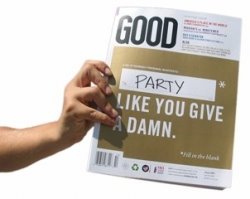
We're going to keep reminding you until we're blue in the face: please don't forget our New York Launch party. It's on Thursday, the 21st, at Emergency Arts at 551 w
Apparently they had a strong turnout with Gore in the mix (his son is on the staff), and from this video footage from Gawker it looks like a great time (Gawker has been pretty brutal & critical – but they seem to be coming around).
Anyway, in a strange twist of fate, turns out the founder is a childhood friend, Ben Goldshirsh. The WSJ profiled him in July, telling his story – he’s done some pretty amazing stuff, which doesn’t surprise me as all I’ve heard about him through-the-grapevine over the years have been super-solid reports about his various successes.
Anyway, main point – subscribe to GOOD!
It’s only $20 and all of it goes to a charity you choose (out of a list of options they provide). From what I’ve seen it looks like they’ve got awesome content and a great, pragmatic, inspiring perspective – and a really cool, innovative business model. Get involved. Stay going.
Thursday, September 21, 2006
Carbon Market News Flash…
A few more exciting recent headlines from PointCarbon – the main clearinghouse for information on the carbon markets – that I wanted to share:
- Goldman Sachs takes 10.1% stake in Climate Exchange
- Schwarzenegger’s climate strategist goes national, beginning a multi-state consultation process aimed at inducing federal regulation of greenhouse gases
- The US Congressional Budget Office (CBO) concluded that putting a price on emissions – through cap & trade – reduces them more cost-effectively than merely funding research and development (R&D) of new technologies
- The global carbon market could see $100 billion being invested each year
in the Kyoto Protocol's CDM & JI, according to the secretariat of the UNFCCC - The Chicago Climate Exchange (CCX), a voluntary carbon trading programme in the US, will allow members to use greenhouse gas emissions reductions achieved through the Kyoto Protocol’s CDM (clean development mechanism), as well as energy efficiency projects, towards compliance with their targets
When you put the pieces together, it paints a nice picture of the
Saturday, August 26, 2006
If we knew then what we know now...
The previous post on backcasting is part of my efforts to catch up on some of the core concepts of strategic sustainable development. Here is an example of why it is such a powerful approach.
This quote from a recent article about Wal-mart’s sustainability efforts, highlights how the understanding of a principle-based definition of sustainability can be used to offset risks and foster competitive advantage by making the right strategic moves in the present:
“[Wal-mart CEO] Scott wondered, "If we had known ten years ago what we know now, what would we have done differently that might have kept us out of some of these issues or would have enhanced our reputation?”
Of course, we can’t predict the future, but we can invent it – by leading the way to a sustainable future, companies (and communities, nations, etc) can avoid the hitting the funnel walls and enjoy the profits and prosperity that accompany such good business all the way along. Stay going.
Backcasting
The concept of “backcasting” is central to a strategic approach for sustainable development. It is a way of planning in which a successful outcome is imagined in the future, followed by the question: “what do we need to do today to reach that successful outcome.” This is more effective than relying too much on forecasting, which tends to have the effect of presenting a more limited range of options, hence stifling creativity, and more important, it projects the problems of today into the future.
In the context of sustainability, we can imagine an infinite number of scenarios for a sustainable society – and ‘backcasting from scenarios’ can be thought of as a jigsaw puzzle, in which we have a shared picture of where we want to go, and we put the pieces together to get there. However, getting large groups of people to agree on a desired future scenario is often all but impossible. Further, scenarios that are too specific may limit innovation, and distract our minds from the innovative, creative solutions necessary for sustainable development.
So strategic sustainable development relies on ‘backcasting from principles for sustainability’ – which are based in science, and represent something we can all agree on: if these principles are violated, at some point our global society will collapse. To achieve a sustainable society, we know we have to not violate those principles – we don’t know exactly what that society will look like, but we can define success on a principle level. In that way, backcasting from principles is more like chess – we don’t know exactly what success will look like, but we know the principles of checkmate – and we go about playing the game in a strategic ways, always keeping that vision of future success in mind.
------------------------------------------ more details on the origins of the term:
Last year, in the Stratleade program, we had the privilege of hearing a lecture from the man who coined the term, John Robinson. The concept was introduced by Amory Lovins, who called it ‘backwards looking analysis,’ and created in response to what he called the ‘monkeys doing energy forecasting.’
Our obsession with forecasting, according to Robinson, comes from our obsession with predictive thinking. It leads us to believe that there is an unavoidable future coming down on us and there’s nothing we can do but react.
This stems from our mechanistic worldview. This view naturally leads to a focus on predictive thinking because it follows that if you can predict how something will behave, then you must understand the mechanics of it. This is problematic when we try to understand and describe complex, non-linear systems as if they were mechanical, linear systems.
Natural systems are complex and non-linear, and while we understand more and more about how they behave on the principle level, we still cannot predict the weather. Social systems are far more complex because they also have intentionality. Still, we try to force these systems into models so we can ‘understand’ them and ‘predict’ how they will behave. To do this, we are forced to make assumptions that often make the models reductionist, simplistic, and absurd. For example, in economic systems the assumptions that people are ‘rational actors’ and that there is ‘perfect information’. In large part, this is due to a tradition of compartmentalized disciplines in academia, where the social scientists have pushed a quantitative, value-neutral approach to studying these systems in the misguided pursuit of establishing concrete laws similar to the laws of nature.
Even if we could predict the future, why would we want to? We have the power to create a better future. The complexity of social systems within the biosphere demands a whole-system perspective and employing backcasting from sustainability principles. In this way, we can acknowledge the value-laden reality of social systems. We can all take a transdisciplinary approach to learning to better understand the basic constraints we must operate in. And together, we can implement the dramatic change in societal design necessary to create a sustainable society.
Friday, August 25, 2006
Karl-Henrik Robèrt
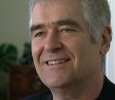 And the start of another year means another introductory series of lectures from Karl-Henrik, co-founder of the programme and founder of The Natural Step. As luck would have it, an excellent web-site called The Big Picture has just posted a series of 7 short clips of Karl-Henrik talking about The Natural Step, the 5-level framework for strategic sustainable development, the A-B-C-D analysis, etc.
So click here: http://www.big-picture.tv/index.php?id=89&cat=&a=242
and enjoy your own personal, abbreviated version of the first day of the Stratleade programme. Stay going.
Subscribe to:
Posts (Atom)