Friday, February 10, 2006

Hållbarhet Huset…

I’ve moved into a new apartment, deemed the Hållbarhet Huset (Sustainability House) in the booming metropolis of downtown Karlskrona. Michelle just posted some pics on her blog if anyone’s interested (scroll down to the bottom when you go to this link):

http://michellemckay.typepad.com/photos/life_in_karlskrona/

… it’s a great living situation with plenty of opportunity for good conversations and reflections with the roommates (Andrew, Geneva, Ingrid, Michelle and Richard) as we get into our thesis projects. Hope you’re all well ~ Stay going.

Tuesday, February 07, 2006

Money where your mouth is...

I think in general people are pretty interested in doing the right thing. After a few months of this program – dealing with strategic sustainable development day-in and day-out – it’s difficult to put my finger in the wind and get a sense of awareness around the urgency of these issues. It seems that climate change is getting a lot of headlines. Some in the mainstream press are starting to connect the dots between things like fossil fuel dependence, international trade, social injustice, climate change, soil erosion, terrorism, water purity, break down in social fabric, hurricanes, deforestation, etc.

Still, I remember how easy these things are to forget. When I was living in New York just a few months ago I would forget. Even as someone who has been passionate about sustainability for years, trying to plot a long-term strategy as to how I could have the most positive impact, I would allow myself to become subdued, to put the problems outside of myself, outside of my control. I would sometimes remember, feel helpless, and then forget again. I would justify my lifestyle to myself because I knew the experience I was getting and the knowledge about business and financial markets would be invaluable to me down the road in sustainability work.

But as for the day-to-day – how could I really do anything about the state of the NYC waste streams? If I raised the issue, is the girl at Go Sushi going to stop and think about how much packaging is really necessary for my dinner? She could barely understand me when I asked for chopsticks. Was I supposed to jump out of bed at 3:30 on Tuesday mornings to ask the guys on the garbage truck if they could send word back to their boss that some kids on 51st want more recycling options?

I could legitimately see those kinds of approaches working if each one of us did them in our communities – but in New York it just seems ridiculous. I guess it speaks to the importance of strength in the social fabric – strong relationships, resilient communities – for sustainability. Businesses and organizations, the people in them, are far less likely to take actions that might harm people they know and care about. Clearly, this is too drastic a simplification – because we’re dealing with complex systems it’s difficult to identify the full impact of our actions (including indirect side-effects, especially when time-delays are involved) – still there’s a lot to be said for having a personal stake in people.

Anyway, back to my point, which stems from a recent conversation I had with a friend in the city who was frustrated by what he could do there. If there’s one thing that city has it’s a lot of options, especially when it comes to food. I’ve always been very conscious about the value of eating local and organic food – but when it came down to it I rarely did. If the option was convenient and not too much more expensive I would go for it, but I wouldn’t go too far out of my way.

Looking back it seems absurd. I would shy away from spending an extra buck on a $3 carton of organic milk – and then go drop $250 for a bottle of vodka. Here it’s been a lot easier – the “ecological” labeling is much more prevalent and the costs usually aren’t much more than the standard option. Plus when you spend all day contemplating the true costs of industrial agriculture and long-haul food transport, it makes you want to throw up, which makes throwing down a few extra kronor easier to stomach.

The impacts of industrial agriculture are huge. The fossil energy that goes into fertiliers, pesticides and production, the run-off of these chemicals and the soil degredation all threaten our civilization. The GMO debate is a whole other can of worms, I won't get into here.

So, I guess the point of this post is a bit of a reminder, a bit of a call to action, however modest. Buy locally produced food whenever possible. Every vote with your wallet for organic food takes it a small step closer to being the norm, which brings us a small step closer to sustainable agriculture system, which would bring us a pretty huge step closer to a sustainable society. Plus it’s way better for you. Stay going…

Friday, February 03, 2006

Orders of Magnitude

Just a quick bit of perspective on Bush's State of the Union speech talking about reducing the US's dependence on foreign oil by 75% by 2025. While it's great to see the administration starting to at least talk in the right direction, what they're laying out seems to be far too little too late.

Also, the resources allotted are far too small.

Bush said that while the US has spent nearly $10-bil to develop clean

alternative energy sources, he would boost funding for clean-energy research

by 22%.

Meanwhile....

Bush Request Would Push War Total to $440B

By ANDREW TAYLOR

The Associated Press
Friday, February 3, 2006; 8:32 AM

WASHINGTON -- The Bush administration said Thursday it will ask Congress for $120 billion more for the wars in Iraq and Afghanistan and $18 billion more for hurricane relief this year.

The White House acknowledges the upcoming requests would cause total spending on the wars in Iraq and Afghanistan since Sept. 11, 2001, to soar well past the $400 billion mark, while spending for hurricane relief would top $100 billion.

Think of how quickly we could get off fossil fuels all together (not just oil, and not just 'dependence on foriegn oil') with that kind of funding, a shared vision, a meaningful purpose. The technology is all there, and with those resources and inspired purpose, I can guarantee better technology would come quickly. It’s the Apollo mentality that we need to pull together – not just in the US, but globally – and make the shift to sustainability!! Check out the Apollo Alliance website again for more. Stay going...

Tuesday, January 31, 2006

Gotta Laugh to Keep from Cryin'...

In case you haven’t seen this yet it’s definitely good for a laugh… Will Ferrell doing Bush on global warming:

http://www.devilducky.com/media/38792/ or
http://www.transbuddha.com/mediaHolder.php?id=1147

Unfortunately, the realness behind that hilarity is just all too real. Another big story on climate change, in case you missed it, hit the papers over the weekend as a NASA scientist spoke out on the administration demanding that any climate change data be screened by them before being released to the public. Clearly, this is very scary stuff when politics are not only interfering and distorting science but actually superseding it.

Washington Post Article on NASA Climate Science

2005 was officially the warmest year on record. Also note in this article how much is spent each year on trying to determine what kind of risks climate change pose ($2 billion) – money better spent on implementing solutions at this point.

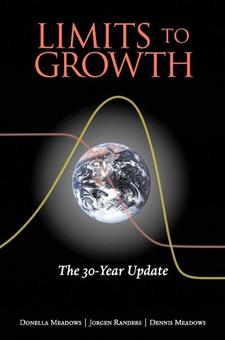
In related news, I’m revisiting Limits to Growth – the 30 year update as we start our literature review for the thesis.


The introduction includes a nice clear explanation of how and why the original text (LTG, 1972) was misinterpreted in some ways and did not prompt the necessary societal and policy reactions that the research showed were vital.

"Not everything bears repetition, but truth does—especially when both denied by entrenched interests and verified by new information."

—Herman E. Daly, former senior economist in the Environment Department of the World Bank and Professor School of Public Affairs University of Maryland

The reason I bring it up is that in systems it’s not so much the limits, or thresholds that are the most important, but the overshoot and consequent collapse that is the issue. Many took a simplistic interpretation of LTG, taking it to mean simply that some day we’ll run out of certain resources, and we need to be ready for that day. But as we know complex systems aren’t that straight forward. The consensus among scientists is now that we have overshot certain limits in the global system in terms of climate change and as we know, we’re already feeling the consequences in the form of storms, terrorism, etc. – which just means that it is that much more important to start acting now to minimize the adverse impacts! Anyway, put LTG on your must read list.

In regards to actions we must take now, below is a quick email exchange with a friend on ethanol, something I’ve been meaning to write about for a while, apologies for the disorganized email style, but it should get the main idea across:

is this the key to the future (ethanol)?

http://money.cnn.com/magazines/fortune/fortune_archive/2006/02/06/8367959/index.htm?cnn=yes

----------------------------------------

thanks for the article, i'll check it out - before even looking at it i can say a couple of important things though:

1) There is no one key to the future - it will take a combination of so many things to reach sustainability - many "new" fuels, better city planning, changes in lifestyle, more efficient technology - the mentality that there is one big thing that will save us has to go.

2) Bio-fuels will, and already are playing a big part in the transition - ethanol has a lot of problems in terms of how much energy you get out of it vs. how much you put in - especially in the states - a lot of technical details behind it that i'm not an expert on, but depends what your raw materials are (sugar cane is among the best - corn, which the US is looking to rely more heavily on, is much less efficient - check out Michelle's post on this for details) - and practices to get that raw material - industrial agriculture in the US requires more embodied energy - used to produce fertilizers, pesticides, run machinery - than you get out at the end of the day - a net loss when you look at the whole system. That's not even counting the all-important (maybe most important) impact on soil through erosion - that is after all the basis of our civilization.

So - yes, ethanol will play a big part and the shift is already starting - still need a lot of work to have it resemble anything sustainable - and as always, gotta keep the whole system perspective to find the true costs. When we start doing it properly on the agriculture side, will be a great way to store solar energy.

Last point - we went to a biofuel conference in Stockholm, talked to the guy from Saab - they have a 'flexi-fuel' vehicle that runs on ethanol mix and/or gas - you can go to an ethonal station, use half a tank and top it off w/ unleaded or visa versa - a great technology for transitioning - and get this.... there are 4.5 MILLION of them on the roads in the US - and most people that drive them don't even know they can do that - point is, no sacrifice in the car / style / performance, and fixes one half of the 'chicken or egg' dilemma changing infrastructure w/out demand or creating demand w/out infrastructure.

Hope you're doing well, my boy.... best – Geo

(As you’ll see in the article, it covers a lot of the issues I touched on in much better detail). Anyway, some random musings, I hope to get a post up on our thesis project soon – we’ll be looking at ways to improve global offset mechanisms, like CDMs under Kyoto, details to follow. Stay going…

Thursday, January 19, 2006

Google & The New Logic

I’ve been meaning to follow up on some of the things I touched on in this post about quantum physics when Göran Carsteadt came to speak with us, and after just finishing a related project on Google, I thought now would be a good time.

Carsteadt spoke a lot about what he calls “The New Logic” in business and society in general. In this age of information and globalization as time seems to speed up, we are entering into what he describes as a more brutal period in human history – similar to when we entered the first Industrial Revolution.

In order for people and organizations to be successful, and more importantly for society to reach sustainability, we will need to embrace this new logic. The underlying shift in perception that is critical to this is one from a purely Newtonian world-view to one informed by quantum physics. It's important to remember that this shift is not an either/or decision, but a both/and situation - you don't leave behind the old, its more like adding to it.


One major associated shift is that from a world of things to a world of ideas. Carsteadt gave us an elegant, simple example of the implications of such a shift: in a world of things, people hold on tight to what they own, because when I give you a thing, you now have it, and I have nothing – so we tend to hold onto our things. But when I give you an idea, and you give me an idea, we both have two ideas, where we previously had one. So in the New Logic, sharing is mutually beneficial.

The internet is the prime example of this and the leader – Google – seems to understand this incredibly well. First, their business by nature has made the jump from the goods to the service economy – a key aspect of sustainable development (see post on Interface) (things --> ideas).

In dealing with the complex system that is the scale-free network (read Linked!) of the internet, it seems that Googlers have fostered a whole systems perspective (linear --> non-linear).
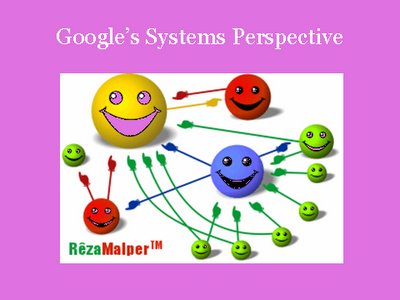


This has led to an adoption of the New Logic on the organizational level. Their hierarchical structure is loose, and they pride themselves on being a ‘flat’ organization – more of a network where people from engineering, finance, sales, etc all talk to one another and work together to co-create new ideas (hierarchies --> networks).

They are a learning organization – maybe in the truest sense of the phrase – they go beyond the scope of their own organization to introduce products in beta phase to the public and have several full-time people doing nothing but reading customer feedback (teaching --> learning).

You’ve probably heard some about the culture at the “Googleplex” – where you can bring your dog to work, play roller hockey, eat for free at the organic café, open doors, common space, etc – a lot of the typical geek, dot-com boom stuff. But clearly, they’ve done it right and created some amazing things for us by taking this approach (livelihood --> lifestyle; fear --> trust).

The most amazing thing about this is this perspective seems to have naturally pushed the company towards sustainability initiatives. They have some pretty proactive stuff going on in the company - $5,000 incentives for employees to buy fuel efficient cars, organic food, staff environmental days. They’re also pushing the server industry to improve efficiency technology for their 10,000 or so servers (clearly they have an economic incentive for this as well – best I could figure they probably spend around $2-3 million per year on energy to run and cool the servers they use to index the web).

The founders have invested in carbon pools – that will invest in CDM (Clean Development Mechanism) projects in China and India. And to top it all they have started Google.org. Check it out, it is pretty self-explanatory, and only in its infancy, but clearly their ambitions for it are large.

This is not to say there is no room for skepticism with this company – their size and influence is becoming mind-boggling. They say they value the integrity of their search results above all else, and I believe them, but there is certainly potential for abuse there. Privacy concerns are also valid – as they scan content that some might consider private domain. Easy access to public but personal information also has many people worried.

Still, I loved looking at this company because it was a pretty straight forward example of all of these things start to fit together – sustainable development, whole systems thinking, organizational learning, complex networks, meeting human needs (participation, understanding, idleness, creativity) – and it shows how businesses can benefit from embracing this kind of approach (the founders are both worth over $10 billion and the stock is above $460). I’m sure we’ll see others start to catch on! Stay going…

Friday, January 13, 2006

Margot Wallström

A quick debrief on Margot Wallström’s visit while it’s still fresh:

Wallström is the VP of the EU, her official title is the “Commissioner for Institutional Relations and Communication” – but for the past 5 years she was the Environment Commissioner. She’s from Sweden and has worked with Karl-Henrik before, and appointed him as a representative on a roundtable to tackle sustainability issues in the EU. For more information on her, check out her blog: http://weblog.jrc.cec.eu.int/page/wallstrom

Her focus now is on democracy in the EU and globally – but because of her past work, and the fact that she is a very thoughtful and insightful person, she knows that democracy, globalization and sustainability are inseparable issues and you cannot talk about any one of them without talking about the others.

She gave a very good brief speech last night downtown at the Karlskrona Konsert Hus that was open to the public. The content was very similar to this previous speech, but with a bit more focus on sustainability.

This morning we were able to meet and continue to ask questions in a small group with just our class and the European Spatial Planning masters program class. We talked about issues of globalization – how trade liberalization might be able to promote democracy – and we danced around how the view that free trade translates into development is simplistic. Unfortunately, we didn’t have enough time to dig into these issues.


Another main point we wanted to drive home was the importance of a scientific definition for success in terms of sustainability that could help the EU in being strategic in its attempts to move towards sustainability. She said that she was disappointed to say that she didn’t think the adoption of such a definition was likely any time soon, but that they would probably continue to use the very inspirational, but very vague Brundtland definition – "Sustainable development is development that meets the needs of the present without compromising the ability of future generations to meet their own needs."

The Four Sustainability Principles take this definition one step further downstream in order to add the necessary specificity to be strategic in moving towards sustainability – so it was a bit of a disappointment to hear that she didn’t think they would be officially adopted soon.

Wednesday, January 11, 2006

Greening Goldman...

This comes as no surprise to us, but still encouraging every time a leading company like Goldman gets proactive. Especially considering Goldman owns so much of so many companies, private and public, with their proprietary investments - it's just good to see they're clueing in.

Now they just need a scientific definition of success in terms of sustainability, so they can work strategically on moving towards it!!

(click the title for full story):

The Greening of Goldman Sachs
Traci Hukill, Alternet via Truthout
One of the world's leading investment banks concedes there are real financial costs to ignoring the environment - and they don't intend to get stuck paying them.
...
This is not a case of Goldman pretending its job is to save the world, or forsaking its primary mission to make money for its investors. Self-interest is in full effect here. Goldman Sachs is positioning itself to be a leader in the green energy sector.

It's also averting risk. The policy says so in so many strangulated, jargoney words: "We believe that companies' management of environmental and related social risks and opportunities may affect corporate performance."

Translation: there are real financial costs to ignoring the environment and the people who depend on it for their survival, and we don't intend to get stuck paying them.
(3 January 2006)

The link this summary came from is also a pretty cool site for news: http://www.energybulletin.net/index.php

Stay going…