Monday, January 09, 2006

Vacation


Updated with some pics I was able to track down....


I’m just back from a much needed and refreshing vacation in France and Switzerland. I really wish I had a camera because I don’t think my words can do the scenery in both places justice, but they were so picturesque, that most of you probably have the exact images in your mind already.

I spent Christmas in Normandy which still looks pretty much like all the movies about the invasion, just without the war. Everywhere were those small houses with dark wood frames and white plaster that make triangle patterns on all the walls. They had thatched roofs with smoke floating from the chimneys. The country side was rolling green pastures, scattered patches of forest, and narrow winding roads. I went to see the beaches, which was intense – hard to describe the emotions that I felt as I tried to imagine what it must have been like to land there.

My hosts, the Lamberts, were extremely generous, welcoming and hospitable in a way that seemed so effortless that I felt right at home as we did exactly what you’re supposed to do at Christmas: eat, walk, drink, nap, eat, sit by the fire, eat… enough cheese and wine to last me through the year.

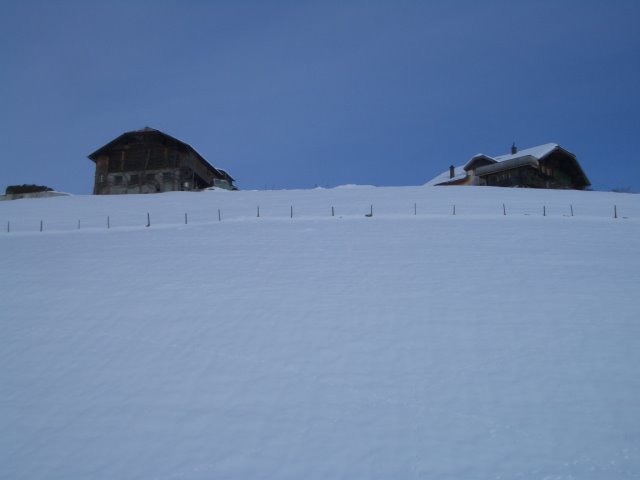
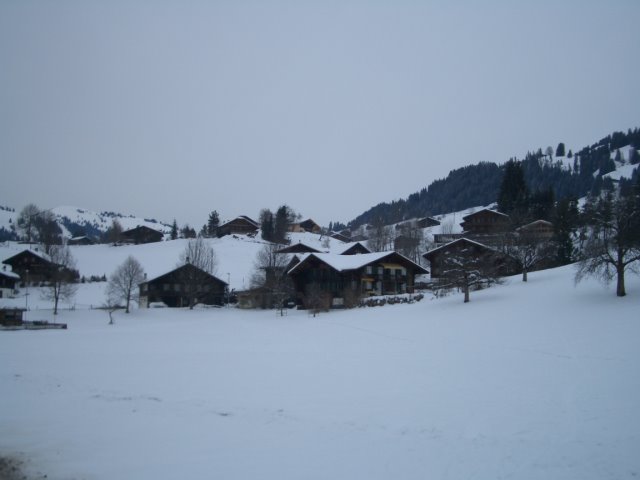
After Christmas we went to Gstaad for a week of skiing among Europe’s fanciest. There were some “celebrity” sightings, although I was pretty oblivious to most of them – mostly big names in high fashion from Paris and London. The only two that really meant anything to me were the ‘other’ Paris – Paris Hilton’s ex-finance and Roman Polanski.

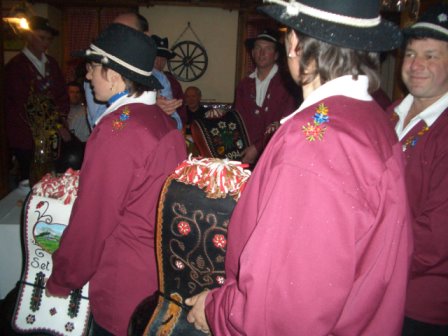
The scenery...


The culture...


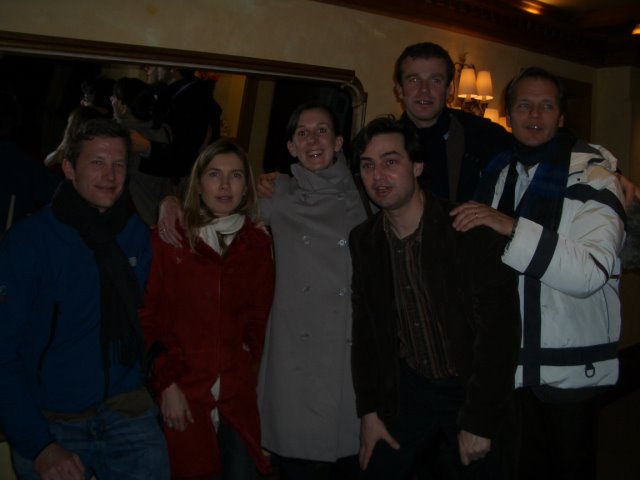
The crew...


after a rough night at "ZeePalace" - my favorite part of Gstaad...


The most encouraging part of the trip though was the genuine interest about my studies and sustainability in general from so many of the people that I met. It’s clear that people are becoming aware that there is no other way for the future of business – whether it be the business of investing, fashion, energy, private equity, airplane parts, Asian import, venture capital, radiators, interior design… there was interest from all.

Many already saw the need, and thought the PR benefit could maybe increase some sales and offset some costs. What was great to see was how a quick chat about how a strategic approach for moving towards a defined vision of sustainability can translate into a competitive advantage, really got these sharp minds from a variety of businesses excited and wanting to learn more. Hopefully some of those contacts will lead to some interesting opportunities down the road.

It was such a treat to get out on the slopes as well – some pretty mellow cruisers for the most part, but it felt so good to get some carves in – and altogether with the scenery and especially the crew I was with and the people we met made it just an unforgettable week.

It’s great to be back in K-town though. I’ve moved into a new place with a great crew, which is a treat – we’ve been having a good time collecting some sparse furnishings and getting set up. We kick back into gear on Thursday, when Margot Wallström – Vice President in the European Commission – is coming to speak to us. She’s pretty big time and it is a huge score for us to be worked into her schedule. She has done some impressive work in terms of sustainability, and it will be very interesting to hear about how it is dealing with these issues in the context of high level international politics. I’ll keep you posted… I hope everyone had enjoyable holiday seasons and got to spend some time with loved ones and took some time to remember what it’s really all about! Stay going…

Karlskrona Waste Management:

Here is a delayed post on our trip a couple of months ago to Karlskrona’s waste management center, which is a pretty impressive operation for our little municipality:

The site was established in ’76 after the previous landfill was capped, and it was expected to fill up in 25 years. Instead they started sorting, recycling and composting on maybe 75% of the area, and only use the remaining 25% or so for land fill. Due to their efforts this far smaller area for landfill is now expected to last 80-90 years – a pretty solid improvement in terms of violating the 3rd Sustainability Principle.

The facility supports the population of about 62,000 people – so it’s not huge, but pretty significant. The amount of material going to landfill has fallen off by about 50% since the ‘90s, due in large part to some modest regulations and financial incentives, as well as outreach and education in the community to help people figure out how to sort waste – particularly organic waste that now gets composted. The company (which is actually owned by the municipality, but runs like a business) also recaptures methane from the landfill and uses it to heat their facilities as well as piping some to the district heating plant.

They had a bunch of roofed concrete bays for the various materials. Plastics are mostly sorted by households and businesses – soft plastics get bailed at this site and sent to incinerators, and hard plastics get sent to a recycling facility. Sweden has a law that requires producers to take responsibility for their packaging and financially support recycling. Surely, these costs get passed on to the consumer eventually, but it’s not a noticeable amount at the check-out line and it’s inspiring to see the results. They also have similar bays for metals, paper and cardboard.


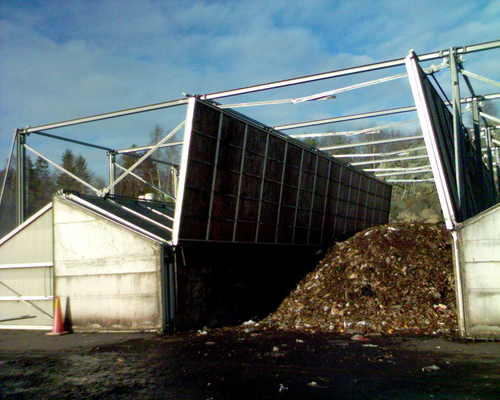
In the middle of the site were large piles of garden waste – branches and shrubs – that were waiting to be chipped. Just beyond these piles were a few long structures, side by side that looked like barracks. They had retractable roofs, so they could be filled with compost materials – kitchen scraps that households have separate bins for, plus the chipped garden waste. When one was full the roof was closed, and the material sat to compost for four weeks. There is a pump system built into the floor of these units that periodically (every couple of minutes or so) blows air into the pile to keep the mix oxygenated. Next the mix sits in an outside been for a couple more weeks, and after 6-8 weeks, they’ve got nutrient rich fertilizer that they can sell to offset some of the costs.


Maybe it’s something cultural about the Swedes that they have the patience and follow the rules enough to set up such a system and make it work – but once it’s up and running smoothly, the results are staggering, if not surprising. As we move towards sustainability ‘closing the loops’ in the technosphere will be key to avoiding violations of the Sustainability Principles. With the proper education and awareness these kinds of systems can be efficient and cost-effective, and will make the concept of landfills obsolete.

But again, it is a challenge that will take coordination and communication between product designers and manufactures, government, business and citizens. Things only really become ‘garbage’ when they are mixed in a way that decreases their value or potential. So if products are designed so they can be separated into basic components, and businesses and households can manage a few bins to separate their waste, and governments or contractors can collect and manage this ‘waste’ as resources – the end result will be a far more effective system for meeting our needs without violating the Sustainability Principles.

This is happening more and more all over the world, and represents a huge business opportunity – but is something that we all need to work to encourage more of in our own communities. So go make it happen!! Stay going…

It's about time...

As we’ve seen and discussed the concept of time is central to movement towards sustainability. Unknown time-delays in complex systems make it very difficult to determine when the system will reach inflection points, tipping points, bifurcations, or thresholds. How long can a company dump mercury into a lake before it all of the sudden dies? How long must cold-war diplomacy and negotiations go on before the wall suddenly comes down? How long will it take for the increases in atmospheric CO2 to result in dramatic and erratic changes in the global climate system? How long can systematic undermining of the capacity for poor Parisians to meet their fundamental needs of participation and protection go on until sustained rioting erupts? How many decades of persistent struggle and resistance are necessary to end Apartheid?

The dramatic shifts are inevitabilities if the inputs driving the change are not altered, but it is very difficult, if not impossible to predict when the systems will “tip,” the threshold will be crossed, or the bifurcation will occur. A variety of factors can contribute to the switch happening. Malcolm Gladwell’s book The Tipping Point looks in detail at some of these dramatic events in the context of society. He tells the stories well, and it’s an easy, interesting read (click on the link for a review).

Even when we’re not dealing with complex systems, the human brain has trouble dealing with the concept of time. Where it is an incredibly perceptive, intuitive, calculating machine, for whatever reason in its evolutionary development, the human brain just gets tricked by time. We have all experienced it with events that seem like they “happened yesterday and a life time ago.” Or how some weekends seem to last for a month, while others go by in about 5 minutes (all too often it’s the latter). We are in awe of the beautiful snow in New England every winter and by January we can’t figure out why the hell anyone would ever want to live there – only to fall in love with it again when spring arrives.

Gladwell’s latest book, Blink, also deals with the tricky issue of time by looking at the split second information we get – from facial expressions, art work, music, tasting food – and how much we can learn from that information. He talks about how that split second information gets processed by the ‘adaptive unconscious’ and creates a kind of intuition, particularly in experienced experts. Again, a good read, and in Gladwell fashion covers a lot of interesting, seemingly obscure research, and makes it readable and relevant to our everyday lives – and thus, movement towards sustainability.

Sort of a random post, but this issue of time comes up again and again in the context of strategic sustainable development – with the world speeding up and the quarterly economy driving decision-making understanding our limitations when it comes to conceptualizing time becomes extremely important. The concept of “slowing down to speed up” is also central to all of this, as we find it’s crucial in understanding and influencing complex systems to step back and take stock to make sure we’re heading in the right direction and doing things appropriately instead of just continuing on with business as usually only faster. So I’m sure we’ll be referring back to all of this. Stay going…

Sunday, December 18, 2005

Macro-Econ - Worldviews, Thresholds & Success

As I’ve touched on before, the prime drivers of our economic system have become growth and efficiency, usually represented by GDP / GNP growth. The logic seems to make sense on the surface – more growth and more efficiency leads to more stuff being produced, more jobs, cheaper stuff all of which should lead to improved welfare, eventually, for all people on the planet. Unfortunately, it is becoming increasingly clear that this is not the case.

Some foresighted thinkers realized this as early as the ‘70s, when these global trends started to become clear. With the development of Systems Thinking techniques, pioneered by Jay Forrester at MIT, it became easier (though still very difficult) to better identify causal relationships in complex systems – such as the global macro-economy.

As a result, one of Forrester’s students, Donella Meadows co-authored Limits to Growth – a landmark work that unfortunately has so far failed to have a major impact on mainstream economic thinking – I’ll get to my thoughts on why in a minute.

Closely related is Herman Daly’s concept of a “steady state economy" – where progress, development, growth of value continue to drive the human endeavor, but physical growth of the economy – extracting more stuff and moving it around – reaches an optimum scale, an appropriate balance, a steady state… sustainability.

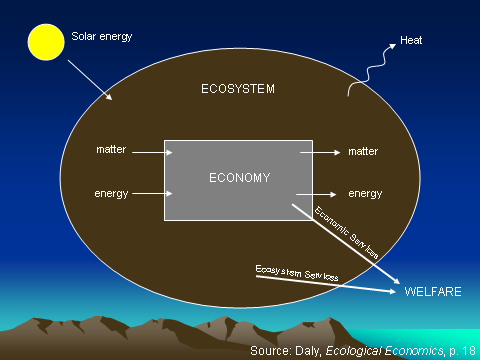
Central to this concept is a very simple differentiation between economic world views. The steady state world view can be represented as such:


The system boundaries are set by the biosphere, and the harsh reality that we only have one planet, which is a closed system – meaning there is transfer of energy across the boundary (sunlight in, and radiant heat out) but no movement of matter across the boundary (with the exception of insignificant movement in the form of satellites/spaceships out and asteroids in). Within that system of the biosphere, we’ve got society cranking along with all of its economic activity that takes resources from the earth’s crust and the biosphere and releases waste back into the biosphere.

These concepts are very closely related to understanding the System (Level 1) that we talk about in the 5-level framework, and the 4 Sustainability Principles (Level 2).

The old, yet still dominant world view is radically different. The economy is not considered in relation other realities – it is considered on its own with growth defining success. Natural resources are seen as inputs and outputs that drive the economy, and boundless growth is assumed to be possible and desirable:


When these economics models were developed they made perfect sense. For all intents and purposes, there were no limits to growth. The “economy” was so small in relation to abundant natural resources that any impact the ‘inputs and outputs’ had on natural systems was negligible to the point of insignificant.

One hundred years of growth and development has changed that. As we know, to say the impacts are now very significant is a gross understatement. So, what’s needed is a change in outlook and a revaluation of what our real goals are as a species. I think we can all agree that first and foremost, we’d like to survive – sustainability. That’s the baseline and to do it we need to shift the sum of our actions so that as a society we don’t violate the Sustainability Principles.

A good place to start is to re-evaluate the indicators we use to measure success. Right now that essentially means one very crude indicator – GDP / GNP. The basic components break down as follows: GDP = consumption (public & private) + investment + exports − imports

It’s very basic and simplistic, and I think if we were to ask most economists they’d concede that. Nevertheless it has become the definition of success for nations, due to the speed and complexity of our global economic system, which demands a simple gauge to measure “success”. The problem is that it measures physical growth (a huge problem in terms of sustainability as we saw through the world-view diagrams), it does not differentiate between desirable and destructive economic activity, and it only measures what is measurable. 

Robert Kennedy (please suspend any political pre-conceptions you may have here) put it much more eloquently than I could:

The Gross National Product includes air pollution and advertising for cigarettes and ambulance to clear our highways of carnage. It counts special locks for our doors and jails for the people who break them. GNP includes the destruction of the redwoods and the death of Lake Superior. It grows with the production of napalm, missiles and nuclear warheads. And if GNP includes all this, there is much that it does not comprehend. It does not allow for the health of our families, the quality of their education or the joy of their play. It is indifferent to the decency of our factories and the safety of our streets alike. It does not include the beauty of our poetry, the strength of our marriages, the intelligence of our public debate or the integrity of our public officials. GNP measures neither our wit nor our courage, neither our wisdom nor our learning, neither our compassion nor our devotion to our country…”

Beyond that, a better understanding of Human Needs should help us evaluate what the aims of our economic endeavors and our resulting economic policy should look like.

So where does that leave us? Well, in addition to an understanding that our true goals are to ensure sustainability and meet human needs so we can live fulfilling lives without undermining future generations’ ability to do so, we should probably develop some better indicators. This has been done, and the results have been fascinating.
The Genuine Progress Indicator and the Index of Sustainable Economic Welfare are two of the better known attempts at developing more appropriate tools for measuring economic success. While their methodologies are different, they essentially work to subtract some of the negative economic endeavors we’re forced to engage in, instead of adding them on as if they were positive attributes to society. The concept is that there are costs as well as benefits and the costs should be subtracted, not added. The costs are things like costs of air, water and noise pollution, loss of wetlands and farmlands, cost of resource depletion, cost of family breakdown, cost of crime, etc.


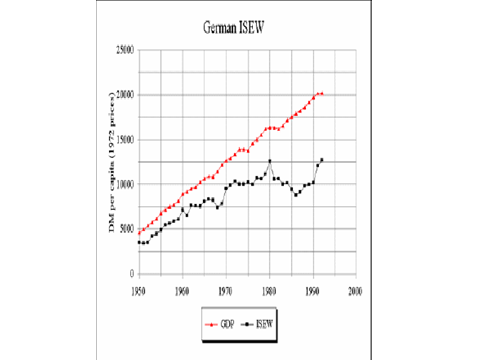
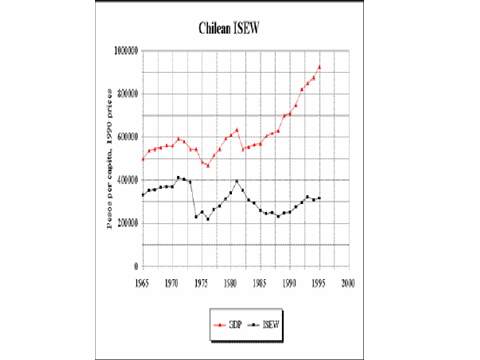
When compared to GDP, some interesting conclusions can be drawn. The results may or may not be surprising to you depending on how you see the world. In most cases, these indicators clearly show that while GDP and a growth-focused model is an effective approach to development initially, there is a threshold point, where continued growth actually starts to result in a decrease in welfare.


THRESHOLD HYPOTHESIS:
“For every society there seems to be a period in which economic growth–conventionally understood and measured-brings about an improvement in the quality of life, but only up to a point-the threshold point-beyond which, if there is more economic growth, quality of life may begin to deteriorate.” (Max-Neef, Ecological Economics, 1995).


In the US that threshold was crossed somewhere in the early- to mid-‘70s…


_


In most other industrialized nations the threshold appears to have been crossed a bit later – the in the late-‘70s or early-‘80s.


In addition to highlighting that GDP should not be the end-all-be-all that it has become, this threshold-hypothesis could illuminate some key aspects of our macro-economic system.

At the top of the list, it helps explain why the dominant growth oriented neo-classic economic model is so deeply entrenched, and why economists hold on to it so desperately - it worked. 

This hypothesis seems to show that welfare increased right along with GDP before the threshold. In addition to the fact that it worked, economists have been hard at work to gain prominence in academia, to prove that the discipline is a science, with concrete laws, and ‘proven’ models to support them. There are slews of jokes about economists working hard to make reality fit the model instead of the other way around – but the consequences of this misguided perception of reality and the policy that springs from it is no laughing matter.

It’s important to remember the obvious here - that most economists are very smart people, and it’s not surprising that after spending huge chunks of their lives (and usually a lot of cash) learning and understanding the nitty gritty details of economic theory and how these models work (with plenty of historic proof that they do work well under certain circumstances) that there is a tendency to hold on to them. Because we’re dealing with complex systems it’s very easy to get lost in the leaves of blame, to write off negative impacts as unfortunate side-effects that are necessary to improve overall welfare, which will happen eventually if we just stick to the model.

Due to the over-specialization in universities and society as a whole, communication and understanding across disciplines is in rapid decline, and that is very dangerous when we get to dealing with the complex, interrelated ecological and social systems upon which our survival depends. I’m over-due for a post on transdisciplinarity on the subject…

But this post has already gotten way too long – it’s because exams are over, and break has begun – the joys of student living, we’re looking at 3 solid weeks of time for idleness and reflection. Hopefully I’ll get a lot of the reflections up on the blog, so stay tuned, and stay going…

Tuesday, December 13, 2005

WTO Meeting, US Subsidies & Efficiency

Just a quick post, as I’m in the middle of exam madness, but wanted to point out that the WTO talks just started in Hong Kong. A group in our program just did a presentation on how the WTO might go about creating a sustainable vision and implementing an action plan to move towards that vision – it was a very impressive and informative project, and it will be very interesting to see if the WTO comes through this ministerial meeting – the vast majority of the world’s poor countries are apparently finally beginning to stand in solidarity against the FIPS (Five Interested Parties – the US,EU, Brazil, India, and Australia), and the closed-door decisions they make that create gross imbalances in subsidy and dumping rules.

This video clip gives a very brief, clear picture of one huge element of the current global trade model that has disastrous effects in terms of social and ecological sustainability…

Warning: if you are like me, and believe that free markets can be hugely effective in meeting peoples needs (if the whole system is considered) than you will probably find this video disturbing, maybe even infuriating, but hopefully also insightful.

Cotton Farmer Subsidies Video

…(also – keep an eye on that slippery word “efficient” – how ‘efficient’ is it for us tax-payers to subsidize farmers so that trade undermines Africans’ ability to meet their needs, so we tax-payers can then turn around and pay for aid money to try to ‘help’ them – usually in a way that further undermines their ability to meet their own needs – a vicious positive feedback loop, and we know from studying systems that positive feedback loops inevitably at some point cross a threshold if they are not checked or balanced. The results are usually very fast, dramatic and unpredictable)


It's not all bad though - when I have some time I'll get some info up from that group's presentation on how the WTO might look in a sustainable society.


I’m finishing up exams this week, and have a few days of down-time here in Karlskrona, so I hope to catch up on a bunch of posts that I’ve been meaning to get to. Hope everyone’s getting stoked for the holidays – I will be missing you all – Stay going…

Wednesday, November 30, 2005

The Importance of Vision and Sustainability at Ford...

Just a copy of a recent assignment - Part I is more or less just a synthesis of some recent readings and lectures on organizational vision. Part II is probably a little more interesting looking at what Ford Motor is doing in terms of Sustainability.


Part I – The Organizational Vision: Composition, Creation and Uses

According to Peter Senge, the vision is “a force in people’s hearts, a force of impressive power.”[1] This force is the result of a gap between the vision and the current situation within the organization, which provokes a creative tension within people, and drives them to get from “here” to “there”. The organizational vision is an articulation of the soul and character of an organization. As such, it acts as a guiding force and a shared point of reference for the organization and the individuals that make up the organization. A powerful vision will motivate, energize and inspire people in a certain direction by providing a shared goal and a “common caring”[2] for all members of the organization. The vision encapsulates the duality of any organization that creates meaning and strength through a strong, core identity, while at the same time constantly strives to innovate, improve and move towards a desired future. The vision is something that can never be ‘achieved,’ but always provokes progress.

It is difficult to pin down a specific definition of what an organizational vision is, so a description of the common components of visions is helpful. According to Collin and Porras in Built to Last the vision encompasses both the Core Ideology (including core values and core purpose) and the envisioned future (ambitious long term goals and inspiring descriptions of the future).

Core ideology speaks to the strong, steady identity of the organization. It is partly made up of core values, which are akin to the organization’s character or personality. These are intrinsic values to which the company holds fast regardless of market conditions or demands, and they should stand up to the question: would you still hold these values if they acted as a disadvantage to you, if you could make more money by abandoning them?

The other key aspect of core ideology is core purpose, which justifies an organization’s existence. It identifies why the organization is important to society and what needs the organization aims to satisfy and for whom. While the core purpose does not change (Collin and Porras suggest it should last at least 100 years) it does inspire change. As it is not meant to be something that can ever fully be realized, the organization must constantly change in its pursuit.

Complementing the core ideology is the envisioned future of an organization, which consists of some combination of strategic goals and/or vivid descriptions of the future. Strategic goals respond to what customers and other stakeholders value and set ambitious targets for the organization to achieve. While achievable, they should be challenging enough that success is not guaranteed. Collin and Porras put them into four categories: target (become a $1 billion company by 2010); common enemy (overtake the market leader); role model (emulate the market leader of another industry); and internal transformation (focus on a revitalization or dramatic shift in the model within the organization).[3] Leaders can transform these strategic goals into vivid descriptions of future success to excite and energize members of the organization.

Just as a vision can take many forms, it can be created in a variety of ways. In The Fifth Discipline Fieldbook Bryan Smith outlines five methods for building a shared vision: telling (the boss creates a vision and tells members that they must get excited about it); selling (management creates a vision and brings it to the members hoping for buy-in); testing (a vision is brought to members and if they’re not enthusiastic, it is revised); consulting (members are asked to provide input for the vision); and co-creating (members work in teams to create and revise a shared vision).[4]

The most effective method depends on the size and nature of the organization. Ideally co-creating is possible because the process allows for people to create personal meaning in their work, it promotes teamwork, and results in a truly shared vision. However, it takes skillful leadership and a lot of time to teach dialogue skills, and allow trust and interdependence to develop. Although the process can potentially be long and costly, the process is beneficial regardless of the outcome. Allowing people to align their personal values with their work will prove to be a competitive advantage for companies as employees increasingly demand a fulfilling work experience.

A vision – and particularly a co-created vision – is important in regards to strategic sustainable development because the task is monumental. Thus, it requires the personal commitment of many people that a powerful vision inspires. It also requires the cooperation of many people that co-creation enables. A vision is also necessary in terms of defining success for sustainability with the four sustainability principles because if we don’t know where we are aiming to go, it is very unlikely that we will get there.

In terms of strategic management, a vision is helpful because it (1) provides an effective way to frame action plans and it (2) promotes integration throughout the organization. In terms of framing the action plan, an organization can better assess its strengths, weaknesses, threats and opportunities as they relate to moving towards the vision. The organization can then identify and prioritize measures in such a way that they create strategic movement towards the vision. In terms of integration, the shared mental model that the vision embodies enables the members of the organization to better communicate and cooperate in order to more effectively implement and carry out the action plan

Part 2: Ford Motor Company – The Challenge of Re-Visioning the Road to

Sustainability

Henry Ford had a highly compelling vision for the Ford Motor Company in the early 1900’s to “democratize the automobile.”[5] This vision was central in sparking the explosion in automobile transportation and infrastructure over the past century and in keeping Ford aligned as a leading company throughout the changes and competition of that explosion period. Today the company’s vision is a bit less inspirational: “To become the world's leading consumer company for automotive products and services.”[6] However, in terms of strategic sustainability, the company is very close to tipping from a reactive ‘market chaser’ back to the inspirational visionary kind of company it was at its inception 100 years ago. In a speech at the Greenpeace Business Conference in 2000, Bill Ford said: “Ford Motor Company once provided the world with mobility by making it affordable. In the 21st century, we want to continue to provide the world with mobility by making it sustainable.”[7]

Currently, Ford touches on sustainability in its statement of values, a sub-set to its vision, saying, “We are a leader in environmental responsibility. Our integrity is never compromised and we make a positive contribution to society.”[8] While this is a rather vague statement and a small component of the vision, the company has also published an extensive Annual Sustainability Report since 1999. In the 2004/05 Report, Bill Ford wrote an introduction, titled “Setting the Vision,” in which he stated:

At Ford Motor Company, we have made sustainability a long-term strategic business priority… Sustainability is about ensuring that our business is innovative, competitive and profitable in a world that is facing major environmental and social changes.[9]

I would argue that Bill Ford is working strategically to bring a vision of sustainability to the company, using the Sustainability Report as a flexible platform to do so.

He has faced a lot of resistance in his attempts to integrate a sustainable vision into the company that his great-grandfather founded. In 2000, he articulated this frustration, saying, "everyday I would push environmental ethics and the top executives hated me for it. It's been a ten year struggle to get where we are now, which is to acknowledge that environmental leadership is central to our strategy.”[10]

And the struggle continues. In 1999/’00 Ford was faced with a myriad of challenges. The first Sustainability Report, Bill’s vocal, public stance on sustainability, and the company’s withdrawal from the Global Climate Coalition (an industry association designed to discredit climate change science) all spooked Wall St. In addition, the Bridgestone/Firestone recall and the bursting technology ‘bubble’ created a ‘perfect storm’ that made sustainability initiatives very difficult. When Bill was appointed Chairman in 1999, Ford’s stock was trading over $35, in March of 2000 it was below $25, after September 11th it broke below $20, and today it is below $10. This has proven to be a difficult environment in which to push sustainability because of the existing context where the vast majority of players in power (within the organization, the investment community, and government) are stuck in the mindset that social and ecological initiatives come necessarily at the sacrifice of economic performance.

As a result, Ford has not lived up to his promise to reduce SUV fuel consumption by 25% by 2005, and in fact CO2 emissions per vehicle and fuel economy are essentially unchanged over the past 5 years. Still, Ford has worked to push sustainability initiatives. In 2000, William McDonough was hired to redesign the company’s Rouge River manufacturing facility and construction is underway. Bill Ford, who said, "we want this manufacturing facility to be what it was 80 years ago, the most copied industrial site in the world-but this time for sustainability,"[11]

The company has eliminated mercury switches in all models as of 2002, installed a large solar array in its Wales plant, and was a founding member in the Chicago Climate Exchange and the UK Trading Scheme. As of September, the company committed to increasing hybrid production 10-fold by 2010, introducing 4 new Flexible Fuel (ethanol) vehicles in ’06, and initiating projects to offset greenhouse gas emissions from manufacturing hybrids.[12] Also, and of utmost importance the company has acknowledged that the future of sustainable mobility will include a combination of better vehicles, fuels, city planning, and conceptualizations about transportation.[13] Regardless, environmentalists are still largely critical of Ford’s initiatives and accuse the company of “green-washing” with the aggressive rhetoric in 2000.

At the recent Clean Vehicles and Fuels Conference in Stockholm, Ford representative Nils Lekeberg said that after pulling back from sustainability initiatives Bill Ford is “officially” back on his environmental crusade.[14] In this year’s Sustainability Report, Ford says “our responsibility to our customers, shareholders, employees and communities includes preparing for the future without delay.”[15] This statement shows that he understands the importance of vision that includes sustainability. The fact that it has proven so difficult to make that change demonstrates that top-management commitment to sustainability is not necessarily enough to integrate those values and that sense of purpose into the company – without a lot of work – particularly in a publicly-traded company.

In addition to the difficulties discussed above surrounding integrating sustainability into the ‘mainstream’ culture at Ford, the company also has some obvious weaknesses within its Sustainable Business Strategies Team. First of all, its definition of sustainability is flawed: “At Ford, we have defined sustainability as a business model that seeks to create value for stakeholders by preserving or enhancing environmental, social and economic capital.”[16] While these are important and admirable aims, they are unclear and could be ineffective in steering the company towards sustainability – how much “preserving or enhancing” is enough? Is sustainability a “business model” or a dynamic state of being? Is an organization sustainable if it only “seeks to create value…”? The group does acknowledge that this is a “working definition,”[17] but it doesn’t provide a clear definition of success in terms of sustainability.

If Ford hopes to be more effective in its approach to sustainable development, sustainability needs to be incorporated into their overarching vision. The existing vision “to become the world's leading consumer company for automotive products and services” does not align with the sentiments expressed in the Sustainability Report, which implies a vision along the lines of “to become the world’s first sustainable mobility company.” In order to establish that they are moving in the right direction towards that goal, they will also need a more concrete, scientific definition of success in terms of sustainability, which the four Sustainability Principles provide.

*************

Still busy here in Karlskrona - just finished a presentation on state of Europe in terms of sustainability, focusing on climate change, which is quite interesting to do with CoP 11 happening in Montreal right now - hopefully some strong news will come from it.

We've gotten some snow and the Christmas decorations are up all over town, so things are good. Hope you're all well as we slide into the holidays - take care and stay going...
Monday, November 21, 2005

Quantum Clarification from a Pro, and a Visit from a Visionary....

Hej all - a quick follow up on my earlier post regarding quantum physics. My dear friend Louisa Gilder is busy battling through the last rounds of editing her book on the subject and offered the following clarification on my amateurish attempt to broach the subject:

ON THE DUALITY OF LIGHT: It is true that matter + antimatter can cancel out and produce photons (gamma rays)... but since photons themselves have no mass (only energy), and are not conserved (in a single ray of light the number of photons is always changing), they don't seem to really count as "matter." But light certainly has a dual nature in that it sometimes acts like a particle and sometimes acts like a wave.

As for her book – it looks like we may have to wait a bit, but I’m sure it will be well worth it…

maybe fall 2006. i hope. the title is "the age of entanglement", and it's a (non-technical) history of quantum mechanical entanglement -- which may have already come up in your classes; at any rate, it's closely related to some of the things you talked about on your quantum physics blog entry -- it's when two particles act as if they are intimately connected even when they are infinitely separated. discovered by einstein and schroedinger and ignored by almost all physicists for fifty years.

In a way it’s hard to imagine that this ground breaking science has been ignored for so long, but on the other hand it can be very scary to start to think about how our most basic assumptions about how our universe operates can be turned upside down. I can't wait to read the book!!

In related news, we just had an unbelievable day of lectures from Göran Carstedt – former President of Volvo France, Volvo Sweden, IKEA North America, and currently sitting on a number of boards, and working closely with Peter Senge at the Society for Organizational Learning (SoL) out of MIT. He was fresh off a trip from China where things are really starting to happen – while deeply entwined in the global economy, and a huge lynch pin for the system, with it’s ~9.5% GDP growth, huge market and labor pool – the government and people of China seem to be very aware of their influence and capacity to really push sustainable development and a brighter future. We saw the article on what McDonough is working on there, and according to Carstedt there is plenty of awareness about the need to develop a circular economy. A lot of hope rests there.

His lectures were full of great stories about the power of shared vision, meaningful, purposeful and learningful work, and the need to really embrace a new way of thinking. As Louisa alluded to – these ideas have been around for 50 years now, and ignored too long – but everyone who comes to talk to us has commented on how things have really started to tip over just the last couple of years. And these are people who have been engaged in this stuff for decades. Exciting times lie ahead.

Göran brought up a rather famous quote that we’ve looked at a lot here, and is worth another mention:

I think that there are good reasons to suggest that the modern age, the industrial era has ended. Today many things indicate that we are going through a transitional period, when something is on the way out and something else is painfully being born. It is as if something is crumbling, decaying and exhausting itself while something else still indistinct, is arising from the rubble

- Vaclav Havel, Philadelphia 1994.

(former President of the Czech Republic)

Another topic we touched on today that got me thinking was about how the first Industrial Revolution did not start on a set date. There was no plan, no headquarters, no tracking its progress. It was thousands of small events, growing, evolving and taking shape. It was about people with vision creating the future. It was also quite unsettling for many – it required transformational change. I remember studying American History stories about farmers in the west violently protesting the railroads – these strange machines entering and drastically altering their lives. The shift to a sustainable future will likely be greater. Exciting times indeed.

It’s going to be quite a rush into the holiday break with projects starting to pile up, but so much exciting material to share – I’ll try to keep getting it out. Hope all is well with you all. Stay going…