Saturday, October 08, 2005

Upstream vs. Downstream

When one steps back, and looks at problems from a whole systems perspective, it quickly becomes clear that there are upstream and downstream solutions. Upstream solutions are often, if not always, more effective (and therefore more efficient). They tend to get to the heart of the problem. And in doing so, they often bring to light many more problems, that are often systemic, complex and challenging – but it’s a rather exhilarating process to look at what’s at the core of various problems, and it opens up opportunity to create new ways of doing things, instead of constantly being stuck in a reactive, problem solving mode. Come to think of it, this process of looking upstream is central to establishing and understanding the 4 Sustainability Principles – all of the various ways that our society is unsustainable can be traced back (upstream) to those four basic activities (violating the 4 principles).

The “stream” metaphor suggests that as one moves upstream, you get to larger streams, rivers and eventually the source. It becomes clear when you think about big river systems that there’s no one “source” but a complex watershed adding to the flow - just as there is no one solution, no “silver bullet” for sustainability. It’s tempting to hope for one – like a hydrogen economy, or solar power, or even a single conceptualization like Natural Capitalism, or an understanding that there are 4 Sustainability Principles – but it will need to be a combination of all sorts of solutions, brought on by different ways of thinking, learning and conceptualizing our roles in this system (the biosphere) that will bring us to a sustainable future.

For these purposes it may be more useful to think of moving “upstream” from the details of the leaves to the twigs, to the branches, to the trunk. So if we were looking at GHG and toxic emissions from the tailpipe of a car, using a downstream approach we would talk about filters on the tailpipe, recapturing and sequestering the emissions, squeezing more efficiency out of engines and passing legislation that mandates the regulation of future emission rates.

But if we were to use an upstream approach, we would explore ways to develop new types of cars that run on fuels that didn’t emit harmful substances. Or we would look at why were driving the car – let’s say to go to the grocery store – and start talking about ways we could design communities so we live close enough to the grocery store that we wouldn’t need to drive in the first place. An immediate and logical response would be something along the lines of “such undertakings are too large and complex and require the coordinated effort of too many players, often with different motivations and objectives.” And that’s true in most cases. But they’re certainly not impossible, and small bits of them are starting to happen all over the place. “Smartgrowth” initiatives in North America work to address such problems, utilizing mixed-used developments with residential, retail, commercial, industrial and recreational building all integrated. (Having “industrial” in that list might seem unwise at first glance – but when you consider a new kind of industry, that is smarter, more efficient and doesn’t require the input or removal of toxic substances and emissions, you can have an industrial facility next to a playground).

Another, simpler example of an upstream approach is the concept of preventative health care – or the idea that if the goal of the healthcare system is to have healthy people, it makes more sense to focus on keeping people well (through exercise and nutrition programs, etc) than to try to cure illnesses.

In more general terms, in relation to the first 3 (ecological) sustainability principles, the upstream vs. downstream considerations are:

· SP I (substances from the Earth’s crust)

o Downstream – the quality of the final deposit (waste) and the societal competence for dealing with it. (Is the waste product mixed with other substances? Can we contain it and keep it separate from natural systems? i.e. Ways in which we can we keep mercury or CO2 in a closed loop after use)

o Upstream – the type and rate of extraction. (how can we mine less mercury or CO2 through substitution (using other substances that are more abundant and less harmful in natural systems to meet our needs) and dematerialization (increasing efficiency and decreasing demand for such substances)

· SP II (substances produced by society)

o Downstream – keep substances in tightly controlled closed loops, and out of natural systems. (Some times impossible, as with CFC’s, or nuclear waste).

o Upstream – only produce substances that can degrade in nature. (Develop more and use existing non-toxic, non-persistent chemicals and compounds).

· SP III (degradation of ecosystems by physical means)

o Downstream – restoring natural systems (re-planting trees, shutting down fisheries for long periods of time to allow for regeneration).

o Upstream – don’t allow the rate of use / physical impact on ecosystems affect the rate of replenishment in the long term (sustainable harvest of timber or fish).

So there you have it – upstream vs. downstream – a big part of whole systems thinking and a hopefully will spark some new ways at looking at things.

A tough end of the Sox season last night, getting swept by the White Sox, but it was a hell of a season – never got old watching the Manny / Papi combo come to the plate, and a treat to have Ortiz dubbed the “greatest clutch hitter in the history of the Red Sox” by John Henry. Anyway – good thing we have the Pats…. Hope you’re all well – Stay going…

Saturday, October 01, 2005

March on...

I was just emailed this website that's running a "virtual march on Washington" to show how many people are aware of the real threats of global change. They've got some sort of physical group traveling around the country and making pit stops to raise awareness, and they've got some pretty cool partners. It's very easy, and hopefully will be very effective. Please take a second to sign up:

Virtual March to Stop Global Warming

Big win for the Sox last night to tie it up. HUGE game tonight with Wake facing the Unit. I'll be airing the game live via internet, projected on the big screen to my program and some local Swedes, all ready for a strong show of solidarity for RSN.

Hope you are all well. Stay going...

Wednesday, September 28, 2005

Leadership, Success, and The Answer you've all been waiting for...

I’m at the end of another very long day, after a couple of very long weeks. This work is extremely draining and demanding, and the emotional strain is high. It’s difficult for the human brain to deal with these kinds of problems, comprehend the complexity of the systems and the daunting nature of the task. An article I just read by Peter Senge (MIT prof and founder of Society for Organizational Learning – SoL) pointed out that the human brain has evolved to deal with problems on the individual, family, tribe and local society levels, and conditioned that way for thousands of years. Someone put forth the analogy that it’s like trying to run brand new software on 50,000 year old hardware. It’s very difficult to get people to all of the sudden start thinking on a global scale, with the biosphere as the system. We just got our first picture of the Earth in the ‘60s. And we are just starting to realize the true implications of our actions. Just a reminder…


...So I’m due for some “success stories” – some feel good stuff about how businesses are profiting from sustainable initiatives and inspiring their employees and everyone “doing well while doing good.” I think I’ve sort of taken for granted that people know about some of the stuff that is going on, because it is these types of stories that have kept me going in this field and brought me to this program. There are a slew of stand-up companies doing good things at different levels of course. But the ones that have really internalized the true concept of sustainability – defined on the principle level – are fewer, but more exciting. They are invigorated and creative organizations. The big ones that come to mind are Interface, Scandic Hotels, Electrolux, and IKEA. The last three had great success after working with The Natural Step, and Interface’s CEO, Ray Anderson picked up the concepts from Paul Hawkin’s The Ecology of Commerce.

I’ll get to a lot of the success stories but just start with a bit about Interface, because we just watched a documentary called The Corporation, which Anderson was in a few times (please go rent that movie by the way, it’s long and a bit heavy, but entertaining, so important and worth the watch). So, basically, Interface is an old carpet company (Anderson founded in the 70s), very big, from the US. As you can imagine, but if you’re a normal person, probably rarely ever think about, carpets are a huge problem from a sustainability view point. They use a lot of materials, usually synthetic made from a mix of petroleum based products as well as man-made compounds, not found in nature, often toxic, with a host of adhesive, glues, etc. I’m no expert, but we all have a basic idea of what carpet is when we think about it, and can sort of imagine the process of laying it down and making it look all nice and flat, and soft, etc.

And carpets wear out rather quickly, in the scheme of things – how long does it take for a carpet to start looking dingy in the places it gets walked on all the time? Like 5 years, maybe? And they can go out of style quickly. I have no idea the average active use of a carpet, I’m sure it varies, but I’d think you can see when a carpet is 10 years old, and it’s usually not a very hot look. Office remodels and new tenants moving into spaces wanting their own look and a fresh start are pretty common events. So this all adds to a lot of turn over, a lot of resource use in the carpets, energy in production, and heaps of carpets in landfills (with all those toxins, etc not disappearing (1st law of thermodynamics) and dissipating into the biosphere (2nd l.o.t.).

So in the early 90s (or thereabouts) some customers started asking about the company’s environmental policy, and they didn’t have one, and the employees started a task force to deal with it and asked Anderson to come give a speech at the task force kick off to the members (employees from the company’s operations around the world). And he didn’t really want to do it, because the company didn’t have an environmental policy or vision or any concept really of its role in the biosphere. And that’s when he found The Ecology of Commerce in a desperate search for guidance, and was really struck by the concepts.

He’s since revolutionized the carpet industry and his company. They’ve shifted their entire operational paradigm from “selling carpets” to “providing the service of comfortable, attractive flooring.” Essentially they lease carpeting to companies. That way Interface has the incentive to build long-lasting, durable, high quality carpets, because they own them. They have the incentive to minimize waste of the carpets. So they’ve done things like creating carpet tiles that cover a whole room, but when the high traffic areas get warn out, they replace those tiles, instead of the whole room, saving them a lot of money. Because they now have the incentive to bring back the warn out parts and refurbish/reuse the materials, they don’t want them full of toxic compounds that are hazardous, difficult to separate, and generally hard to deal with – things that really weren’t any of their concern under the previous model where they washed their hands of it the minute they left the factory.

And as you can imagine, when those incentives are there, the innovations follow (like the tile-carpets). They’ve also brought in emerging experts to help them with developing safer alternatives in terms of dyes and adhesives – natural alternatives, or chemicals that are safer and more easily managed in closed loops, less persistent, etc. I know they’ve done some work with Bill McDonough’s (author of Cradle to Cradle, and another Dartmouth grad) MBDC group (http://mbdc.com/) to develop some of these alternatives.

I think the real key here though, beyond the significant cost savings and opportunities to improve margins through the new model, is the huge revolutionary and exciting change that the culture of that company must have gone through, and is still going through. I mean, how often do you hear in management and business literature about the importance of corporate culture, core-values, and clear, shared vision? In most businesses labor is the huge cost factor, far outweighing all of the physical and material inputs. And can you imagine how exciting and rewarding it must be to work for a company who’s goal is “sustainability by 2020”? The improved productivity, the innovation that this approach has sparked at the company and in the industry as a whole must be immeasurable… [I apologize for not doing more research on the facts and stats of the story, but you get the idea (and a google search on any combination of “Interface, sustainability, success” etc will pull up a ton of info on their story).]

And that brings me to a point I’ve been meaning to make for a long time. A lot of very supportive friends have asked me half in jest, when I’m going to figure out things like how we can have wind power without killing birds, how to get the water out of New Orleans, when I’m going to hire them at my futuristic sustainable business, how long it’s going to take me to structure the new-world-economic-order, etc etc… Well, as much as I like to fantasize that I am, I think we all know, that I’m not nearly smart enough to do any of that. But what I’m hoping I can do on some level is lay-out the current problems that we face as a species, along with a simple, shared framework that we can all agree on, to enough people that they can then use that perspective, and those tools to save us. It’s going to be those CEOs that inspire those middle-managers and engineers and designers that save the world. It’s going to be anyone who reads this and starts applying it to their lives, to their organizations that their involved with (employers, local governments, schools, whatever) that really makes this possible. And the beauty of it is, that once that leap is made, that confrontation with the reality of our situation (the funnel, if you like) and the shared, scientifically irrefutable framework for success (the 4 principles) are understood, the possibilities for solutions are limitless. The potential for creativity in working together to conquer this challenge, the artistry that will get us there, is just incredibly exciting.

… As I said, we’re moving on to a leadership and organization learning module of the course, and it’s really exciting, powerful stuff (and of course, as usual, daunting, overwhelming and challenging). Tomorrow we’ve got lectures from David Cook – head of TNS in the UK. He’ll be talking more about applications in business, and I’m hoping some about what the organization is doing to make in-roads into China (speaking of daunting, overwhelming, powerful challenges).

Tuesday, September 27, 2005

On a more personal note...

Here is the link to my girl Michelle's blog.

She's way better at covering the day to day of life in Karskrona, the good times with the people in our program and those we've met here, and all of those things that are actually really important. (Although, she did get some nerd-envy when she saw my blog and has started dorking it out a bit more as well).

The pictures are great as well, on the right hand side - all of the albums that say "karlskrona" or "friends" or some combination there of are mostly from her time here. Also, I live in the same building, so the pics of that and the bikes and her room are all pretty much the same as what mine look like (except my room's a little neater and better decorated). Enjoy...

And congratulations to Wakefield for pitching a stand-up game this afternoon, to get us at least half of the double header. Six games to go. Need a big one out of Schill tonight.

Monday, September 26, 2005

Isn't It Organic...

I’m coming off a thrilling weekend digging into some of the finer points of the Carbon Cycle. But the internet research led to a lot of interesting websites on climate change – a debate I’ve largely avoided for the past few years, as it seemed fruitless to spend time bickering about what might happen, when that is inherently unknowable in such a complex system (for evidence of this, see your local weather report’s success rate).

But I was surprised by how much we do actually know at this point and how much consensus there really is among scientists. The IPCC (Intergovernmental Panel on Climate Change, http://www.ipcc.ch/), The Pew Center on Global Climate Change (http://www.pewclimate.org/), and The Global Carbon Project (http://www.globalcarbonproject.org/) are a few organizations trying to tie together all the data and tackle the daunting task of establishing some policy measures that will address this problem.

It also became clear the huge impact the media has on this debate. Not to say that they’re politically motivated one way or the other, but it just makes better TV to have the “dissenting” view expressed. Maybe they think they’re being fair and balanced by giving the view of 1% side-by-side with the view of 99%, but I think too often it comes across as sounding like it is 50/50. Not to say that view should be ignored, but it’s a bit skewed right now. And then of course there are some political-economic interests that are pushing that 1% view, and making sure it’s louder than it probably should be.

Another cool aspect of having to sit down and actually look at the Carbon Cycle was really learning / relearning how it works and how little we understand about it. Many of you may have heard of the mystery “land sink” that has come up in the CO2 emissions debate. It’s essentially a missing flow of carbon on the order of about 1.8 Giga-tons C per year, from the atmosphere and we are not really sure where its going – it’s probably a combo of various factors (like increased fertility from climate change and run-off fertilizers), and the impact of some time-delayed flows (like fires from forest clearing that release a bunch of CO2 in the short term, but actually capture some in the form of black carbon that’s left behind and doesn’t breakdown). Anyway, some of the other interesting numbers in it from the most recent data I could find were: land-use changes (paving, deforestation, reforestation, etc) produce a net addition of 1.2 GtC/yr to the atmosphere, fossil fuel emissions and cement give-off 5.9 GtC/yr, and over-all (including exchanges b/n the air and ocean, and photosynthesis and respiration, etc) a net flow of about 3.5 GtC is added to the atmosphere each year. (Mostly in the form of CO2 … 1 GtC is about 3.7 Gt CO2).

The searching also led to some sites on Emissions Trading – a more “market based” approach to creating incentives for lower emissions. The process essentially securitizes emissions as credits that can than be traded between companies. It seems like a useful tool for companies that either (a) don’t have the long term strategic vision to see the benefits of sustainable operations (avoiding the funnel walls) or (b) are hindered from implementing long-term investments with difficult to quantify ROI due to shareholder demands, need to meet quarterly numbers, etc.

Anyway, I’m going to look into all of this more, including trying to figure out where policy watchers are placing bets as to the odds of the US signing on to Kyoto post-Bush. (That Forbes article on GE made it sound like businesses were gearing up for the possibility of that happening after G.W.’s time is through). Regardless, it looks like there are already some lucrative opportunities there for visionary companies, as well as people set up to get in the mix and trade the credits.

So, we’ve finished up this basic science section, and have another section on Organization Learning & Change and Strategic Management coming up this week – so I’m sure I’ll get some more stuff up on the business side of all this. HUGE week for the Sox though, so the blog might take a backseat… Hope everyone’s doing well -

Thursday, September 22, 2005

The Posse:

Here's a link to a pdf of the bios (with pictures) for all the members of this year's Strategic Leadership Towards Sustainability program. As you'll see quite an impressive group and ridiculously diverse range of backgrounds in terms of nationality, experience, etc., which has provided for an amazing experience so far. A real solid crew in terms of hanging out and having a good time as well...

Class Brochure

Presenting...

Last week was busy with group presentations and exams. Most of the work consisted of group meetings, where we came up with and gave presentations individually on the ABCD Model, and then as a group created a hypothetical case study where we hypothetically went through the ABCD with an organization, and put together a presentation that was somehow a report on how that case study went.

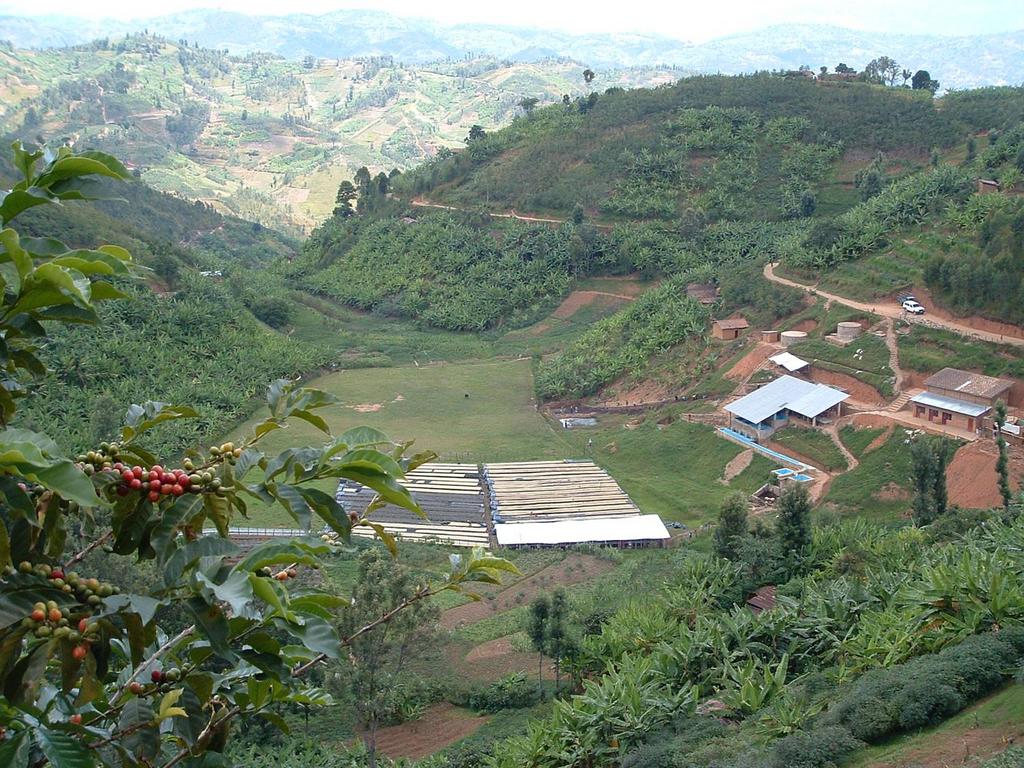
Our group went with a cell phone company, and pretended we were a group of consultants presenting the results to our newly hired consultants in training. Another group went with a fictional local restaurant, one did a funeral business / mortuary, another did Absolute vodka, and my personal favorite was the one group that chose a real-life topic, which was Pierre’s (a great guy in our program from Rwanda) coffee plantation. Looks pretty nice, eh?


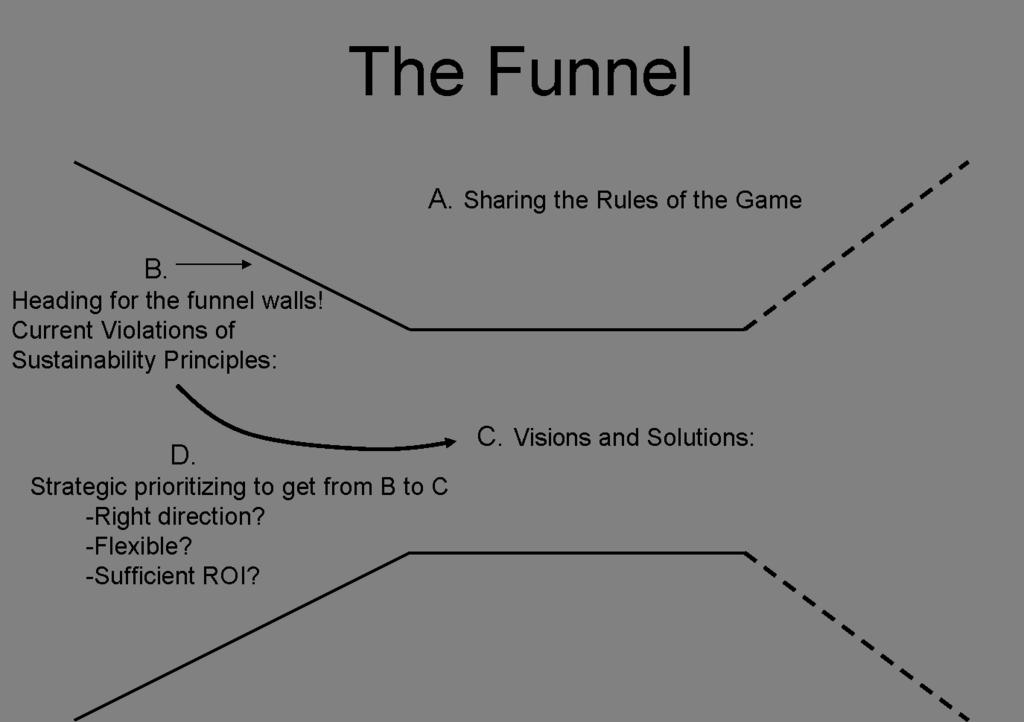
All of the presentations followed pretty much the same format, in that they started with a quick overview of “A” – that is defining (1) the system (that particular organization within society within the biosphere) and how that system is akin to the funnel metaphor; (2) success in terms of sustainability (not violating the 4 sustainability principles); and (3) some strategic guidelines (in particular the concept of backcasting, which is what the group would be doing in steps “B” and “C”).


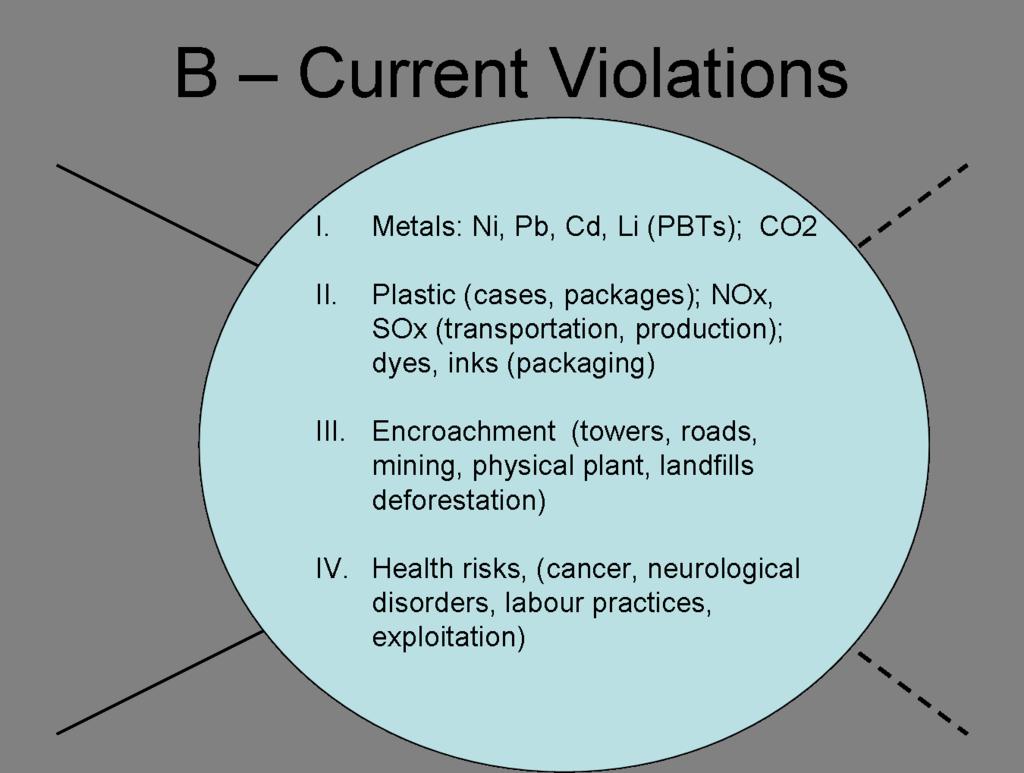
Then they described how “B” went – and there were a lot of assumptions and generalizations, because the point wasn’t really to get a full handle on the topic, but to learn the process. Also, when you do it for real, you let the group of experts do all the talking, so you don’t really need to know specifics of the operation. So all of the “B” sections had a bunch of examples as to how the present operations violated the 4 principles. So the Vodka group, for example talked about CO2 (from energy in buildings and distilling processes, transporting the product, etc) (violating Sustainability Principle I) and about the farm land used for the grains (SP III) and the pesticides and fertilizers used in the farming (SP II) as well as problems with alcoholism (SP IV) and drunk driving (SP IV). Our group’s slide for B looked like this:


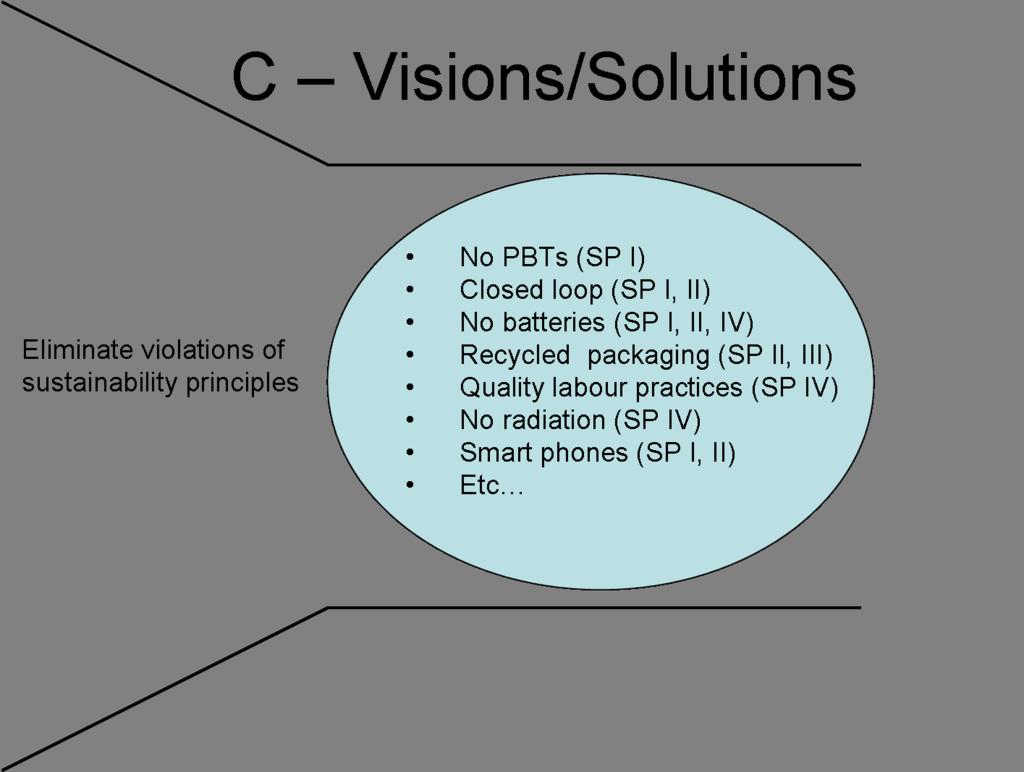
Then on to “C” where the hypothetical groups started brainstorming about solutions and an ideal vision of the future, without regard for what might not actually seem possible or feasible today (due to limitations in cost or technology, etc). So the coffee plantation group talked about a chemical-free farm, and a bean-cleaning operation that used recycled water and renewable energy, and a living wage for workers ($1 per day vs. the $0.60 they currently get, which is already higher than the $0.40 average for the area). Some of the examples for our cell phone company were:


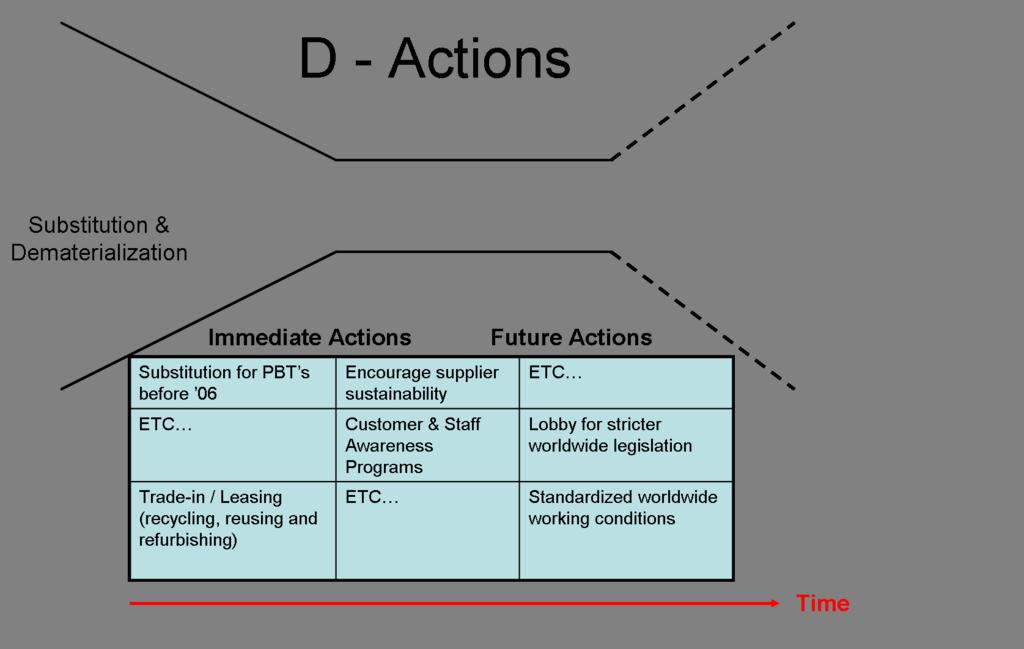
Then we got to “D” where you start prioritizing immediate actions the company can take (keeping in mind that those actions need to be in the right direction towards “C”, they are flexible enough to adapt to unforeseeable changes on the way to “C” and they provide a good ROI so the company does well and has extra $ to reinvest in more challenging sustainability options down the road). The funeral group talked about biodegradable caskets, vertical burying, alternative embalming techniques… (this presentation brought up a lot of interesting talk about cultural considerations and the importance of traditions, and how they can change – our current land-use intensive burial practices haven’t really been around all that long). Here's our D slide:


And that was that – good practice to go through the steps again, and play around with different examples and very interesting to see how it works with any organization and application, even weird ones like funeral operations.