Monday, November 27, 2006

Kenya Travel Log, Part I

As many of you know, Michelle and I are in Nairobi, Kenya for three weeks – so while I can’t help but write through the lens of sustainability, below is a bit more self-indulgent, for the family type of post…

Originally, the main purpose of the trip was two-fold: to visit my sister’s family and be “outside observers” at the Conference of the Parties (COP). COP is the annual climate change negotiations that have been taking place since the earth summit in 1992. In 1997, the COP was in Kyoto, and produced the now famous Protocol. Unfortunately, our connection to get outside observer status fell through at the last minute, leaving us in the happy position of being able to focus on the first purpose of visiting family.

The internet access has been patchy here – ironically because the power consumption from the COP has been causing blackouts – so I’m planning on trying to keep up with short daily posts, which I can put online all at once later.

Getting there

Early Saturday morning we boarded the train to Copenhagen, and after a long, but smooth day of travel we arrived in Zurich for an overnight layover. Thanks to Swiss efficiency, we hopped a train downstairs in the airport (why don’t all US cities have this??) and were in the central station in 15 minutes. Michelle’s friend Eric hooked us up with the royal treatment, walking us 5 minutes to his styled-up apartment in the old-town part of the city – every European city has one of these, and they’re all awesome, this one was no exception. Right into drinks & appetizers, and after a few more friends came over we headed out to a great Spanish restaurant.

The crew was fun, and very interesting to talk to as many of them worked for the largest (physical) commodities trading firm in the world – lots of implications regarding SPs # 1 & 3 moving around most of the world’s coal, oil, grains, etc – and so a lot of interest in strategic sustainability, and how a company like that could lead the way, as opposed to hindering progress. As they’re essentially a middle man, it’s easy to see how they could still do great business in biofuels, recycled materials, sustainably-managed renewable raw materials, etc.

All in all it made for a great night, a new city, and much appreciated hospitality. We were up early Sunday morning back on the train, and flying to Nairobi. It was a long but smooth ride with great views of Italy, Greece, & Egypt on the way. My sister’s family has a driver they hire regularly who was there to pick us up at the airport – which was incredibly smooth through customs, etc.

His name is Bradley, and he gave us the run-down on Nairobi as we sped through it in the dark. He is Luo, a tribe from the area around Lake Victoria, but grew up in Nairobi, went to school here and studied art, but because it’s tough to be an artist (even here in Kenya!) he’s been a driver for years – first driving a matatu, which is what they call the minibuses here, which are basically hell-on-wheels minivans that drive regular bus routes stopping more or less at random. Now he’s managed to get in the taxi businesses, and does hire-by-day gigs. He’s a great guy, knows everyone in the city and is hooking us up with many insights.
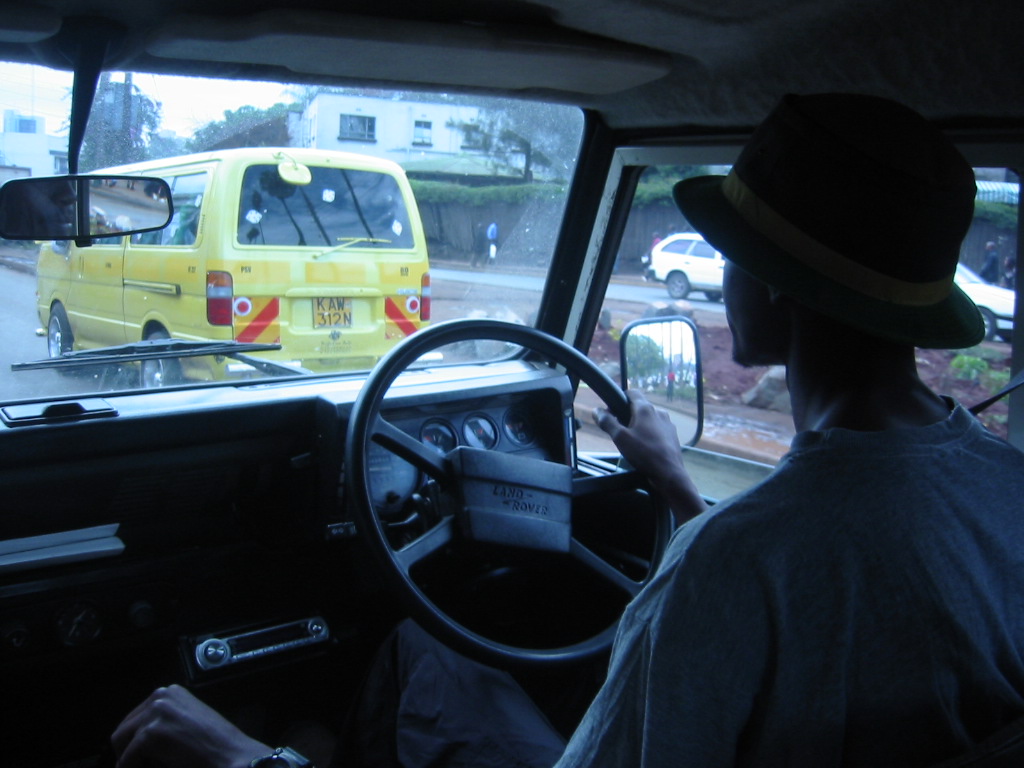


So we arrived at the house around 8 through an armed guard gate, into a neighborhood, through another gate into the drive way, where two night guards and Simba (they didn’t pick the name, she was adopted), the watchdog greeted us. The kids were asleep, unfortunately, but Em had a full-spread dinner ready to go which was great, and so good of course to have some time to catch up after over a year. The house is beautiful – not too big, but not too small. Em’s office became our bedroom, complete with a big bouquet of orange roses (and apologies from Em that they are probably partly responsible for the drying of Lake Naivasha).


Mads was in Rwanda on business (for UNICEF) so we just had a chill night and went to sleep very excited for the African adventure to begin.

DAY 1 - Kitengela Glass

Rain. But still so beautiful out the window, the small house has a huge yard, framing a huge, full-in-bloom Jacaranda tree, which has scattered a purple carpet of flowers everywhere. A shy girl helped wake us up, and we got to know each other over a bowl of fresh mangos before taking her to school.
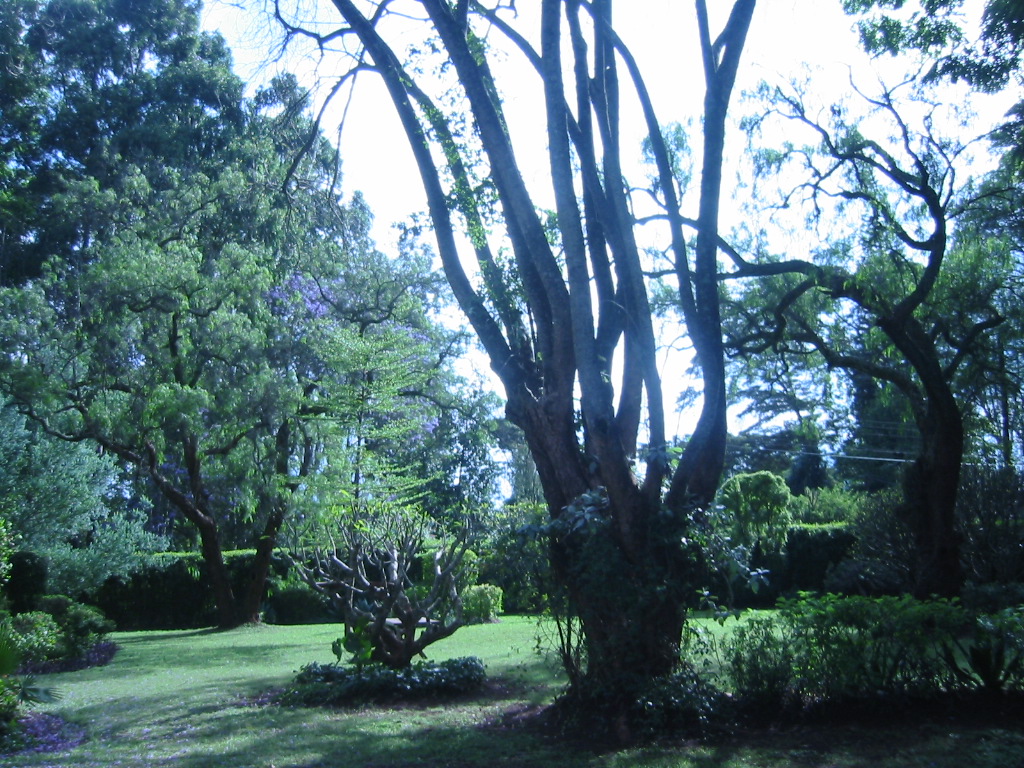
After the drop-off at a very cute little-kid school with cut-outs and collages hanging everywhere, a playground surrounded by bamboo, and a healthy mix of little Africans, Indians and Europeans running around – we went for a run ourselves to explore the neighborhood. We quickly remembered we were at 2500 meters, and didn’t explore a whole lot of the neighborhood. We got back to the house, greeted by the day guard, Evans, and of course the always-on-duty, Simba, took showers and got settled in, before grabbing lunch and hitting the road with Bradley.

Our first destination was the Kitengela Glass http://www.kitengela.com forge. It is only about 30 kms from Nairobi, but the drive took about an hour in the Land Rover, which we were happy to have given the condition of the roads.

This place is a total trip. After pulling off the paved road and winding our way through an area lined with tin-shack shops, and through a valley, up a big hill, passing Maasai in traditional dress (the long colorful robes, bald heads, beaded jewelry) to a mesa – clear grassland with a view back over the city’s skyline (surprisingly modest, less high-rises than I remember from my time in Harare, Zimbabwe) – and no real road. Bradley somehow navigated us to the glass shop following clues of funky 70s-esque art pieces by the side of the road.


We got a brief tour of the place, through the workshops where the artists were doing their thing (paying us little mind) – some beautiful work. The last room was connected to the forge and we stood and watched them toss the broken, recycled glass in the furnaces (oil run) and crank out a couple large vases and a couple glasses with ease. The forge was a dark, tall dome with stained glass windows about 20 feet up ventilating and letting in light. The blowers moved with a natural grace around one another, they seemed to not even look at each other, but manage to avoid hitting others as they swung the molten glass around and were right there for each other, just in time when more hands were needed to cut this or pinch that – it was mesmerizing.
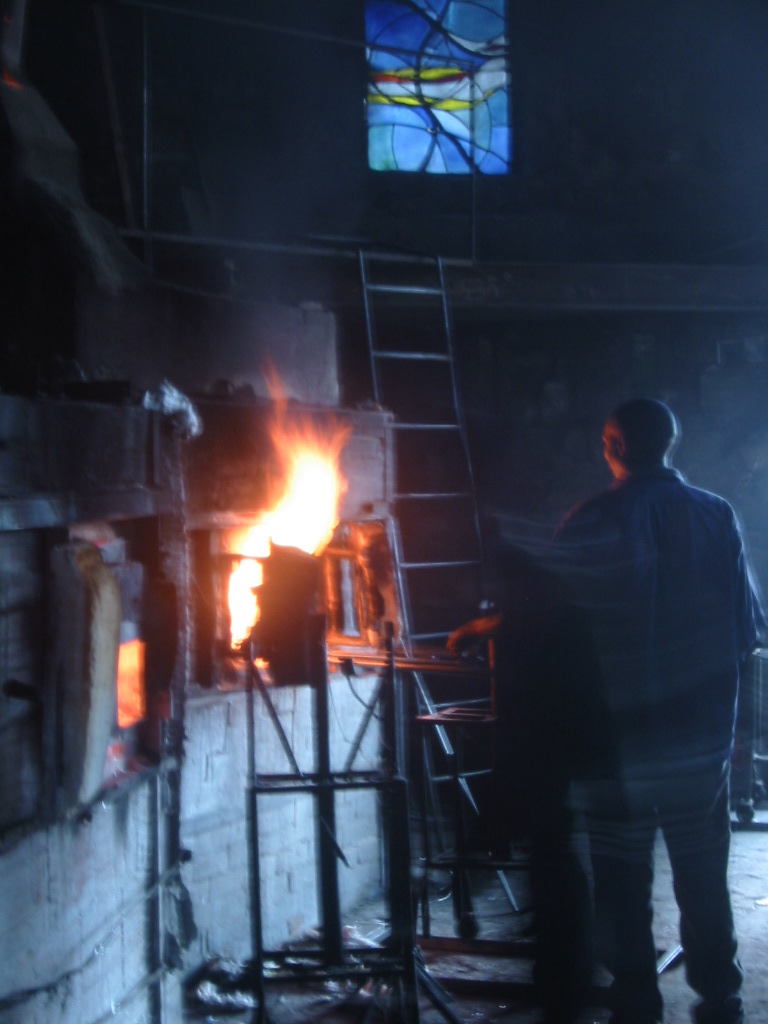


We bought a few pieces and the long bumpy ride home seemed shorter than on the way out.


DAY 2 – Giraffe park & lunch, Karen Blixen style



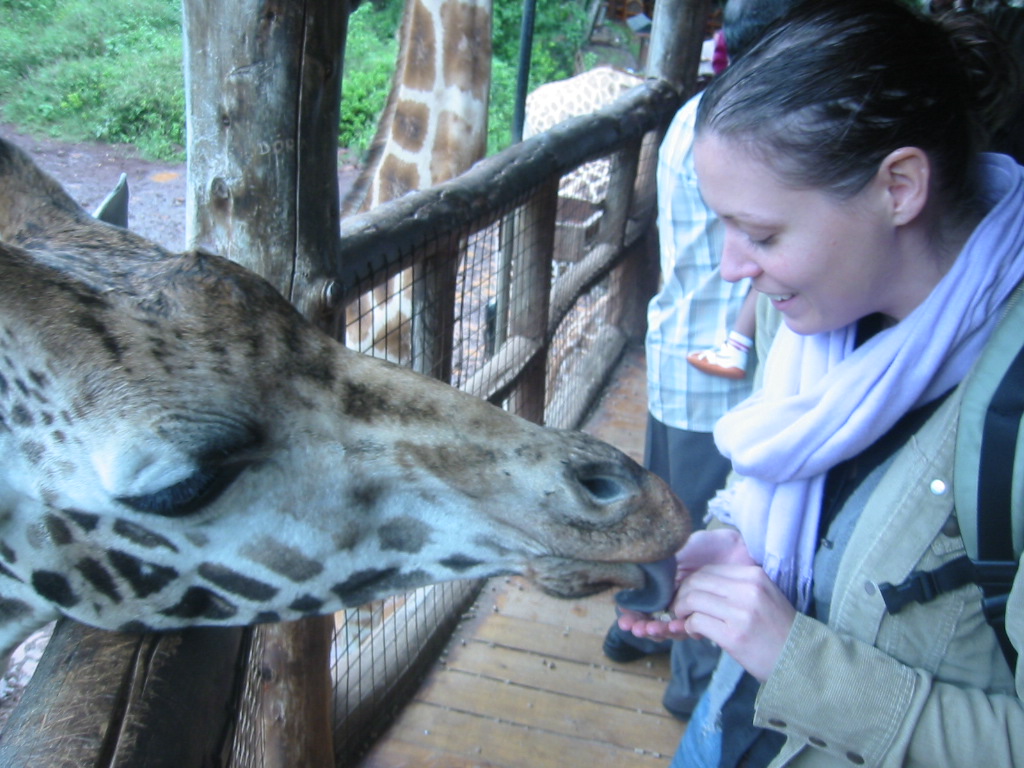
We went to the Giraffe park in the town of Karen (named after Karen Blixen, the Danish woman the movie Out of Africa was based on). The park is like a zoo, but a really nice zoo where the giraffes have a huge savannah to roam around in. The main attraction is a raised circular building where you can feed the giraffe by hand. Of course it feels contrived (it is) but you still get a thrill of being so close and in contact with these huge graceful beasts.
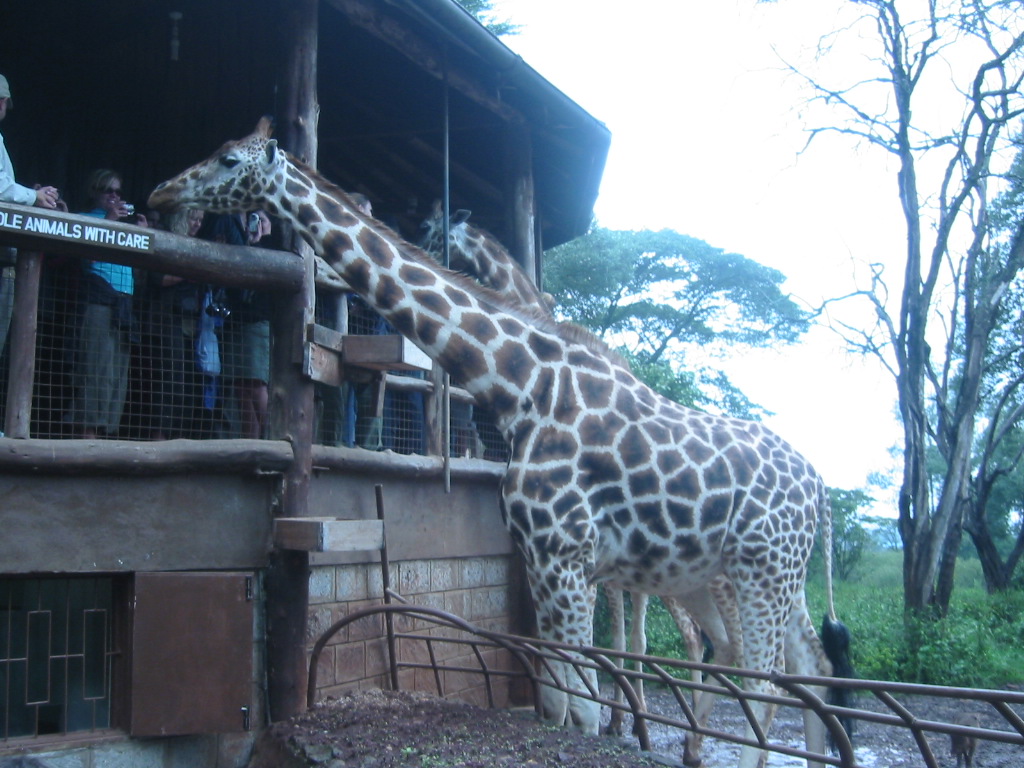


The real attraction though was a different kind of beast – the Aussie- & Americano-tourist. We were joined by a busload of load tourists, who distracted much of our attention from the ‘wildlife’. Liv was helpful in showing us how it was done (this is part of her regular routine).


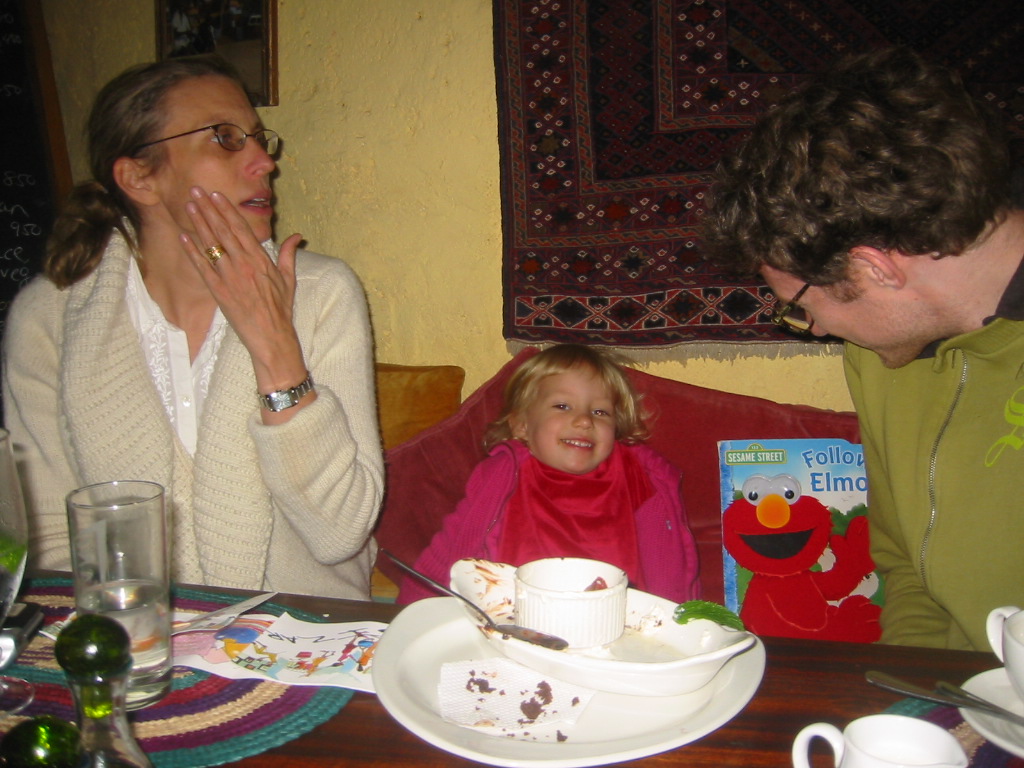
Next we went for a luxurious lunch at the Talisman restaurant – a mellow indoor-outdoor ex-pat hang out, where we sat by the fire, watched the Nairobi drizzle and read books with Liv. Lunch lasted most of the afternoon, and after some errands and work, it was dinner and bed.

Thursday, November 02, 2006

I'm Riiiiacch Biiaaach

Social sustainability can be a tricky concept. As the 4th Sustainability Principle says, in a sustainable society people worldwide are not subject to conditions that systematically undermine their capacity to meet their needs.

Now, this is very different from “no poor people” or to “be sustainable we must meet everyone’s needs” – and it represents only the bare minimum for sustainability, because if you have a situation where peoples’ capacity to meet their needs are systematically undermined – through abuses of power (political, economic, environmental, etc.) or other means – at some point you will have a breakdown of the social fabric.

It’s also always very important here to differentiate between basic human needs, and satisfiers of those needs – when we do this, it becomes clear that social sustainability is not just an issue of rich and poor, industrialized and developing, but a very real issue for all of us, because you can start to see how certain needs that are not met in rich places can be expressed as “poverties” and those poverties can then result in a variety of pathologies that we see all the time (eating disorders, depression, divorce, gun violence, etc.)

Currently, global society is unsustainable and violating this principle at a frightening rate – the results are all around us (though often difficult to see clearly, due to the complexity). This systematic deterioration represents a part of the funnel – and a particularly serious part of this is the widening gap between the rich and poor. This website is a cool & powerful way of conveying this idea:

http://www.globalrichlist.com/

Now donating and helping some people meet their needs does not necessarily address the underlying, fundamental mechanisms that cause the serious violations of SP 4, (but of course it is a nice a meaningful thing to do, so I recommend it!) - to address the underlying mechanisms, we really need to deeply evaluate our actions and those of our organizations and consider their full implications in an honest way – this is of course a huge part of the sustainability challenge. Stay going!

Monday, October 30, 2006

Stern review on the economics of climate change

An interesting report on the economics of climate change was released in the UK today - I won't get into the details of where I agree and disagree with the analysis, but hopefully this will continue to push the much needed drastic action. Here are a couple of interesting quotes from presentation session to the Royal Society:

Tony Blair today said that the world was facing "nothing more serious, more urgent, or more demanding of leadership" than climate change...

The chancellor, Gordon Brown, who commissioned the review, said climate change was "the world's biggest market failure"...

I realize there's not much new in those kinds of statements, but it highlights what I think are two of the most important aspects of this challenge: the need for leadership, and the need to improve and update our thinking on markets - what free-markets were, what they are, and what they ought to be (of course, this brings us back to leadership)...


Publication of the Stern Review on the Economics of Climate change

30 October 2006

The most comprehensive review ever carried out on the economics of climate change was published today.

The Review, which reports to the Prime Minister and Chancellor, was commissioned by the Chancellor in July last year. It has been carried out by Sir Nicholas Stern, Head of the Government Economic Service and former World Bank Chief Economist.

Sir Nicholas said today:

“The conclusion of the Review is essentially optimistic. There is still time to avoid the worst impacts of climate change, if we act now and act internationally. Governments, businesses and individuals all need to work together to respond to the challenge. Strong, deliberate policy choices by governments are essential to motivate change.

But the task is urgent. Delaying action, even by a decade or two, will take us into dangerous territory. We must not let this window of opportunity close.”

The first half of the Review focuses on the impacts and risks arising from uncontrolled climate change, and on the costs and opportunities associated with action to tackle it. A sound understanding of the economics of risk is critical here. The Review emphasises that economic models over timescales of centuries do not offer precise forecasts – but they are an important way to illustrate the scale of effects we might see.

For more information and the complete report, click here.

One of our external lecturers at the MSLS programme, Christian Azar, did a simliar analysis back in 2002, also finding how small the costs of mitigating our emissions are compared to "baseline" GDP forecasts -- (of course, these are measurements wrought with flawed assumptions in that we talking about 'business as usual' and using GDP as if it were a measure of success or well-being -- still, it makes a point):


On a percentage basis the difference between the BAU and the stablization at 350 PPM up around the $200 trillion mark in 2100 is tiny - what the graph doesn't show is the huge costs associated with impacts if anything close to the BAU scenario were to occur.

Stay going.

Thursday, October 19, 2006

The final product

Our thesis is finally published! Of course it feels quite good, and at the same time as I look back over it I immediately wish we could have done more - expanded here, clarified there - I suppose that's the way it usually goes! All in all it was a great experience, and I am ever grateful to my partners, Michelle & Mauricio for making the process so amazing and fulfilling.

If you're interested, you can access it through the BTH system by clicking here.

Stay going.

Wednesday, October 18, 2006

Amsterdam, making markets work:


I am on the train back from Amsterdam, where Greenland Enterprises just presented at the Make Markets Work for Climate conference. We hosted a side event at the end of a long first day, and were pleased by a good turn out, engaged participants from around the world and an interesting dialogue following the presentation.


We started off talking for about 20 minutes, introducing our background and briefly describing our thesis research and the creation of CDM Select, focusing mostly on the framework for strategic sustainable development, on which the tool is based. Then we had our panel members – Mauricio Mira (our thesis partner and sustainability consultant in Bogota, doing some CDM-related work), Anne Morgan (a student in this year’s class with background in the NGO sector) and Brendan Demelle (a friend who does freelance research on all kinds of social & environmental topics, with a big focus on global warming education & public awareness) – join us and we spent about 40 minutes in a dialogue with the audience.

It was great. Although we essentially packed an hour presentation into 20 minutes, most people seemed to grasp the concepts of the funnel, the importance of understanding the system and having a clear definition of success in the system (the 4 sustainability principles), and the power of backcasting in the context of group decision making and strategic planning. There was a good deal of confusion as well, of course, and some of the expected questions and responses that typically bring the discourse into the “leaves” of detail, confusing the issue, but overall I think people appreciated the broad, high-level, whole-system perspective, and saw how helpful, and indeed vital it is to have some clarity and agreement on that, before diving into the details. Great learning experience for us, and really exhilarating to engage with a live, fresh audience on these ideas and see such a positive response.


The conference itself was dominated by finance and policy types, though there was some NGO presence, energy & technology company reps and project developers. The Prime Minister of the Netherlands opened up the conference, and the main session speakers and panelists were a pretty high-profile bunch – including a former PM of the Netherlands, Chairman of ABN AMRO, execs from Shell and BP, Ministers from China, India, Brazil and Pakistan, and a couple of World Bank execs (and of course the accompanying protestors outside).

On the whole, the conference reinforced for me a lot of the trends I’ve been seeing over the last year: a huge focus on long-term certainty (post-2012 when Kyoto ends), and a need for reform of CDM administrative procedures & capacity building.

The long-term certainty issue is a bit amusing, as I would say there is certainty that there will be an international carbon regime of some kind post-2012, but just not clarity on what it will look like exactly – the policy makers and the private sector were playing ping-pong, both saying they needed the other to really commit (business wants a clear message in the form of a long term framework on what regulations will look like and how quickly they’ll have to de-carbonize, and policy makers say it’s complicated and they need clear signals from business on how aggressive they can be). Regardless, the bottom line is that the EU ETS is an EU directive, which goes on in perpetuity – there’s a chance it could be dissolved, but it wouldn’t be easy, and given the growth, momentum and excitement it has enjoyed I’d say the chances are slim-to-none that it goes away. Credits from CDM projects are accepted in the EU ETS – and it looks like RGGI in the US (which is now likely to link up with California as well) will accept project-based credits – so even without getting total certainty on “Kyoto 2” right now, I don’t think it’s at all crazy to be initiating long-term CDM projects.

There wasn’t a whole lot of talk on the technicalities of the CDM accept to say (as usual) things need to be improved – more talk of “programmatic CDM” (where a program comprised of lots of smaller GHG reductions can generate credits, as opposed to having to be a larger, distinct project – e.g. an efficient lighting initiative across a city) and sector-based CDM. There were calls from non-Annex I (i.e. “developing”) countries for better technology sharing, capacity building and education around CDM. And finally, there were some calling for an increased focus on the sustainable development aspect of CDM projects - we attracted some them to our session, and got some good feedback about the potential for the framework and CDM Select to be helpful in capacity building, designing more appropriate projects and evaluating proposed projects with a whole-system perspective.

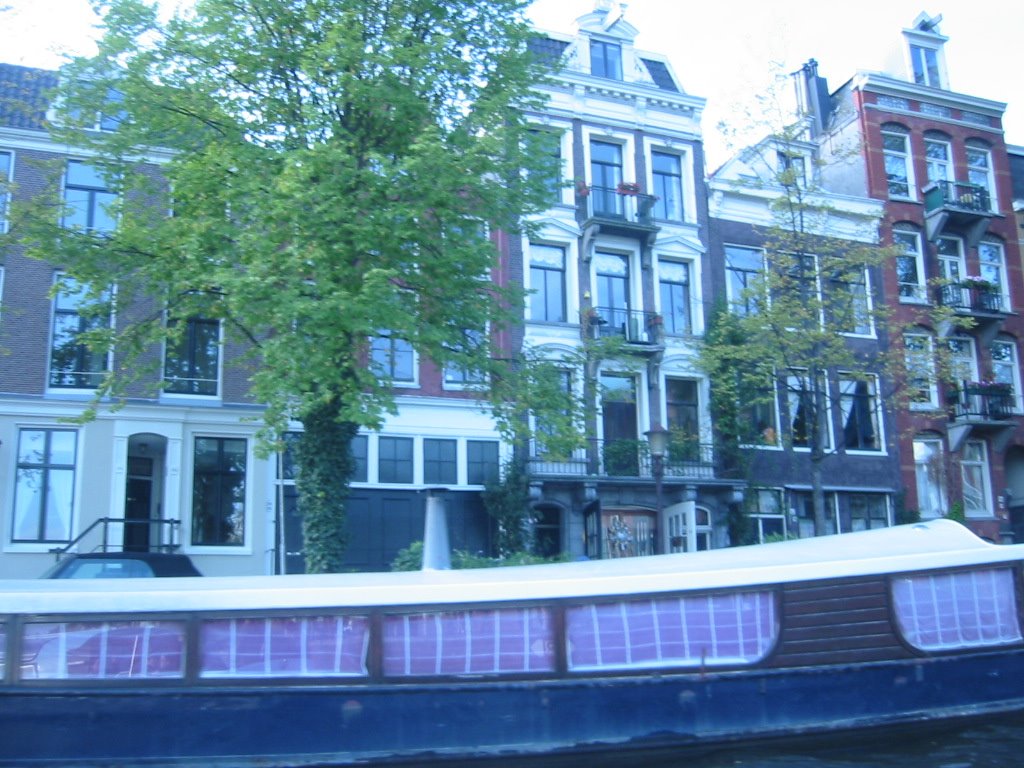
All in all it was a great experience at the conference – we learned a lot, met some more great people, and enjoyed some encouraging feedback on our work. The city of Amsterdam was also incredible – beautiful old buildings (many of which are sinking, as most of the city is below sea level – hence their leadership in fighting climate change), great food, and good vibe – the energy of the chaordic bike and trolley traffic balanced by the serenity of the canals and quiet side streets.


After a few weeks of focusing hard on our BTH project, it was refreshing to check back in with the world of carbon finance and got me really excited about heading to Nairobi in November for COP (the annual international climate negotiations) – it will be an exciting session and hopefully result in serious progress in meeting this colossal challenge. Stay going.

Monday, September 25, 2006

Business regulation or innovation?

A quick note taken from the New Yorker - the sentiments from PG&E (with regards to California's recent greenhouse gas bill) echo what I've been hearing in Europe - that utilities & big emitters are eager to do better, but need some long-term regulatory assurances:

Peter Darbee, the head of the state’s largest utility, P.G. & E., whose support was crucial to the bill’s passage, said he welcomed the strictness of the regulations as a spur to innovation. “The incentives really aren’t there for the creation of new technologies and investments to reduce carbon dioxide unless mandatory caps are put in place,” he told the Times.

GHG caps are not the crippling regulations they're often made out to be - and they have the power to actually help drive development. Stay going.

A Convenient Solution

In response to the common and valid criticism of An Inconvenient Truth – that it drops a lot of solid, scary facts on you, and then leaves you with only flimsy, seemingly insufficient actions to take – the Stratleade alumni have sparked up a dialogue on what some effective ‘next steps’ could be.

The movie is causing some real change – this article from Saturday’s SF Chronicle shows how congress is showing signs of moving past the counter-productive partisanism and towards policies that foster solutions. But Truth is not explicit in how we can identify what the best steps are, and how we can address greenhouse gas emissions, global warming, and climate change in ways that provide jobs, improves America’s reputation, promotes peace, etc.

This needs to be done in a way that moves towards a sustainable society so that the solutions of today do not become tomorrow’s problems. The common example we use is CFCs – refrigerants that replaced toxic chemicals, but were later discovered to destroy the ozone layer. Now in an ad hoc attempt to solve that problem many are moving to HCFCs, which have serious greenhouse gas implications. Given a whole system, sustainability perspective, we know that HFCFs violate Sustainability Principle 2, just as CFCs did – and we need a smarter approach (in this case, Electrolux is taking such an approach, and driving innovation & competitiveness as a result).

With the climate change issue so hot, we run the risk of similar solutions. Nuclear being the most obvious – it is a ‘low carbon’ solution, but not a sustainable solution (it takes very little uranium / plutonium to result in a systematic increase in concentration in the biosphere – thus violating Sustainability Principle 1).

So, the Stratleade crew has thrown the idea of a sequel out there – A Convenient Solution* – that could lay out some possibilities for serious action, based on backcasting from principles for sustainability. We know we have the capabilities, and while “convenient” may be misleading, we can eliminate our sustainability principle 1 violations (and 2 through 4) with a mix of intelligent design for buildings & cities, smart policy moves, ending perverse subsidies, bio-fuels from sustainable agriculture, etc, etc.

Coming to a theater near you…anyone interested? Stay going.


*we're not the first to use the phrase...The Oil Drum uses similar language on the topic, as I'm sure others have...