Start dancing
Great to see tipping points in action. Stay going.
Wednesday, June 03, 2009


Wednesday, May 20, 2009
Everything Bad Is Good for You
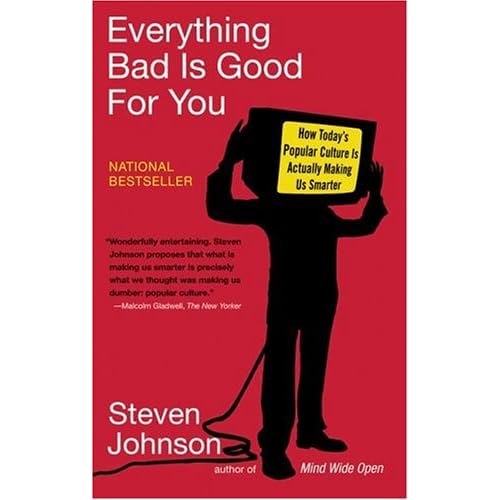
I went to a bachelor party last week and found myself tearing through all of Everything Bad Is Good for You during my travels - it seemed an appropriate way to start the weekend. Steven Johnson is becoming one of my favorite authors having loved both Emergence and The Invention of Air. But given the title, I had low expectations for this one - it seemed like a title designed to stir up controversy and sell some books. And in some ways it was. But, again his clear style and systemic perspective won me over, and I was sold.
The premise pretty straight-forward: common wisdom is that popular culture is dumbing down society as sex, violence, gossip, and other such trashy themes become more common in TV shows, movies, and video games. Johnson turns that idea on its head, by pointing out that most shows, movies, and games have gotten increasingly complex and smart - referencing the likes of Lost, The West Wing, The Usual Suspects, Memento, Adaptation, SimCity, and even Grand Theft Auto - and analyzing what he calls the Sleeper Curve (derived from Woody Allen's Sleeper where a future society discovers that junk food is actually healthy).
Technology drives this curve in large part - things like TiVo and DVD sales allow for more complex story lines and subtle jokes because people don't have to catch everything in real time. This has led a shift from "Least Objectionable Programming" where bland, easy to understand themes rule, to "Most Repeatable Programming" where complexity and subtley rule (if you're going to buy a DVD you want to know it won'g grow stale after one viewing - and you're going to pick Seinfeld over Three's Company).
I won't spoil the book too much, as it's a good, quick read - but for me the important, and hopeful take-away from this book is that our generation of gamers, Sopranos watchers, and Facebook users are training our minds to deal with complexity - and that is exactly what we need when we confront the sustainability challenge. For the masses of us who aren't supergeniouses, but can see what's going on around us, we are increasingly aware of and in tune with the implications of our actions in a complex system - burning oil here can cause droughts there that can cause famines, unrest, and war, and disrupt trade, displace refugees, and require us to send soldiers to far off lands - multiple story lines, delayed cause and effect, complexity - all things we need to understand to create a sustaianble society, and all things that are increasingly common in pop culture.
Not to say that playing video games is going to save the day - but an interesting perspective to challenge some commonly held assumptions. I'm still looking for the parallel that shows how bachelor parties are good for you... Stay going.
Monday, May 18, 2009
be rich
"Working for the earth is not a way to get rich, it is a way to be rich."
- Paul Hawken
Just a quick quote to start off your Monday - this one from a recent commencement address by Paul Hawken at the University of Portland - based largely on Blessed Unrest. Stay going...
- Paul Hawken
Just a quick quote to start off your Monday - this one from a recent commencement address by Paul Hawken at the University of Portland - based largely on Blessed Unrest. Stay going...
Wednesday, May 06, 2009
less than 1 trillion tons...
A quick news piece on a new report that I just saw on Van Ness Feldman's policy update (a great, free email update from a law firm in DC that specializes in climate law):
Scientists Set Fossil Fuel Budget for Planet. According to new research published this week in Nature, the world can burn only a quarter to a third of known fossil fuel reserves, and must limit anthropogenic emissions between 2000 and 2050 to about 1 trillion tons of carbon dioxide equivalent, in order to have good odds (>75%) of limiting global average temperature rise to less than 2 degrees Celsius. Many climate scientists have concluded that temperature increases beyond 2 degrees will greatly increase the odds of catastrophic and potentially irreversible climate changes. According to one of the lead researchers, realistically, global emissions must peak around 2020 to meet this budget.
I think it's really helpful to get a sense of the concrete amounts of GHG we can emit to avoid the worst impacts of climate disruption, as opposed to continuing to talk in relative terms about % reductions from arbitrary baselines, which are based on forecasting what is perceived as feasible, vs. backcasting from what we know is necessary. I'm curious to check out the report in Nature to see if this limit of 1 trillion tons of CO2e is on par with what would give us a chance to stablize atmoshpheric concentrations (currently at 388.79 ppm) or actually lower them to what many believe to be a necessary level for safety of 350 ppm.... Stay going.
Scientists Set Fossil Fuel Budget for Planet. According to new research published this week in Nature, the world can burn only a quarter to a third of known fossil fuel reserves, and must limit anthropogenic emissions between 2000 and 2050 to about 1 trillion tons of carbon dioxide equivalent, in order to have good odds (>75%) of limiting global average temperature rise to less than 2 degrees Celsius. Many climate scientists have concluded that temperature increases beyond 2 degrees will greatly increase the odds of catastrophic and potentially irreversible climate changes. According to one of the lead researchers, realistically, global emissions must peak around 2020 to meet this budget.
I think it's really helpful to get a sense of the concrete amounts of GHG we can emit to avoid the worst impacts of climate disruption, as opposed to continuing to talk in relative terms about % reductions from arbitrary baselines, which are based on forecasting what is perceived as feasible, vs. backcasting from what we know is necessary. I'm curious to check out the report in Nature to see if this limit of 1 trillion tons of CO2e is on par with what would give us a chance to stablize atmoshpheric concentrations (currently at 388.79 ppm) or actually lower them to what many believe to be a necessary level for safety of 350 ppm.... Stay going.
Tuesday, April 14, 2009
Sustainability Strategy for Cities
To quickly follow-up on a rather gloomy reality-check out of Australia, I'd like to get right back to a strategic, solutions-oriented approach to sustainability, and highlight what sounds like a great webcast coming up on Thursday (Apr. 16, 2009) about developing strategies at the city and county level.
This event - and a strategic approach to sustainability generally, jibes nicely with a great piece I just read about "rants" - and how they can help us break from problematic trajectories we're on and create the future we want.
Have a read, and check out the webcast Thursday, they've got an excellent line-up of speakers, and it's free, you just need to register - here are the details:

"Creating Your Most Effective Sustainability Strategy: What Cities and Counties Can Do"April 16, 2009, from 1 - 2:30 pm (EDT)
~Harvard online event. Pre-registration required, and free of charge.~
This online event, cosponsored by greenerApplications and Harvard’s Government Innovators Network, will enable city- and county-level executives and policy-makers to create highly effective sustainability strategies. The panel will offer a full spectrum review of the latest tools and policies your jurisdiction can use to lower greenhouse gas emissions and implement low-risk energy cost saving projects.
* Gerry DeSeve (moderator) - President of greenerApplications
* Michelle Moore - Senior Vice President, Policy & Public Affairs, U.S. Green Building Council
* Missy Stults - Senior Program Officer ICLEI-Local Governments for Sustainability
* David Smith - CEO, Princeton Energy Systems, Inc.
For more information and to pre-register for this event, visit our event page.
Stay going...
This event - and a strategic approach to sustainability generally, jibes nicely with a great piece I just read about "rants" - and how they can help us break from problematic trajectories we're on and create the future we want.
Have a read, and check out the webcast Thursday, they've got an excellent line-up of speakers, and it's free, you just need to register - here are the details:

"Creating Your Most Effective Sustainability Strategy: What Cities and Counties Can Do"April 16, 2009, from 1 - 2:30 pm (EDT)
~Harvard online event. Pre-registration required, and free of charge.~
This online event, cosponsored by greenerApplications and Harvard’s Government Innovators Network, will enable city- and county-level executives and policy-makers to create highly effective sustainability strategies. The panel will offer a full spectrum review of the latest tools and policies your jurisdiction can use to lower greenhouse gas emissions and implement low-risk energy cost saving projects.
* Gerry DeSeve (moderator) - President of greenerApplications
* Michelle Moore - Senior Vice President, Policy & Public Affairs, U.S. Green Building Council
* Missy Stults - Senior Program Officer ICLEI-Local Governments for Sustainability
* David Smith - CEO, Princeton Energy Systems, Inc.
For more information and to pre-register for this event, visit our event page.
Stay going...
Oz on fire
Worth taking a quick read of this update from the LA Times last week on the situation in Australia this winter (their summer) - it's been very hot and dry, and showing many of the features of what climate disruption looks like, and how it impacts human civilization, and the natural systems on which we depend.
http://www.latimes.com/news/nationworld/world/la-fg-climate-change-australia9-2009apr09,0,65585.story
A great gathering of MSLS alums took place down under in February for the Hallbarhet '09 event - part conference, part reunion, part sustainability learning journey - and while it was by all accounts an uplifting and positive experience, it took place with the backdrop of rampant wildfires and drought - just a real-time example to underscore the urgency we face in creating innvative strategies for sustainability... Stay going.
http://www.latimes.com/news/nationworld/world/la-fg-climate-change-australia9-2009apr09,0,65585.story
A great gathering of MSLS alums took place down under in February for the Hallbarhet '09 event - part conference, part reunion, part sustainability learning journey - and while it was by all accounts an uplifting and positive experience, it took place with the backdrop of rampant wildfires and drought - just a real-time example to underscore the urgency we face in creating innvative strategies for sustainability... Stay going.
Thursday, April 02, 2009
Biochar & Synergistic Solutions
When dealing in complex systems, and working to create solutions to tough problems, it’s rarely useful to look for a “silver bullet” – one single answer that can solve all the problems. We hear this with regard to the climate crisis quite a bit – we can’t eliminate our net emissions with just one activity or technology. It’s not just efficiency, or better design, or biofuels, or solar, or wind, or geothermal, or changing lifestyles, or new laws that will do it – it’s some combination of all them, plus many more exciting solutions we will create.
However, in complex systems we can (and should) look for synergistic solutions – positive activities that also generate more positive side-effects. We’ve been talking about this with regard to Village Corps, and the possibility of helping to generate some economic activity through animal husbandry, which could provide food and income, and could help the chances of reopening a processing plant which would create jobs, and the animal waste could be used in an anaerobic digester to generate methane for cooking fuel, which is cleaner burning and more healthy than wood fires, and would help stem deforestation in the area, which would help stop erosion and improve agriculture, which would provide more food and jobs, etc. etc.
Well, a similar kind of synergistic solution with tremendously exciting global potential is biochar – essentially charcoal derived from any kind of biomass that acts as a carbon sink for thousands of years. It is essentially a way to lower the atmospheric concentrations of CO2 (currently at 387 parts per million) back down to what more and more scientists are sighting as a safe level – 350 ppm. The process of creating it generates carbon neutral electricity (displacing the current common sources like coal, that has a whole host of other negative side effects) and the char itself provides a powerful organic soil amendment (displacing the current common sources of chemical based options that deplete soils over time and pollute oceans and water tables). While the reasons are fully understood (because the complex world of soil science isn’t fully understood), the biochar provides a great habitat, essentially, for the diverse array of soil microorganisms that create healthy, fertile soils.
This article from the Financial Times last month provides a great overview on how this technique was “rediscovered” by studying patches of fertile soil left by ancient peoples of the Amazon: http://www.ft.com/cms/s/2/67843ec0-020b-11de-8199-000077b07658.html.
There is lots of exciting research and development going on around the world. Our colleague Scott Grierson in Australia has been doing research on the potential of algae feedstocks for biochar. Universities in the US are looking into as well, including Cornell, UGA, and Iowa State.
And there are some young companies looking to commercialize this process and bring it to scale, including Best Energies and Eprida (who we had a chance to see present at Bioneers last year – very exciting results). The International Biochar Initiative is keeping track of the developments in this rapidly growing area and has a lot of great information.
It’s no silver bullet, but estimates for how much CO2 this process could remove from the atmosphere each year range from 2-4 Gigatonnes –that’s a billion tonnes – and a significant percentage of the approximately 8.8 GTs humans emit annually. And with all of the positive ‘side effects’ – like clean renewable energy, and healthy, productive soil gives biochar great potential as a synergistic solution on the path to sustainability.
Subscribe to:
Posts (Atom)