Wednesday, September 21, 2005

Dose of Doomsday

So, already I’ve fallen way behind on keeping up with the program on this blog. This week we’re going a bit more in depth on science – still fairly basic, most of the math is straight up calculus and most of the concepts I remember from undergrad Environmental Studies.

It’s a little involved and tough to keep up with for us non-engineers, but the real challenge is not getting depressed and giving up as we get into the most recent science on why there is a problem, how complex it is, and how catastrophic the consequences could be.

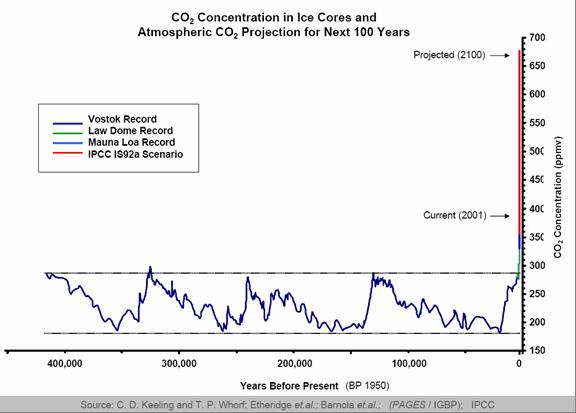
We’ve been dealing a lot with thermodynamics and global change. The CO2 issue is central to this, basically the chart below tells the story. It is incredibly unsettling and probably one of the most significant, and under-acknowledged research findings of the 20th century, in my humble opinion…


As you can see, over the past 450,000 years or so, the concentration of atmospheric CO2 has been stuck in a pretty steady range – you’ve got your ice ages and warmer periods (global average temp correlation with CO2 not shown here), but the various ecosystems kick into gear and balance out the greater biosphere system. As you can also see, in the past 50-100 years (just a blip on this time scale!!) we’ve fired that level through the upper range by an alarming degree. (the red part of the “projected” obviously includes a lot of assumptions about rates, etc – and while it looks dramatic, I think it actually just takes away from the really dramatic picture the known data paints of the breakout through the 290 level to the ~400 ppm level today).

I’ve been having those thoughts about why everyone isn’t totally freaking out and screaming from the rooftops and stopping the use of any fossil fuels whatsoever. It is mind boggling to think how quickly and easily we could transition to a sustainable energy system if we just all got on board and did it, even with today’s technology – solar, wind, biomass and improved efficiencies – not to mention what we could develop very quickly if we had a fire under our ass and some funds for it. We’re up to about $300 billion or so in Iraq, and people talk about solar being ‘not economically viable.’ Meanwhile, a recent study out of Princeton estimated that a $10 billion boost for the solar industry could make it an economically viable alternative to oil ($10B ~ 5 days of oil revenues… this study was quoted in an early lecture, I’ve been meaning to find it and check out the details)

Anyway, the fact remains that for the most part people aren’t freaking out. Maybe we’re starting to a bit with wars on a few fronts related to oil, American refugees from New Orleans (and now maybe Houston??), gas prices “skyrocketing” (still well below most of the world) – but it’s just natural to not want to deal with such frightening realities, especially when they’re difficult to conceptualize, and easy to explain away. I’ve understood that for a while and shied away from the doomsday approach to promoting sustainability, instead focusing on practical solutions and alternatives. But after days like this, I realize we need some doses of doomsday reality, because it’s there, it’s true, it’s frightening, and we need to do something about it.

If it’s not too late… in looking at natural systems, you find that the collapse thresholds often are not preceded by much in the way of forewarning. So if you’re polluting a small pond for example, and that poisons some of the small fish, and the vegetation gets a bit out of whack, but for the most part, you look in and see plants and fish and things look fine, until that line is crossed, and very quickly a certain key fish or plant can’t handle the stress on the system any more, dies off and disrupts the balance to a point where the whole pond system quickly “dies”.

Anyway, hopefully we’ll get it worked out before that all happens. No lectures tomorrow so hopefully I’ll have a chance to get realigned and catch up on a bunch of half-written postings, so look out for flow on the blog… and please keep some perspective on what’s really important here: the Sox are only ½ a game up on the Yanks and it’s coming down to the wire. Guide your prayers appropriately.

Monday, September 12, 2005

Elephants at the table...

Wanted to thank my old man for alerting me to the cover story in the latest Forbes on GE going green. I'm sure you've all seen the new Ecomagination ad campaign - the article's a pretty good concise look at what they're actually doing.

Definitely some good stuff going on, certainly some PR smoke and mirrors and misguided initiatives that will probably create more problems than they solve (a lot of ‘dealing in the leaves’) – but all in all its encouraging to see the big dogs address the issue with their wallets in hand. I also think Immelt's been doing a hell of a job through some tough times in general (and he's a Dartmouth alum and damn good man).

The article also speaks to the importance of the political process in all this with the companies gearing up for a post-Bush, Kyoto-reality world. Those with the competitive advantage when that breaks will be pretty psyched as they make the market for their competitors to buy credits from them.

Here’s the link - http://www.forbes.com/business/forbes/2005/0815/080.html

You might have to go to Forbes.com and register.

Fisher-Price My First Presentation

(A quick disclaimer: these first few posts have been pretty dense, theoretical, and longwinded – that’s mainly because we’re establishing these core ideas of sustainability. Once we get through that, they’ll get more concise and grounded. Hopefully you’ll bear with me here, so we’re all on the same page down the road. Please keep the questions and comments coming in the meantime)

The following is a preliminary script I put together for one of our first presentation exercises. It’s essentially the info from the last post jammed into a 5 minute spiel...

Hi, today I’m going to explain to you how to run something called an “ABCD Analysis” – which is a method or a tool for organizations to use in strategic planning towards sustainability.

First, “Step A” is to explain how the method works. To do this, we first need a common understanding of what sustainability is and how it can be achieved. This requires an understanding that we are looking at this organization’s role within society and society’s role within the biosphere.

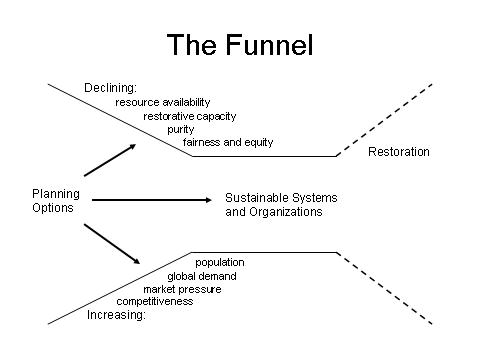
Currently society is on an unsustainable path within the biosphere. I’ll use the analogy of a funnel, where we have systematic declines in resource availability, purity, and social equity on the one hand and systematic increases in population, consumption, and competitiveness on the other hand. As the walls of the funnel close, we are left with fewer and fewer options as to how to meet our needs. If trend continues at some point (though we not sure exactly when) we won’t be able to sustain our society – a scary prospect.

In order to open the walls of the funnel, we need to establish some principles for what it means to be sustainable. To do this we must first look at the natural systems and how they provide for us and make life on Earth possible. Central to this is photosynthesis, where plant cells use sun energy to organize matter into a useful form (such as food, timber). Society then pulls those resources from natural systems, along with resources from the Earth’s crust (such as metals and oil), and we use them to meet our needs before they once again flow back into the biosphere in various forms of waste (due to the first and second laws of thermodynamics, which essentially say that nothing disappears, and everything spreads).

Currently the ways in which these flows between society and the biosphere are unsustainable can be categorized into four distinct systemic problems. By setting the goal of eliminating these four problems, we can then establish four principles for sustainability, which are to:

I. Eliminate the systematic increases in concentration of substances from the Earth’s crust in the biosphere (ie, metals from mining, CO2 from fossil fuels);

II. Eliminate the systematic increases in concentration of substances produced by society in the biosphere (ie, persistent, potentially toxic man-made compounds);

III. Eliminate the systematic degradation of natural systems by physical means (ie, deforestation, over-fishing); and,

IV. Eliminate the systematic undermining of people’s ability to meet their needs (ie, exploitation of labor or resources in developing nations).

If all of our institutions, organizations, business and governments abide by those principles, we will be able to open the walls of the funnel, establish a sustainable society and eventually start restoring some of the damage we’ve already done in the biosphere.

Now that we have a common understanding of the system we’re dealing with and a shared notion of what our goals are (not violating the sustainability principles), we can move on to how B, C and D work in this method.

Step B entails asking the group to come up with a long list of how current practices violate the 4 principles.

Step C is then a brainstorming session envisioning the operation in an ideal future state when the sustainability principles aren’t violated, without worrying about current restraints (such as cost, or technology). This process is called “backcasting” from a future vision of success, as opposed to forecasting from a present flawed reality.

Step D consists of prioritizing actions that can be taken immediately to embark in the right direction on the path from the current, unsustainable reality to the future vision of sustainability. These actions must also be flexible and provide an attractive return on investment to promote subsequent actions later on.

The ABCD process can be used time and again as the organization continues to innovate and strive towards sustainability.

Sunday, September 11, 2005

Some more details on the 5-level framework...

I’ve been getting some great questions about all of this “theoretical” stuff – the framework, the principles – and how they’re applicable and what they’re really good for. Basically the idea here is to create a shared mental model of what it is we’re trying to do to “be sustainable.” On the one hand it seems obvious, but without really stating what exactly it is to be successful things can get confusing – it’s easy to get lost in the details, and while a lot of great solutions are going on in the ‘green movement’ it is hard to be truly strategic when dealing with these complex systems on such a huge (global) scale.

So, why a framework? We have pressing problems, and we should be getting right down to action to fight them, right? Definitely, and people are, which is great and absolutely vital. But without a framework to develop a long-term view it’s very difficult for organizations to be strategic on how we become sustainable, or what it even really means to be sustainable.

We’re back to dealing with problems on the detailed “leaves” level instead of the core “trunk and branches” It’s kind of like those space-ship video games, where you meet the big bad boss at the end of the level, and he’s firing all kinds of missiles and smaller ships out at you. Right now (since the 70’s) we’ve been blasting the missiles, and getting better and better at doing it. But to win, we need to start figuring out how we’re going to get to the big ship, and where we need to shoot it. We need a strategic approach to do that.

Obviously, we need to keep shooting the missiles, especially the ones that are closest to us, and looking like they have a good chance of connecting – is global warming really a problem? We can’t really prove it … is that missile going to hit us? We can’t be sure, but it looks like it’s heading our way, and it’s coming in pretty hot, we might want to take care of it, just in case. But we need our organizations and institutions to get down to the business of going after the Mothership – in most cases we need to bring the fact that there is a Mothership to the attention of our leaders in business, government, etc.

Once the framework is understood, we can dive right into tools for applying the framework, come up with strategic courses of action and start implementing them.

The Natural Step did this in the late 80s / early 90s through a rigorous scientific peer-review process, in which they came up with some basic principles in a ‘consensus document’ and sent it out to bunch of scientists with different specializations, who tore into it, hashed out all the errors in logic and science, sent it back, they corrected it and sent it out again, 21 times until they had a final product.

Now they had a clear, concise vision of success, based on 4 simple principles (that allow for endless combinations of courses of action to reach success, as opposed to a rigid view of what the future should look like based on where we are today), that they could bring to organizations, municipalities, companies and enable them to be strategic in their approach to becoming sustainable.

Early success stories from IKEA, McDonald’s Sweden, Electrolux, Scandia Hotels, the Federation of Swedish Farmers, and a bunch of municipalities demonstrated that the approach works and preliminary, flexible actions towards sustainability were prioritized based on their ROI (return on investment) which helped the bottom line, but were often reinvested in more sustainability initiatives.

I realize in attempts to keep these postings brief (with limited success) I’ve thrown some ideas out there without getting into too much detail or specifics – but that will come once the framework is laid out. I also have been trying to go step by step so concepts can get digested as we go, but I think it might be worth laying out the major concepts in the framework, so everything’s on the table, and then we can dig into more specifics once we’re more or less on the same page.

So, back to the 5-level framework (this is a generic strategic framework for organizational learning and action – we are just applying it to reaching the goal of sustainability in this case):

I. System Level – this is just identifying the scope of the system we’re dealing with. If a self-sufficient farmer was using this, the system would be the farm and all of its components. In terms of sustainability the system is the entire biosphere. So we need an understanding of the major flows (in basic terms) that run the system:

Energy from the sun drives cycles that sustain life (photosynthesis uses the energy to organize matter into a useful form). The system is “open” in regards to energy, as it exits our atmosphere. Matter from the crust is introduced into the biosphere naturally (through weathering and volcanoes) and through human activity (mining / drilling). The system is “closed” in regards to matter as gravity keeps things here (with the exception of some space ships and satellites). Matter flows back to the crust through sedimentation (usually takes a while).

Looking at our role in the biosphere, we have the “techno-sphere” where society does its thing to survive and entertain itself. To do this we pull “input” flows from the crust (metals, oil, etc) and from natural systems (timber, crops, fur coats, etc). We then discard “output” flows back into the biosphere through emissions, solid waste, etc.

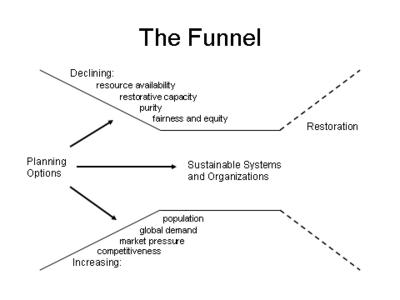
The Funnel – a core concept at this level is the idea that we are in a “funnel” in that as we move through time, we have a decline in resource availability, productive ecosystems, purity, trust and equity in society on the one hand and an increase in population, resource demand, and competitiveness on the other hand:
II. Success Level – In this case the success level is “sustainability.” There was no clear consensus on what exactly this meant until the principles were laid out. Once again, they are that in a sustainable society, nature is not subject to systematic increases in:

1) concentrations of substances from the Earth’s crust;
2)
concentrations of substances produced by society;
3)
degradation by physical means;

and, in that society,
4) people are not subject to conditions that systematically undermine their capacity to meet their needs.

Quick note on why the principles are framed in the negative – “not subject to…” It may seem restrictive, but really it’s just defining the known restraints of the natural cycles. Aside from these 4 constraints, anything can be done. It’s meant to foster positive, creative solutions-based thinking. We’ve been referring to it as free creativity within constraints, and it works to promote brainstorming, knowledge sharing, and organizational learning when the framework is applied in real-world situations.

III. Strategic Level – these are some strategic guidelines for organizations to follow in implementing the framework and taking actions towards sustainability. One example would be precaution which we touched on with the car driving towards the abyss example, or the video game missile that may or may not hit your spaceship.

But the most important one to focus at this point is Backcasting from Principles: it consists of establishing a vision of the organization in the future when the 4 principles are not being violated and then ‘backcasting’ to the present to see what specific actions should be taken first to start strategically working towards that vision. Two initial points:

1) It is preferable to forecasting because when you look forward from the present, you are bound by the current realities and trends, and even if those are flawed, you will bring them into the future.

2) Backcasting from principles as opposed to from scenarios allows for more flexibility and adaptation as unforeseen situations arise on the journey towards the vision of success. Imagine it’s like chess – the vision of success is checkmate, or satisfying 3 basic principles that ensure victory (your piece can attack the king, the king can’t avoid the attack, and no other piece can kill your attacking piece) – on the way there the board is constantly changing and you’re constantly reevaluating and adjusting your strategy in this dynamic situation. Backcasting from scenarios would be more akin to doing a puzzle, where you have a picture of a set future, and you set out to make it real. It can be done, but it’s harder to get a group / organization to agree on what the picture and details should look like exactly, and you’re left with fewer options and less flexibility as new knowledge is discovered and/or problems arise.

The concept of backcasting is integral for “ABCD Analysis” – a tool for helping organizations implement the framework. I’ll describe it my next posting.

IV. Action Level – these are the concrete actions that are taken on the path to sustainability. Depending on the nature of the organization, they could include things like phasing out fossil fuel use by switching some capacity to renewable energy, or substituting metals that are naturally abundant in the biosphere and therefore benign for ones that are scarce and potentially harmful. Later we’ll look more at really cool real-life case studies and success stories to see what kind of actions have been the most effective and provided the best ROI.

V. Tools Level – here we find a variety of tools that help organizations manage their path towards sustainability. Certain tools are effective in different situations, but a lot of them work well together and create synergies when utilized within the context of the framework. They include things like Environmental Management Systems, ISO 14001, Life Cycle Assessment, Factor 10, Natural Capitalism, Ecological Footprinting, Zero Emission, etc. A lot of these tools have great organizations behind them and are helping organizations with various environmental and / or sustainability initiatives.

The first tool we’ll be looking at is ABCD Analysis, which is a method of walking organizations through the process of applying the framework for their specific case. We’ll be working on presentations for ABCD all week, so I’ll throw something together explaining it in a couple days – it’s getting closer to the cool part where you start to see real results, hope for the future and opportunities to make tons of money...
Saturday, September 10, 2005

Could you provide an ie for point #1? I don't understand "concentration of substances from the earth's crust."

Sure thing - these 4 principles can appear vague, or even simplistic, but they're actually pretty involved, and can be tricky once you dig into 'em, so I appreciate the question. We’ll be revisiting all of these core concepts again and again as well, so they’ll start to make more sense.

So probably one of the most high-profile examples of violations of the first principle in our society today is CO2 from the fossil fuels we pull up from the crust. But anything that is brought up from the Lithosphere (basically the solid bedrock level of the earth, as I understand it) and introduced into the biosphere falls under this category - things like metals, uranium, mercury - the things we mine and drill for.

It's important to note that it has to be a systematic increase in concentration to violate the principle. The biosphere is able to deal with fluctuations in concentration of all kinds of substances and restore balance. But time is a key element. It took the earth billions of years to develop life forms that provided order to the "toxic stew" of the original atmosphere and make it all livable for highly developed, sensitive life forms like mammals.

Photosynthesis is the key driver to this process with plant cells - originally (and still a big player) it was blue-green algae doing all the work - converting the sun's energy into structured, more valuable (for our purposes) forms. Turning energy into exergy, which is basically energy with the capacity to perform work. It is this little miracle that makes earth livable for us and maintains the balances in the atmosphere.

A couple of things to consider here:

1) Systematic increases in concentration in anything will theoretically cause problems eventually (if for some reason we were systematically increasing concentrations in Oxygen in the atmosphere we’d eventually reach a point where it would be toxic). The big question is where that threshold or tipping point is – when the system can no longer absorb the imbalance. Imagine you’re speeding down a highway on a dark cloudy night, and you know there’s a cliff into a big abyss somewhere ahead on that road – but you’re not exactly sure when you’ll reach it. You’d probably stop driving on that road and take another one instead of assuming that it’s miles away and continuing to drive.

2) We are no threat to nature, only to ourselves. Unless we can build the Deathstar and blow up Earth, anything we do will just make the planet unlivable for humans and other advanced, sensitive higher life forms. The blue-green algae and cockroaches are tough enough to survive anything we do – they made do in that toxic stew. So the concern is that we disrupt the natural systems (by violating the basic sustainability principles) to the point where they can no longer maintain the balances that we need to survive. Resources will become scarcer – like pure air and water, the sub-systems (like forests, rivers, lakes, oceans, wetlands) in the overarching system of the biosphere will systematically start to fail. We’ll be forced into some form of barbarism where the social fabric breaks down as we find it necessary to ruthlessly compete for these scare resources (think Iraq, Afghanistan, the Middle East, New Orleans). Time comes back into play as we won’t be able to shift existing infrastructures and social organization to keep up with changing climate patterns – some areas become colder or warmer, droughts, hurricanes (think Katrina, the Tsunami, the recent intense typhoons in Japan and China). Eventually the chaos wipes us out and the earth is set back to a “republic of grass and insects,” at which point the basic life forms get back to work structuring the chaos through photosynthesis and restoring the balances through the same processes that took billions of years to create this beautiful system that we enjoy today.

It becomes increasingly clear as you work with all this, that the 4th principle is central. At first I thought it was a sort of a nice little add-on, basically saying “oh yeah, and while we’re at it, let’s see what we can do to help the poor people out too.” But it’s really imperative that we have some shared understanding of our role in this system, ‘cause we’re all in it together, and we need everyone taken care of to make it work. (Again, remember that the 4th principle says “systematic undermining of people's ability to meet their needs” – we’re not really talking about a utopian future, as nice as that might sound, and there will still be poor people, murders, starvation, wars, etc in a sustainable society. It’s when it is systematic, as it is today, that we’re in real trouble).

Luckily there are more and more really smart people – like you all – realizing that these problems are real, even if there imbedded in confusing, complex systems that make them hard to quantify and prove (the problems are all tangible out in the “leaves” – but they are the result of violations of the core principles at the “trunk and branches”). And there are more and more success stories, where organizations, municipalities, and companies are creating solutions and working towards sustainability where they meet their needs without violating the basic principles. And they’re doing it in a way that saves money, creates competitive advantages, and makes them more profitable and successful. And that’s where the really sweet juice is.

How’s that for making a short answer long? …CO2 would be an ie for the first principle.

Thursday, September 08, 2005

The Trunk and Branches - Whole Systems Thinking – The Rules of the Game…

Many of you are probably familiar with the concept of "whole systems thinking" - it's more or less explained in the name - in dealing with complex systems (such as the biosphere, or a government or the weather, or a company or an ecosystem, or a farm) it's important to take into account all of the components of the system, how they interact, and cause-and-effect relationships among them - think in terms of the whole system. This is a very daunting task. But it's important to do, otherwise you get lost in the details, specific areas of specialization (which are usually very complex and confusing on their own) and you can spend a lot of time and energy trying to solve a problem, only to realize that you've created another, and go on and on until you get confused and frustrated and give up.

So we've been using the metaphor of a tree (yeah, kind of a cliche for a sustainability framework - but it works well), where the trunk and branches represent the core principles (discussed last time - essentially the 'rules of the game') and the leaves represent all of the glorious details - specific problems and specific areas of expertise. Because the task at hand is so massive and complex, no one is going to have all the answers - there's simply too much information. So we need all kinds of scientists, economists, policy makers, researchers, teachers, business leaders, etc etc to work together. Now, imagine all of the ideas, opinions, special interests, etc that come with this group. Any dialogue will quickly degenerate into bickering, confusion, misunderstanding. This is dealing in the "leaves,” the details - and it's very frustrating, and too often the path that discourse on the environment and sustainability follow –

“Paper or Plastic?” (paper contributes to deforestation, plastic doesn’t biodegrade) “Solar, Wind or Oil?” (solar is inefficient and uses weird metals, wind kills birds and makes noise, oil causes global warming… but global warming doesn’t even exist as far as we know) etc… These are the details – obviously not insignificant - but we can’t approach these complex, confusing, politically charged issues without a shared framework, some facts that everyone can agree on. Then we can tackle the details with all kinds of specialists working together.

So by establishing a common framework - and starting with the trunk and branches - we can all get on the same page, understand the rules of the game, and proceed further out on the branches, into the details of the leaves with a shared mental model. True dialogue can commence, eliminating the usual confusion. Again, the details will need to be dealt with in time in order to act - but with a common framework action can be cohesive, moving toward a common goal.

You can think of the 4 principles as the rules of the game - like in chess or soccer. It's the easy part, but if everyone doesn't understand them, no one's going to get very far, and it’s very often the step that is skipped when we set out to create strategies to reach sustainability.... which brings me to the 5-level Framework:

I. Systems Level ... (in terms of sustianability, it's the biosphere - individual in an organization in society in the biosphere)

II. Success Level ... (in this case, the sustainability principles - the 4-principles, the rules of the game)

III. Strategic Level ... (not strategies, but strategic guidelines, planning methodologies, we'll get into these)

IV. Actions Level ... (concrete things we do, plans into action)

V. Tools Level ... (help in putting plans into action - indicators, modeling, life-cycle analysis)

It all probably seems pretty vague and theoretical at this point, but it does come together and make sense. Hopefully by the end of '05 I'll be able to give you all an hour presentation that will convey all of this and more with brilliant clarity. As for what's been happening here this week, we've had more lectures from Karl Hendrik, and trying to work out some of the subtleties, nuances and technicalities in the framework to be clear we understand it to the point of being able to teach it -- "is that a strategy, or a strategic guideline?" ..."why are CO2 emissions in violation of principle 1, while NOx emissions violate principle 2?" ...stuff like that. The weather remains beautiful, and having a blast being a student in this little town... I’ll try to keep these shorter in the future.

Hope everyone's doing well - take care, Go Sox!!!

Tuesday, September 06, 2005

Welcome... and the 4 principles for sustainability

Hello all,

As most of you know, I'm studying for a Masters in Strategic Leadership Towards Sustainability at the Blekinge Institute of Technology in Sweden this year. The programme was founded by Karl Hendrik Robert (founder of The Natural Step) and Goran Broman, and is in its second year. The year will focus on leadership, management and communication skills as well as technical issues in sustainability. The first half of the year consists of course work, lectures, group and individual projects, etc. and the second half will be a real-world thesis project.

I have put together this email list of friends, family and colleagues that I thought might be interested in hearing about the programme and the projects we are going to undertake. I've taken the liberty of adding some who haven't asked for info, so if anyone would rather not receive these updates for whatever reason, please tell me at any time and I'll take you off the list and promise not to be offended in any way. I'm looking at this as a journal and record for my own benefit as much as a way to share with other people and promote dialogue on the subject, so please feel free to ask questions, add comments, etc.

As this first email is mainly an introduction, I'll keep it brief and limit it to a quick comment on Karl Hendrick's first day of lectures, which we had Friday. He was an excellent and amusing speaker and essentially just recapped much of what is in his book, The Natural Step Story. Along with explaining the history and evolution of the organization (The Natural Step - "TNS") he walked through the basic framework for sustainability that they developed. It includes four principles that must be met in a sustainable society. They are to:

1) eliminate systematic increases in concentration of substances from the earth's crust in natural systems

2) eliminate systematic increases in concentrations of substances produced by society (i.e. compounds not found in nature) in natural systems

3) eliminate systematic physical degradation of nature through over-harvesting, introduciton and other forms of modification (i.e. actions that prevent natural systems from performing the services upon which we depend)

4) eliminate the systematic undermining of people's capacity to meet their needs

I've found these principles to provide an elegant, simple framework from which to approach sustainability issues and utilize other tools and concepts in sustainability (such as Life Cycle Analysis, Ecological footprinting, Natural Capitalism, Factor 10, ISO 14001, etc). They establish a launching point from which there is scientific consensus, and a sort of check-list, or lens to look through when organizations, businesses, gov'ts, etc make decisions. It also provides perspective that can be lost when things get bogged down in the "details" of individual issues and problems (ie, climate change, deforestation, declining fish stocks, ground water contamination, etc) which quickly become overwhelming when addressed individually.

More to follow, I'm going to shoot to put out a weekly update, but who knows as things get busy. On a more personal note, by the way, this place (Karlskrona Sweden) is beautiful and an absolute blast. Our group is very cool and international (us, canada, china, russia, nigeria, rwanda, costa rica, brazil, sweden, jordan, uae, pakistan, etc) and we've been having a great time so far. If you want more info on the programme or TNS, check out the websites: http://www.bth.se/tmslm and http://www.naturalstep.org/

Hope this finds you all well -- take care,